Simple, Compound, Complex, and Compound-Complex Sentences
Once you can spot a clause, every sentence in English sorts into exactly four structures. That is the whole secret. Questions about sentence types look intimidating – compound-complex sounds like advanced machinery – but they all reduce to counting two things: independent clauses and dependent clauses.
This lesson gives you the counting method, one clear example of each structure, and practice sorting sentences the way test writers expect you to.
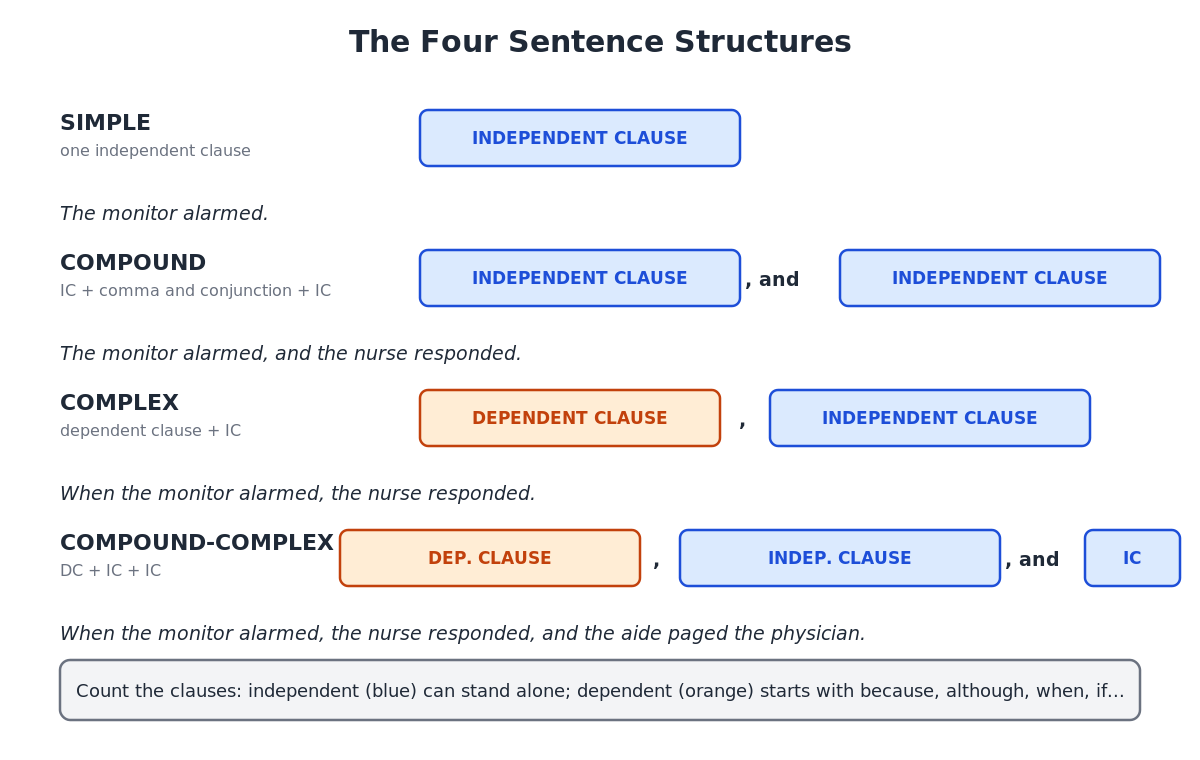
Sentences are classified by their clauses. A simple sentence is one independent clause. A compound sentence joins two or more independent clauses. A complex sentence pairs one independent clause with at least one dependent clause. A compound-complex sentence has two or more independent clauses plus at least one dependent clause.
What is the difference between an independent and a dependent clause?
Every clause has a subject and a verb. The difference is whether it can stand alone:
- Independent clause (IC): a complete thought – The nurse checked the IV line.
- Dependent clause (DC): starts with a subordinating word (because, although, when, if, while, since, that, who) and leaves you hanging – because the pump kept beeping…
A dependent clause is a full clause – it has its own subject and verb – but the subordinating word makes it lean on something else. Counting ICs and DCs is all the classification you will ever do.
What does each sentence type look like?
Simple = 1 IC. The lab called with the results. Watch out: a simple sentence can still be long. The lab technician on the third floor called with the morning results before the shift change is one clause – one subject, one verb – dressed up with prepositional phrases. Length does not change the type. Even a compound subject or verb keeps it simple: The nurse and the aide lifted and repositioned the patient.
Compound = IC + IC. Two complete thoughts joined correctly, in one of three ways:
- Comma + FANBOYS conjunction: The clinic closed at five, but the phone line stayed open.
- Semicolon: The clinic closed at five; the phone line stayed open.
- Semicolon + conjunctive adverb + comma: The clinic closed at five; however, the phone line stayed open.
Complex = IC + at least one DC. Because the pump kept beeping, the nurse checked the IV line. Flip the order and the comma usually disappears: The nurse checked the IV line because the pump kept beeping.
Compound-complex = 2 ICs + at least one DC. When visiting hours ended, the family said goodnight, and the unit finally grew quiet. Count it: one DC (when visiting hours ended) plus two ICs. That combination, and only that combination, earns the name.
How do I tell the four types apart at a glance?
| Type | Recipe | Example |
|---|---|---|
| Simple | 1 IC | The monitor alarmed. |
| Compound | 2+ ICs | The monitor alarmed, and the nurse responded. |
| Complex | 1 IC + 1+ DC | When the monitor alarmed, the nurse responded. |
| Compound-complex | 2+ ICs + 1+ DC | When the monitor alarmed, the nurse responded, and the aide paged the physician. |
What is the counting routine?
- Underline every subject-verb pair. Each pair marks a clause.
- Label each clause IC or DC. A clause opening with because, although, when, if, while, who, that is dependent; everything else that expresses a complete thought is independent.
- Count. 1 IC, 0 DC → simple. 2+ IC, 0 DC → compound. 1 IC + DC → complex. 2+ IC + DC → compound-complex.
- Do not be fooled by length – phrases (no subject-verb pair) never change the count.
- Check the joints. Two ICs need a comma plus conjunction or a semicolon between them; a comma alone creates a comma splice.
Watch: A Short Video Lesson
The Mindsprings English Teacher walks through this skill clearly in a few minutes. It is a helpful companion to the reading above:
Why does sentence variety matter in writing?
Beyond test questions, these four structures are a style toolkit. A paragraph of simple sentences sounds choppy; a paragraph of long compound-complex sentences exhausts the reader. Strong writers alternate – a short simple sentence lands a key fact, a complex sentence explains the reasoning behind it. When a revision question asks which choice “best combines” two sentences, it is really asking you to build a compound or complex sentence with the joint punctuated correctly and the logic (contrast, cause, time) matched to the right connector.
Practice: classify each sentence
- The pharmacist double-checked the dosage and initialed the order.
- Although the waiting room was crowded, triage moved quickly.
- The residents reviewed the chart, and the attending confirmed the plan.
- Because the elevator was out, the team took the stairs, and the transport arrived on time anyway.
- After a long orientation day filled with paperwork and safety videos, the new hires went home.
- Fix the error and name the resulting type: The X-ray came back clear, the patient was discharged.
Answers
- Simple – one subject (pharmacist) with a compound verb (double-checked and initialed); still one clause.
- Complex – DC (although the waiting room was crowded) + IC.
- Compound – two ICs joined by a comma plus and.
- Compound-complex – one DC (because the elevator was out) + two ICs.
- Simple – the long opener is a phrase, not a clause; there is only one subject-verb pair (hires went).
- It is a comma splice. Fix: The X-ray came back clear, so the patient was discharged (compound), or Because the X-ray came back clear, the patient was discharged (complex).
Where this fits
Sentence structure is the backbone of our English and language usage study hub. This lesson assumes you can already tell a clause from a phrase – refresh that in complete sentences and clauses. Bad joints between clauses create run-ons and comma splices, and missing clauses create sentence fragments. To choose which idea deserves the main clause, read coordination and subordination, and keep paired ideas matched with parallel structure.
Recommended Prep Books
These study guides and practice books help you keep building momentum as you prepare:

Related to This Article
More math articles
- The Ultimate NES Elementary Education Math Course
- Divide and Conquer: How to Tackle Word Problems with Division Facts up to Twelve
- Top 10 Tips to Create a HiSET Math Study Plan
- Best Equipment for Online Math Tutoring
- New Mexico NM-MSSA Grade 8 Math Free Worksheets: Printable Grade 8 Math PDFs with Worked Solutions
- Maximize utility by equalizing marginal utility per dollar
- Theories of Aging
- Comparative Advantage, Specialization, and Trade
- The Best Grade 7 ELA Practice Tests for Arkansas Students
- Sound bites






















What people say about "Simple, Compound, Complex, Compound-Complex Sentences"?
No one replied yet.