YOUR SAT STUDY COMPANION
SAT Math vs ACT Math: Which Test Should You Take in 2026?
ACT format update, checked October 2, 2026: Enhanced ACT Math has 45 questions, 50 minutes, and four answer choices. Older 60-question practice sets remain useful for skill review, but they do not reproduce the current test format. Historical topic percentages below should not be treated as the current blueprint. See ACT’s current test information .
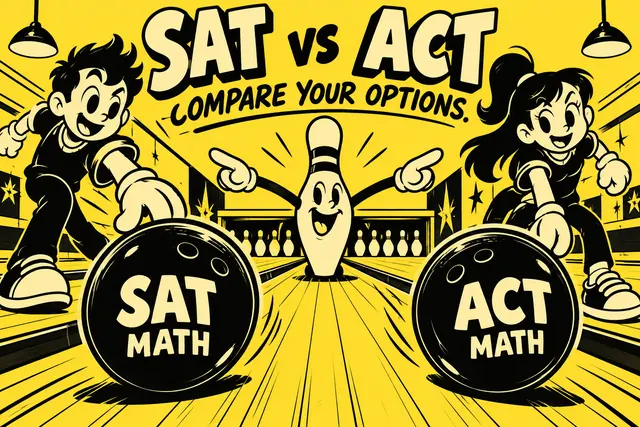
For most college-bound students, the question isn’t whether to take a standardized test. It’s which one. Now that the SAT has gone fully digital, the differences between SAT Math and ACT Math have shifted. Here’s a clear, no-hype look at both tests so you can pick the one that fits you best.
Format at a glance
| Digital SAT Math | ACT Math | |
|---|---|---|
| Total questions | 44 | 60 |
| Time | 70 minutes (two modules) | 60 minutes |
| Time per question | ~1.6 min | ~1 min |
| Calculator | Allowed on all questions | Allowed on all questions |
| Adaptive? | Yes (Module 2 adapts to Module 1) | No |
| Scoring | 200 to 800 (combined with Reading & Writing) | 1 to 36 |
The SAT now gives you more time per question but uses adaptive difficulty. The ACT is steadier in difficulty but moves much faster.
Content differences
- Algebra & functions: Heavy on both, slightly more emphasis on SAT.
- Geometry & trigonometry: ACT has more pure geometry, plus a small amount of right-triangle trig.
- Data analysis / problem solving: SAT leans harder on charts, units, and ratios; ACT mixes data into general problems.
- Word problems: SAT favors longer, multi-step setups; ACT prefers shorter, direct setups.
Which test should you pick?
You’ll likely score higher on the SAT if you:
- Like to take your time and think.
- Are strong with charts, units, and word-problem analysis.
- Prefer fewer questions with more “depth.”
You’ll likely score higher on the ACT if you:
- Work quickly and don’t second-guess.
- Have solid plane-geometry foundations.
- Don’t mind a steady pace with familiar question types.
A simple test for choosing
Take a free, full-length practice test for each under timed conditions. Convert both scores to the College Board’s concordance table percentile. Whichever percentile is higher. That’s your test.
Common mistakes when choosing
- Picking a test because a friend did. Score percentiles, not vibes, should decide.
- Ignoring the digital format change on the SAT. It’s a meaningfully different test now.
- Studying both tests at once. Pick one and go deep.
FAQ
Is SAT Math or ACT Math harder?
Neither is harder for everyone. ACT Math moves faster, with 45 questions in 50 minutes, about 1.1 minutes each, and includes more geometry and some trigonometry. Digital SAT Math gives 44 questions in 70 minutes, about 1.6 minutes each, but its second module adapts to your performance and leans on data and word problems. Fast workers often prefer the ACT; careful readers often prefer the SAT.
What is the difference between SAT Math and ACT Math?
The biggest differences are pace, format and content mix. The digital SAT splits math into two adaptive modules totaling 70 minutes and reports a math score from 200 to 800. ACT Math is one 50-minute section that does not adapt and is scored from 1 to 36. The ACT tests more pure geometry and some trig, while the SAT puts more weight on charts, units and ratios.
Is the ACT or SAT more math based?
The SAT is more math-heavy in scoring. Math is half of the SAT total, 800 of the 1600 points. On the ACT, the composite score averages English, math and reading, with science now optional, so math counts for about one third. If math is your strongest subject, that weighting is one reason to lean toward the SAT.
What topics are on SAT Math vs ACT Math?
Both tests are built on algebra and functions, which make up a large share of each. The ACT adds more plane and coordinate geometry plus some trigonometry, and can include topics like matrices or logarithms. The SAT focuses more on problem solving with data, such as percentages, ratios, rates and reading graphs, along with advanced algebra like quadratics and exponential functions.
Are SAT Math and ACT Math similar?
Yes, they overlap a lot. Both cover algebra, functions, geometry and data at a high school level, and both allow a calculator on every math question, so prep for one helps with the other. A key format contrast: SAT Math includes some questions where you type in your own answer, while every ACT Math question is multiple choice with four answer choices.
What changed with the digital SAT
The digital SAT (rolled out fully in 2024) changed several things:
- Length: Total test time dropped from ~3 hours to ~2 hours and 14 minutes.
- Adaptive modules. Each section has two modules; your performance on the first determines the difficulty of the second.
- Built-in calculator (Desmos). Available on every math question, even ones that used to be “no-calc.” This is a huge shift, students who master the Desmos calculator gain a real edge.
- Shorter reading passages. One question per passage, much less reading per question.
- All on a Bluebook app. Students bring their own laptop or tablet (or borrow one from College Board).
Score conversion: SAT ↔ ACT
| SAT (Math+R&W) | ACT Composite |
|---|---|
| 1600 | 36 |
| 1550 | 35 |
| 1500 | 34 |
| 1450 | 33 |
| 1400 | 31 |
| 1350 | 30 |
| 1300 | 28 |
| 1250 | 27 |
| 1200 | 25 |
| 1100 | 22 |
| 1000 | 19 |
Use this to compare your two practice scores at apples-to-apples percentiles.
A realistic prep timeline
- 8 weeks out: Take a diagnostic of each test. Pick one.
- Weeks 7 to 6: Content review, the math, grammar, and reading skills the test emphasizes.
- Weeks 5 to 2: Section-specific drills, then full timed sections.
- Final 2 weeks: Three full-length timed tests under realistic conditions, with detailed review of every miss.
- Test week: Light review, plenty of sleep, no cramming.
Test-day logistics
Whether you take the SAT or ACT, the morning matters:
- Bring photo ID, your registration ticket, and, for the SAT, your charged device.
- Eat protein for breakfast. Skip the sugar crash.
- Arrive early so you’re not stressed.
- Bring water, a snack, and an analog watch (no smart-watches allowed).
- Trust your practice. The test is just another timed problem set you’ve done a dozen times.
Comparing math sections head to head
The math sections look different enough that they’re worth separating:
SAT Math (digital)
- 44 questions total across 2 modules.
- ~70 minutes total.
- Calculator allowed throughout (Desmos built in).
- Heavy on algebra, problem-solving, and data analysis.
- Some advanced math (functions, geometry, trig basics).
ACT Math
- 45 questions in 50 minutes.
- Calculator allowed throughout (TI-84 or similar).
- Pre-algebra, elementary algebra, intermediate algebra, plane and coordinate geometry, plane trigonometry.
- More geometry and trig than the SAT.
- Faster pace (1 min/question vs ~1.5 min on SAT).
If you’re stronger in algebra and like having a powerful calculator, the SAT is your test. If you’re a fast worker who’s comfortable with geometry and trig, the ACT may suit you better.
Reading sections head to head
SAT Reading & Writing
- One question per short passage (50 to 75 words usually).
- Fast moving. You don’t have to remember a long passage.
ACT Reading
- 4 long passages, ~700 to 900 words each.
- 10 questions per passage.
- Tests stamina and speed-reading.
If you’re a slow reader but precise, SAT helps. If you devour books, ACT plays to your strength.
Two-test strategy
Some students take both. Here’s when that makes sense:
- You score significantly better on one than the other after diagnostics.
- Your target colleges accept either, and a higher score in one will materially help your application.
- You have time before deadlines to study for both.
Most students should pick one and go all-in. Splitting your prep dilutes your gains on both.
How to choose if your diagnostics are close
When scores convert to similar percentiles, choose based on:
Extra study tips that move the needle
Most students don’t fail because the math is too hard. They fail because their practice habits are inefficient. Here are the habits that separate the students who improve fast from those who stall.
Practice with a timer. Untimed practice teaches you to eventually get the right answer; timed practice teaches you to get it in test conditions. Set a stopwatch every time you sit down. Aim for 90 seconds per question on most standardized tests.
Keep an error log. A simple spreadsheet with three columns, Problem, My answer, Correct answer, Why I missed it, is the single most powerful study tool ever invented. Review your error log weekly. The same mistakes show up again and again until you name them.
Mix topics every session. Doing 20 problems on the same topic feels productive, but spaced and interleaved practice, mixing topics, builds retrieval skills, which is what the test actually measures. Spend 70% of your time on mixed sets and only 30% on isolated drills.
Sleep on it. Memory consolidation happens during sleep. A 30-minute session the night before a quiz, followed by 7+ hours of sleep, beats a 3-hour cram session that ends at midnight. This is settled cognitive science.
Teach the topic out loud. If you can’t explain it, you don’t fully know it. Either record yourself, write a one-paragraph “how I’d teach this” explanation, or grab a friend to listen. Teaching exposes the gaps your problem sets hid.
When to ask for help
Spinning your wheels for more than 15 minutes on a single problem is a signal, not of failure, but of a missing piece of background. Stop, mark the problem, and either ask a teacher, post in our community, or watch a video on the relevant subtopic. Resuming after gaining the missing piece is much more efficient than guessing your way forward.
A quick self-assessment
Before you close this tab, answer these three questions honestly:
- What’s the one topic in this article you understood best?
- What’s the one topic that still feels fuzzy?
- What concrete next step (a worksheet, a practice test, a video) will you take in the next 48 hours?
Writing those answers down, even just in a notes app, has been shown to roughly double the chance you actually follow through. Treat the next 48 hours as a small, doable experiment, not a marathon. Your future test-day self will thank you.
- Test-day stamina. ACT is grindier; SAT is shorter.
- Calculator preference. Desmos is incredibly powerful; if you’re already comfortable, lean SAT.
- Reading speed. Slower readers tend to do better on the new digital SAT.
- Practice material. The SAT has Bluebook (College Board’s official adaptive practice). The ACT has paper practice tests. Pick what feels comfortable.

Related to This Article
More math articles
- Reproduction and Development
- Comparing & Ordering Numbers Practice (Free)
- Z-Score & Normal Distribution Calculator (Free)
- Free Grade 3 English Worksheets for Missouri Students
- Empirical and Molecular Formulas: Calculate Atom Ratios
- When do the ACT Scores Come out?
- Reading Tables, Percentages, and Graphs
- How to Ace the PSAT Math Test?
- Variables, Controls, and Experimental Design
- TOEFL Adaptive Reading and Listening: What Changes in Practice? (2027 Prep)























What people say about "SAT Math vs ACT Math: Which Should You Take?"?
No one replied yet.