Claim, Reason, and Evidence
Almost every nonfiction passage you read is trying to convince you of something. To answer questions about it, you need to see the moving parts underneath. Those parts have names, and once you can spot them, arguments stop feeling like a wall of words and start looking like a simple frame.
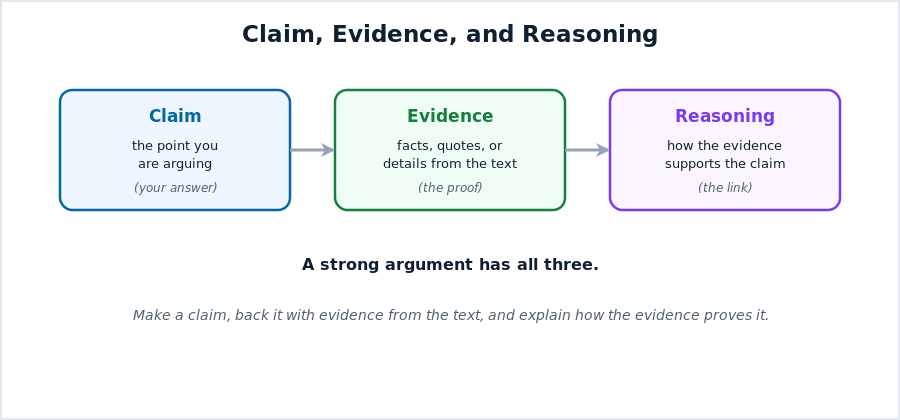
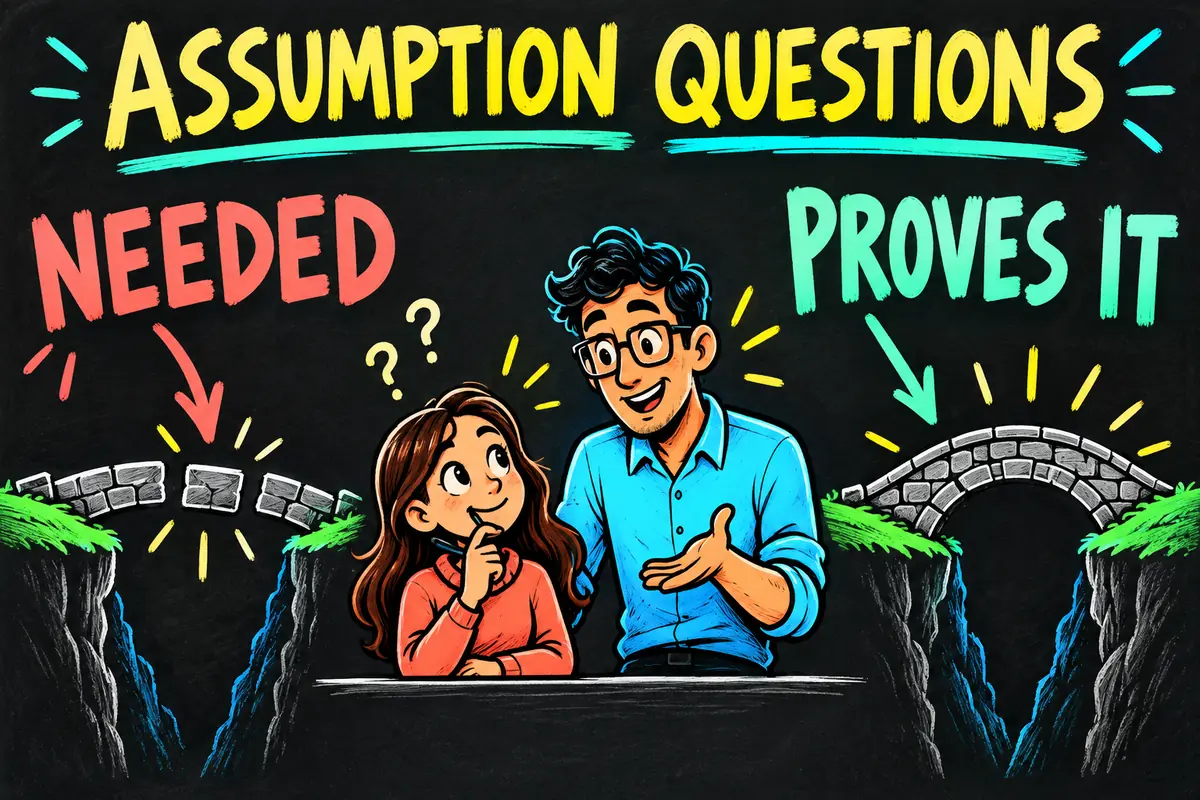
An argument has three parts. The claim is the point the writer wants you to accept, the evidence is the facts or examples that back it up, and the reasoning is the explanation that connects the evidence to the claim. Together they form a complete, convincing argument.
The Three Parts in Action
Picture a short paragraph: “Our town should add a bike lane on Main Street. Last year, forty cyclists were injured there, more than on any other road. A protected lane separates riders from cars, so fewer crashes happen.” The claim is the first sentence — the town should add a bike lane. The evidence is the forty injuries, a concrete fact. The reasoning is the last sentence, which explains why that fact supports the claim: a lane keeps riders and cars apart. Notice that without the reasoning, the evidence just floats there. A writer who lists facts but never explains their meaning leaves the argument half-built, and test questions often ask you to name exactly that missing piece.
Telling the Parts Apart
When you read, ask one question at a time. First, what does the writer want me to believe? That is the claim, and it is often near the beginning or the end. Next, what did they give me to prove it? Those are the evidence — numbers, examples, quotes, or events. Finally, how do they say the evidence proves the point? That is the reasoning, and it usually hides in words like “because,” “so,” or “this shows.” A quick test: a claim is arguable (someone could disagree), evidence is checkable (you could look it up), and reasoning is the bridge between them. Sorting sentences into these three buckets makes even a dense passage easy to follow.
Watch: A Short Video Lesson
Bozeman Science gives a clear overview to go with this lesson:
A Routine for Finding Claim, Evidence, and Reasoning
- Ask what the writer wants you to believe — that is the claim.
- Underline in your mind the facts and examples — that is the evidence.
- Look for “because” or “this shows” to find the reasoning.
- Check that the reasoning actually links the evidence to the claim.
Practice
- What are the three parts of an argument?
- Which part is the point the writer wants you to accept?
- Which part can you check or look up?
- What does the reasoning do?
- Which signal words often introduce reasoning?
- What is missing if a writer lists facts but never explains them?
Answers
- Claim, evidence, and reasoning.
- The claim.
- The evidence.
- It connects the evidence to the claim.
- Words like “because,” “so,” and “this shows.”
- The reasoning.
Where This Fits in Your RLA Prep
Once you can name the parts of an argument, practice sorting the proof itself with types of evidence and supported vs. unsupported claims. See every topic on the Language Arts Prep Hub.
Recommended Prep Books
Keep building momentum with a full study guide and practice tests:

Related to This Article
More math articles
- Full-Length Accuplacer Math Practice Test
- The Best Algebra 1 Book for New Jersey Students
- Top 10 Tips You MUST Know to Retake the SSAT Math
- Superdelegates
- The Best Grade 3 Math Book for New Mexico Students
- The Ultimate Common Core Algebra 1 Course (+FREE Worksheets)
- FREE 3rd Grade Common Core Math Practice Test
- Full-Length DAT Quantitative Reasoning Practice Test-Answers and Explanations
- Best AI Math Solver for Students: Why StudyX Should Be Your Go-To Study Buddy
- What Are the Applications of the Law of Sines?



















What people say about "Claim, Reason, and Evidence"?
No one replied yet.