Essential Spelling Rules
English spelling has a reputation for chaos, and it has earned some of it. Still, the words that show up again and again on editing questions do not break randomly. They break in predictable places: a silent e that should have been dropped, a consonant that should have been doubled, an ie that should have been ei.
You do not need to memorize a dictionary. You need a handful of patterns, plus an honest list of the words that refuse to follow them.
Spelling rules are patterns that predict how English words are written. The four with the biggest payoff: use i before e except after c (a memory aid with many exceptions), drop a silent e before a vowel suffix, change y to i after a consonant, and double a final consonant in words like running.
Is “I Before E Except After C” a Real Rule?
Treat it as a memory aid, not a law. The rhyme points the right way in words like believe, achieve, and piece, and it correctly flips after c in receive, ceiling, and deceive. But English is full of words that ignore it completely. Science and efficient put ie right after a c, while height, weird, seize, foreign, and caffeine use ei with no c in sight.
The practical habit: let the rhyme break a tie when you are genuinely unsure, and memorize the short list of rebels above. They are exactly the words test writers reach for.
When Do I Drop the Silent E?
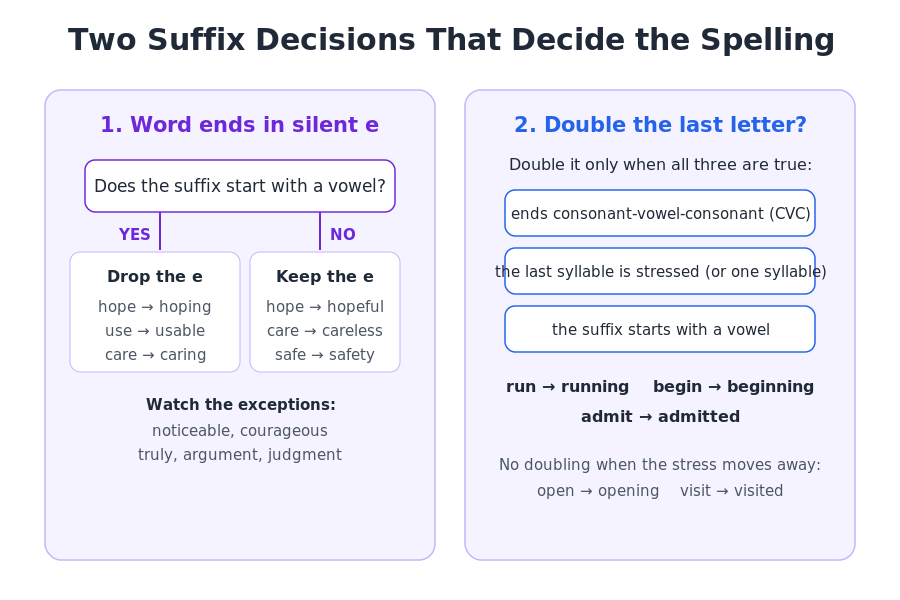
When a word ends in a silent e, look at the first letter of the suffix. A vowel suffix takes the e away: hope becomes hoping, use becomes usable, continue becomes continuing. A consonant suffix leaves it alone: hope becomes hopeful, care becomes careless, safe becomes safety.
A few words keep the e to protect a soft c or g sound—noticeable, manageable, courageous—and a few drop it where you might expect to keep it: truly, argument, judgment.
When Does Y Change to I?
After a consonant, y turns into i before most suffixes: carry becomes carried, study becomes studies, happy becomes happiness. After a vowel, the y stays put: played, enjoys, monkeys. And the y always survives before -ing, because English avoids a double i: carrying, studying.
When Do I Double the Final Consonant?
Before a vowel suffix such as -ing or -ed, double the final consonant when three things line up: the word ends in a single consonant after a single vowel (the consonant-vowel-consonant pattern), the final syllable is stressed (or the word has only one syllable), and the suffix begins with a vowel. That gives us run to running, begin to beginning, and admit to admitted.
When the stress falls earlier in the word, skip the doubling: open becomes opening, visit becomes visited, benefit becomes benefited.
The Four Patterns at a Glance
| Pattern | Follows the rule | Watch out for |
|---|---|---|
| i before e except after c (memory aid only) | believe, receive, ceiling | science, efficient, height, weird, seize |
| Drop silent e before a vowel suffix | hoping, usable, caring | noticeable, courageous, truly, argument |
| Change y to i after a consonant | carried, studies, happiness | carrying (keep y before -ing), played |
| Double the final consonant (stressed CVC) | running, beginning, admitted | opening, visited, benefited |
Watch: A Short Video Lesson
VOA Learning English takes a closer look at the famous i-before-e rhyme—and at just how often English ignores it:
A Routine for Spelling Questions
- Find the seam where the base word meets the ending—that is where most misspellings happen.
- Silent e? Drop it before a vowel suffix; keep it before a consonant suffix.
- Consonant plus y? Change the y to i—unless the suffix is -ing.
- One stressed syllable ending consonant-vowel-consonant? Double the last letter before -ing or -ed.
- Choosing between ie and ei? Use the rhyme as a tiebreaker, then check it against the exceptions: science, efficient, height, weird.
Practice
Choose the correct spelling in each pair.
- hoping / hopeing
- studys / studies
- begining / beginning
- recieve / receive
- wierd / weird
- noticable / noticeable
Answers
- hoping — -ing starts with a vowel, so the silent e drops.
- studies — a consonant comes before the y, so y becomes i.
- beginning — begin stresses its last syllable and ends consonant-vowel-consonant, so the n doubles.
- receive — ei after c, one of the cases where the rhyme actually works.
- weird — an exception the rhyme cannot save you from; it simply must be memorized.
- noticeable — the e stays to keep the c soft.
Where This Fits in Your Prep
Spelling patterns run straight into their neighbors: see how English forms regular, irregular, and medical plurals and the homophones and frequently misspelled words that spelling rules cannot catch. From there, commonly confused words and contractions and apostrophe rules round out the word-level skills. Find every topic on our English and Language Usage practice hub.
Recommended Prep Books
These study guides and practice tests help you keep building momentum as you get ready:


Related to This Article
More math articles
- The Best Grade 7 ELA Practice Tests for California Students
- Vises and Clamps: Holding Work Safely
- Different Question Types on the ACT Math Test
- 5 Best Smartphones for Math Teachers
- Positive vs. Normative Economics: Facts and Value Judgments
- Religious Revival, Rock and Roll, the Beats and Cultural Dissent
- The Best Grade 2 English Worksheets for Kentucky Students
- How to Add and Subtract in Scientific Notations? (+FREE Worksheet!)
- Oklahoma OSTP Algebra 1 Free Worksheets: 60 Free PDF Worksheets Aligned to OSTP Algebra 1
- Common Resources: Overuse, Shared Costs and Rules






















What people say about "Essential Spelling Rules: I Before E, Silent E, and More"?
No one replied yet.