Homophones and Frequently Misspelled Words
Spell-check cannot save you from a homophone. Write their when you mean there and every letter is correct—it is simply the wrong word. That is exactly why editing questions lean on these pairs so heavily: they hide from your ear and only show themselves on the page.
The fix is not more listening. It is a quick check of the job the word is doing in the sentence, plus a short list of words whose spellings just have to be learned.
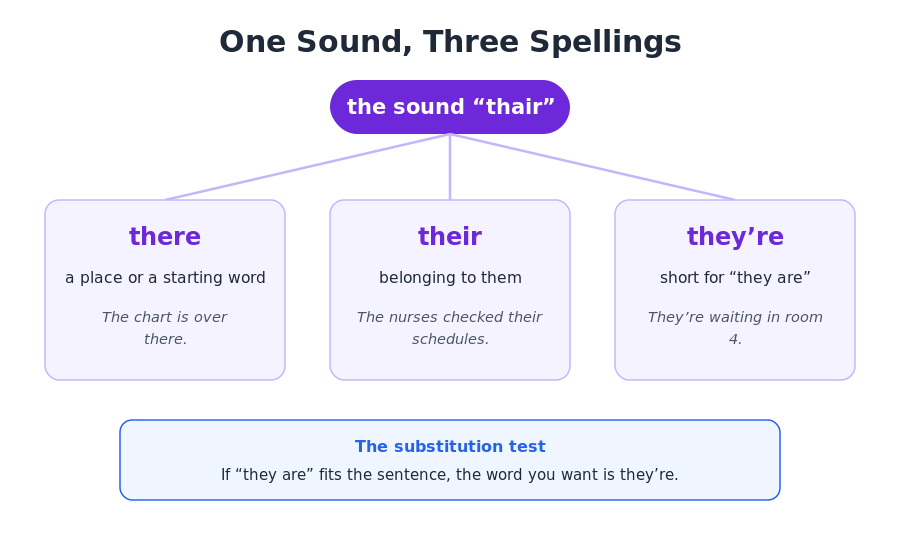
Homophones are words that sound the same but differ in spelling and meaning, such as there, their, and they’re. Because your ear cannot tell them apart, you match the spelling to the word’s job in the sentence. Frequently misspelled words, like definitely and separate, break at predictable trouble spots you can learn.
Why Are Homophones So Easy to Miss?
When you proofread, your brain often reads what you meant, not what you typed—and since homophones sound identical, reading the sentence aloud does not help. A sentence like Your going to do fine sails right past the ear. The only reliable catch is a deliberate check: what job is this word doing—showing a place, showing ownership, or standing in for two words?
Which Homophone Sets Cause the Most Trouble?
| Set | How to tell them apart | Example |
|---|---|---|
| there / their / they’re | place / ownership / “they are” | They’re parking their car over there. |
| your / you’re | ownership / “you are” | You’re going to need your stethoscope. |
| its / it’s | ownership / “it is” | It’s time for the clinic to close its doors. |
| to / too / two | direction / “also” or “excessively” / the number | Two nurses were too tired to drive. |
| affect / effect | usually the action (verb) / usually the result (noun) | The noise affected her sleep; the effect lasted all week. |
| brake / break | stopping / a pause, or to split | Check the brakes before you take a break. |
How Do I Pick the Right Spelling Every Time?
The strongest tool is the substitution test. Every apostrophe version is a contraction, so expand it: if they are, you are, or it is fits the sentence, the apostrophe form is right. If the expansion sounds wrong, you want the possessive—and possessive pronouns (their, your, its) never take an apostrophe.
Memory anchors handle the rest. There contains here, and both point to places. Their contains heir, someone who owns things. For affect and effect, remember the order of the alphabet and of events: action first, then the result—affect is usually the verb, effect usually the noun.
Worked example. Wrong: The new schedule had a positive affect on morale. The sentence needs a thing, a result—a noun. Corrected: The new schedule had a positive effect on morale.
Which Words Are Misspelled Most Often?
Most hard-to-spell words have one small trouble spot. Aim your attention there instead of at the whole word:
- definitely — finite lives in the middle; there is no a in it.
- separate — there is a rat in the middle: sep-a-rat-e.
- necessary — one c, double s: a shirt has one collar and two sleeves.
- occurred — double c and double r, thanks to the doubling rule.
- embarrass — double r and double s.
- rhythm — no full vowel, just the y.
- calendar — ends in -ar, not -er.
- privilege — no d; it ends in -ege.
- recommend — one c, double m.
- maintenance — -ten- in the middle, not -tain-.
Watch: A Short Video Lesson
Khan Academy sorts out there, their, and they’re—the busiest homophone set in English—with plenty of examples:
A Routine for Homophone and Spelling Questions
- Name the job of the tested word: place, ownership, contraction, direction, or result.
- Expand any contraction. If “they are,” “you are,” or “it is” fits, the apostrophe form wins.
- If the word shows ownership, remember that possessive pronouns never take an apostrophe: their, your, its.
- For affect/effect, ask whether the sentence needs an action (verb, affect) or a result (noun, effect).
- For a suspected misspelling, zoom in on the word’s trouble spot—the middle of definitely, the double letters of occurred—and check it letter by letter.
Practice
- (Your / You’re) going to need (your / you’re) badge for the night shift.
- The storm had little (affect / effect) on the clinic’s schedule.
- (Their / There / They’re) results are posted over (their / there / they’re).
- Choose the correct spelling: definately / definitely.
- The dog wagged (its / it’s) tail.
- Choose the correct spelling: seperate / separate.
Answers
- You’re (you are) going to need your (ownership) badge.
- effect — the sentence needs a noun, a result.
- Their results (ownership) are posted over there (place).
- definitely — keep finite in the middle.
- its — “it is tail” fails the substitution test, so no apostrophe.
- separate — remember the a rat in the middle.
Where This Fits in Your Prep
This lesson pairs naturally with commonly confused words and contractions, which digs deeper into the apostrophe side of these pairs. The essential spelling rules explain why occurred doubles its letters, and forming plurals handles endings of a different kind. When two words are close in meaning rather than sound, denotation and connotation shows how to choose the precise one. Every topic is gathered on our English and Language Usage practice hub.
Recommended Prep Books
These study guides and practice tests help you keep building momentum as you get ready:


Related to This Article
More math articles
- Full-Length DAT Quantitative Reasoning Practice Test-Answers and Explanations
- Free Grade 3 English Worksheets for Nevada Students
- 3rd Grade NYSE Math Practice Test Questions
- Free Grade 3 English Worksheets for Kansas Students
- The Best Grade 2 Math Worksheets for Mississippi Students
- Energy and Simple Machines
- Free Grade 7 English Worksheets for Indiana Students
- What’s A Good ACT Score?
- The Best Grade 7 ELA Practice Tests for Connecticut Students
- Taft-Hartley, the Fair Deal and the Election of 1948




















What people say about "Homophones and Frequently Misspelled Words Made Simple"?
No one replied yet.