Understanding Overall Text Structure
Nonfiction writing is not just a pile of sentences; it is arranged in a pattern. When you recognize that pattern, the whole passage becomes easier to follow and remember.
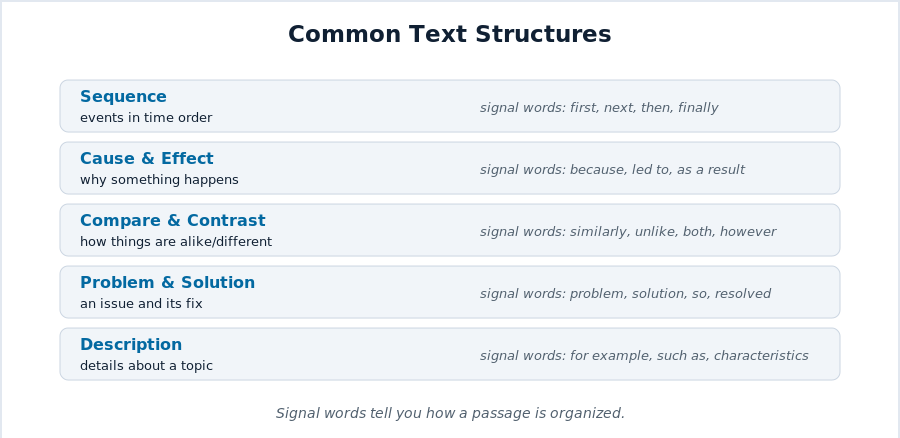
Text structure is the way a writer organizes information in a passage. Common structures include sequence, cause and effect, compare and contrast, problem and solution, and description. Each has its own signal words. Spotting the structure tells you how the ideas relate and where the important points are likely to appear.
The Common Structures
There are a handful of patterns you will meet again and again. Sequence puts events or steps in order and uses words like “first,” “next,” and “finally.” Cause and effect shows why something happened, with signals such as “because,” “led to,” and “as a result.” Compare and contrast lays out similarities and differences using “like,” “unlike,” “both,” and “however.” Problem and solution names a trouble and then a fix. Description paints a detailed picture of a topic, listing features and traits. Many passages mix structures, but one usually dominates. Asking “How is this information arranged?” early in your reading helps you predict what comes next and hold the passage together in your mind.
Using Signal Words
Signal words are your fastest clue to structure. When you see “as a result,” you are likely in a cause-and-effect passage; when you see “on the other hand,” you are probably comparing two things. These words act like road signs, telling you how the next idea connects to the last. Train yourself to notice them. If a passage is packed with time words — “in 1920,” “later,” “by the end” — it is almost certainly telling a sequence. If it repeatedly weighs one thing against another, it is comparing. Recognizing the structure does more than answer “how is this organized” questions; it helps you locate main ideas, because writers usually place their key point where the structure builds toward it.
Watch: A Short Video Lesson
Khan Academy gives a clear overview to go with this lesson:
A Routine for Spotting Structure
- Ask early: how is this information arranged?
- Watch for signal words that reveal the pattern.
- Name the dominant structure.
- Use it to predict what comes next and find the main point.
Practice
- What is text structure?
- Name three common text structures.
- What signal words point to cause and effect?
- What structure uses “first,” “next,” and “finally”?
- What do signal words act like?
- How does structure help you find the main idea?
Answers
- The way a writer organizes information in a passage.
- Any three: sequence, cause and effect, compare and contrast, problem and solution, description.
- “Because,” “led to,” and “as a result.”
- Sequence.
- Road signs showing how ideas connect.
- Writers place key points where the structure builds toward them.
Where This Fits in Your RLA Prep
Overall structure is the gateway to sequence and chronology and cause and effect in reading. See every topic on the Language Arts Prep Hub.
Recommended Prep Books
Keep building momentum with a full study guide and practice tests:

Related to This Article
More math articles
- The Best Grade 4 Math Book for Louisiana Students
- Exponents and Powers: Rules You’ll Use for Life
- Fractional Forecasts: How to Estimate Sums and Differences Using Benchmarks
- Genetic Variation, Common Ancestry, and Cladograms
- Higher Education, Debt, and Unequal Returns
- 8th Grade STAAR Math FREE Sample Practice Questions
- Samples, Populations, and Bias
- 7th Grade NSCAS Math Worksheets: FREE & Printable
- Work Control: Hold the Work, Control the Hazard
- 3rd Grade Georgia Milestones Assessment System Math Worksheets: FREE & Printable





















What people say about "Understanding Overall Text Structure"?
No one replied yet.