YOUR HiSET Reading STUDY COMPANION
HiSET Reading Online Center
Prepare for HiSET Reading with independent practice, flashcards, and connected lessons. Use the text to support the answer rather than relying on what you already know about the topic. Choose one skill to strengthen before your next practice session.
HiSET Reading Practice Tests
Open the existing practice form, review explanations, and use the results to choose a skill. Results are study feedback, not official scores.
HiSET Reading Flashcards
Recall the idea, then connect it with an example.
HiSET Reading Study Guides
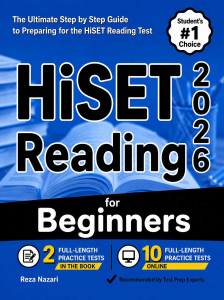
HiSET Reading for Beginners
Reading-focused preparation. Review the contents and sample pages before choosing the guide.
View book & purchase options →HiSET Reading Quick Review
Choose a topic or review explanation before returning to practice.
Open this resource →MEET THE ASSESSMENT · CHOOSE YOUR NEXT SKILL
Know HiSET Reading before you start.
HiSET Reading has 50 multiple-choice questions, with 65 minutes for the English form and 80 minutes for the Spanish form. Study literary and informational texts, evidence, inference, and interpretation. The independent practice forms here provide study feedback rather than official HiSET scores.
Official assessment information ↗Main ideas and text evidence
Use the text to support the answer rather than relying on what you already know about the topic.
Explore this study route →Word meaning and structure
Read surrounding sentences to distinguish the meaning intended in this passage.
Explore this study route →Comparing passages and claims
State the point of agreement or difference before evaluating the supporting evidence.
Explore this study route →Official preparation
Check the current assessment guidance and use official samples alongside your independent study.
Explore this study route →HiSET Reading Practice Center
Take a full practice test, review the explanations, then use the flashcards to repair the terms and ideas that slowed you down.
HiSET Reading Study Blueprint
Open each area to see what to master. The bars show how this Online Center distributes its lessons, so you can plan study time without mistaking the map for an official exam weighting.
01 Explicit meaning and main ideasFind what a text states and separate central ideas from supporting details. 8lessons
- Explicit information, topic, main idea, and summary
- Sequence, cause and effect, and key details
02 Inference and evidenceBuild conclusions that remain inside the evidence provided by the passage. 8lessons
- Inference, prediction, and supporting evidence
- Fact, opinion, assumption, and conclusion
03 Structure and vocabularyUse organization and context to interpret meaning. 8lessons
- Text structure, transitions, and relationships
- Context clues, figurative language, and word choice
04 Literature and author craftAnalyze character, theme, point of view, tone, and purpose. 8lessons
- Plot, conflict, setting, and theme
- Narrator, mood, tone, and author choices
05 Arguments, paired texts, and pacingEvaluate claims and compare texts while controlling time. 9lessons
- Claim, reason, evidence, credibility, and bias
- Paired passages, visual information, and test strategy
Study-map shares describe the learning resources on this page. They are not presented as official test percentages.
HiSET Reading: Lessons, Flashcards, and Study Guide: a single starting point that brings together the lessons, flashcards, practice questions and review material for this section of the test, arranged in the order you would sensibly work through them.
Choose a HiSET subtest
HiSET has five subject areas. Pick the Online Center that matches the subtest you are studying.
Choose your next move
A strong reading score comes from repeatable decisions, not from trying to memorize every answer. Start where your current study session needs help.
Review the HiSET format
Check the official Reading and Writing task descriptions, timing, and practice resources for your test language.
Build a reading habit
Practice a short routine for mapping a passage, paraphrasing difficult lines, and proving each choice.
Find the proof
Get faster at returning to the exact sentence or detail that supports a correct answer.
A simple four-step study routine
Use this sequence for a lesson, a passage set, or an error you found in a practice test.
Name the task
Underline the key verb in the question. Are you finding a detail, making an inference, or judging an argument?
Read for the map
Notice the topic, main movement, and signals such as however, for example, and therefore.
Prove one answer
Return to the relevant part of the text. Choose the answer that the passage supports most precisely.
Repair one pattern
After practice, name one reason for a miss and work the connected lesson before testing again.
HiSET Reading Vocabulary Flashcards
Strong readers know the terms that questions use: inference, central idea, tone, counterclaim, credibility, synthesis, and more. This complete 96-card deck groups the important vocabulary and gives each word a clear test-use example.
The deck is available here in the Online Center and in its own tab for focused study.
Two printed full-length tests
Practice Tests 1 and 2 are printed in HiSET Reading for Beginners. Use each as a full simulation: set a 65-minute timer, answer every question, then review the evidence behind each miss.
Form 1 • establish your baseline
Practice Test 1
Use this printed form to identify one high-value repair move before you begin the online series.
- 50 questions
- 65 minutes
- printed book form
Included in the book
Form 2 • measure the repair
Practice Test 2
Take this printed form after focused practice. Compare your reading process and evidence choices, the total score.
- 50 questions
- 65 minutes
- printed book form
Included in the book
Complete reading skill map
This directory follows the nine chapters and 53 lessons in HiSET Reading for Beginners. Choose a lesson by the reason you missed a question. Each lesson opens separately, so you can study without losing this map.
Chapter 1: Finding What the Text Says
Locate Explicit Information Precisely
A direct-detail question is a test of accuracy, not memory. The correct response may rephrase the text, but it cannot change the person, condition, time, quantity, or relationship that the text states.
Separate the Topic from the Main Idea
The topic names the subject. The main idea states the most important point the author develops about that subject.
Understand What Supporting Details Do
Details do more than fill space. They define, illustrate, prove, qualify, compare, explain a cause, or show a result. Recognizing that job helps you decide which details are essential.
Summarize Without Distorting the Selection
A summary preserves the central idea and essential development while leaving out minor examples, repeated wording, and decorative detail.
Recognize an Accurate Paraphrase
A paraphrase expresses the same meaning in new words. It may shorten or reorganize a sentence, but it must preserve relationships, conditions, and degree of certainty.
Build an Evidence Chain
A defensible answer can be traced through a simple chain: question, controlling evidence, reasoning, and conclusion.
Chapter 2: Inference and Logical Conclusions
Build an Inference from Textual Clues
A sound inference connects at least one concrete clue to a conclusion that explains it.
Control Scope and Certainty
The strongest inference is often the choice that says no more than the evidence permits.
Infer Causes, Motives, and Relationships
When a text does not name the reason for an action, look for the problem the action solves.
Draw Conclusions and Make Limited Generalizations
A conclusion brings the evidence together; a generalization extends a pattern beyond the individual details.
Predict and Apply an Idea to a New Situation
A prediction extends an established pattern forward; an application transfers a stated rule to a closely matched case.
Read Unstated Meaning in Narrative Text
Narratives reveal feelings, relationships, and change through behavior, dialogue, setting, and contrast.
Chapter 3: Organization, Sequence, and Relationships
Trace Sequence and Chronology
Sequence tells what happens first, next, and last; chronology places events on a timeline, even when the author mentions them out of order.
Read Directions and Conditional Rules
In directions, small words control large actions. A reader must preserve conditions, exceptions, and stopping points.
Separate Cause and Effect from Mere Sequence
A cause produces or helps produce an outcome. Earlier timing alone is not enough.
Compare and Contrast on Consistent Points
A useful comparison places two subjects beside the same criteria instead of collecting unrelated facts.
Recognize Problem, Solution, Description, and Classification
Common structures answer different questions: What is wrong and how is it addressed? What is something like? How can examples be grouped?
Explain the Function of Sentences and Paragraphs
A part of a passage has a function because of what it contributes to the author’s larger purpose.
Chapter 4: Words, Tone, Purpose, and Perspective
Determine Meaning from Context
Context is the evidence surrounding a word: definitions, examples, contrasts, causes, results, and the logic of the sentence.
Read Denotation, Connotation, and Precise Word Choice
Denotation is a word’s basic meaning; connotation is the attitude or association the word carries in context.
Identify Tone and Its Development
Tone is the author’s attitude toward the subject or audience, revealed through patterns of language and emphasis.
Connect Author’s Purpose to Audience and Form
Purpose is what the author wants the text to accomplish for a particular audience.
Analyze Point of View and Perspective
Point of view controls who tells or presents the information; perspective controls what that person or source values, notices, and knows.
Explain Rhetorical and Figurative Choices
A rhetorical choice is a deliberate method for guiding attention, clarifying an idea, or influencing judgment.
Chapter 5: Functional Documents and Procedures
Reading the Architecture of a Document
Use headings and labels to locate information, but use complete sentences to decide what the information means.
Applying Policies, Exceptions, and Deadlines
Policy questions are usually solved by matching a person’s facts to a rule, then checking whether an exception changes the result.
Reading Schedules and Solving Constraints
A schedule question is a filtering problem: keep only the choices that satisfy every stated requirement.
Completing Forms Accurately
Form questions test whether you can connect a field or attachment to the instruction that makes it necessary.
Following Procedures and Safety Conditions
A procedure has both a sequence and a logic. Some steps always apply; others apply only when a stated condition occurs.
Combining Information Across Documents
When a message, policy, and schedule concern the same event, no single source may contain the complete answer.
Chapter 6: Reading Tables, Charts, Maps, and Other Visuals
Labels, Units, Scales, and Legends
Every value in a visual belongs to a category and a unit. Leaving either one out can turn an accurate calculation into an incorrect answer.
Reading Tables by Row, Column, and Denominator
A table answer comes from the intersection of the correct row and column. A comparison may also require a total or a rate.
Reading Change in Bar and Line Graphs
Bar graphs emphasize comparisons among categories. Line graphs emphasize change across an ordered variable such as time.
Proportions, Percentages, and Misleading Displays
Percentages describe parts of a whole. Axis choices affect visual emphasis but do not change the underlying values.
Reading Maps, Routes, Legends, and Scale
A map represents space selectively. Use its orientation, symbols, route restrictions, and distance scale; do not assume that it shows travel time or every physical feature.
Integrating Visual Evidence and Recognizing Limits
A visual may support, qualify, or contradict a written claim. It rarely proves a cause by itself.
Chapter 7: Arguments and Evidence
Map Claim, Reason, Evidence, and Conclusion
Before judging an argument, identify its parts. A persuasive sentence is not automatically evidence, and a statistic is not useful merely because it contains a number.
Judge Relevance and Sufficiency
Relevant evidence bears directly on the claim. Sufficient evidence provides enough support for the strength and scope of that claim. Evidence can satisfy one standard without satisfying the other.
Evaluate Sources, Samples, and Generalizations
Evidence quality depends on how the information was produced, who or what was observed, and whether the source is positioned to know what it claims.
Identify Assumptions and Alternative Explanations
An assumption fills a gap between evidence and conclusion. An alternative explanation shows another way the same evidence could have occurred.
Decide What Strengthens or Weakens an Argument
New information strengthens an argument when it supports a necessary link, rules out an alternative, or adds relevant evidence. It weakens an argument when it undermines one of those parts.
Judge Whether a Conclusion Is Earned
A conclusion is earned when it matches the evidence in direction, degree, population, time, and cause. The most common error is not a completely false statement but a statement that takes one step too far.
Chapter 8: Comparing and Integrating Sources
Building a Comparison Matrix
A comparison matrix keeps the sources separate before you try to combine them. It is the safest defense against mixing evidence.
Comparing Central Ideas and Themes
Compare ideas at the same level: a central idea with a central idea, or a broader theme with a broader theme.
Comparing Purpose, Perspective, and Emphasis
Sources on the same event may select different details because their writers have different goals and responsibilities.
Distinguishing Agreement from a Shared Topic
Two sources agree only when both support the same proposition. Discussing the same subject is not enough.
Integrating Text with Tables and Charts
Let prose and visuals perform their different jobs. The text may provide context or a claim; the display provides measured relationships.
Resolving Tension and Making Evidence-Based Decisions
A multi-source decision is correct only if it satisfies every required condition, including conditions found in notes and tables.
Chapter 9: The 65-Minute Reading Plan
Use Checkpoints, Not Constant Clock-Watching
A pacing checkpoint answers one question: do you need to adjust? It should guide your next action, not interrupt every paragraph.
Budget Time by Stimulus Set
Passages, notices, and visuals create clusters of questions. Judge the value of reading a source by the whole cluster, not by the first item alone.
Read the Question Before You Solve
HiSET Reading practice questions use four choices and one best answer. A response can be partly true and still be wrong because it answers a different question, changes a condition, or states more than the passage supports.
Eliminate, Flag, and Change for a Reason
Elimination is evidence analysis. Flagging is time management. Changing an answer is justified when new evidence or corrected reasoning identifies a specific defect in the first choice.
Turn Results into a Repair Plan
A score reports what happened. An error log explains why and specifies what will change next time. Guessed answers belong in the log even when they happen to be correct.
HiSET Reading: 104 terms and definitions
Every flashcard above written out as a list and grouped by topic, with the prompt that goes with each term. Use it to revise without clicking through the cards, to search the page for a term, or to print the set.
Argument and sources
- Analogy
- A comparison used to explain or support an idea. An argument may compare public health to maintaining a shared water system.
- Assumption
- An unstated belief an argument depends on. A plan that assumes everyone has internet access may overlook a serious problem.
- Bias
- A preference or viewpoint that can affect how information is selected or presented. A company’s advertisement may show bias toward its own product.
- Caption
- Text that identifies or explains a visual. A caption can explain when and where a photograph was taken.
- Claim
- A statement an author wants the reader to accept. “The town should protect the wetland” is a claim.
- Correlation and causation
- Correlation means events happen together; causation means one produces the other. Ice-cream sales and sunburn rise together, but hot weather causes both.
- Counterclaim
- A reasonable opposing claim or different point of view. An author may acknowledge that a plan costs money before answering that concern.
- Counterevidence
- Evidence that challenges a claim or conclusion. A fair argument considers research that does not support its position.
- Credibility
- The trustworthiness of a source, speaker, or piece of evidence. Research from a qualified organization can add credibility.
- Fallacy
- A mistake in reasoning that makes an argument weaker. A fallacy may sound persuasive but does not provide sound support.
- False dilemma
- Presenting only two choices when other reasonable options exist. “Either close the library or raise taxes” ignores possible alternatives.
- Hasty generalization
- A conclusion about a large group based on too little evidence. Two late buses do not prove that buses are always unreliable.
- Objective evidence
- Evidence based on verifiable facts rather than personal feeling alone. A government data table is more objective evidence than “everyone knows.”
- Premise
- A starting statement or reason on which an argument is built. If a premise is weak or false, the argument built on it is less convincing.
- Reason
- A statement that explains why a claim should be accepted. “The wetland prevents flooding” is a reason supporting protection.
- Rebuttal
- A response that challenges or answers a counterclaim. The author rebuts the cost concern by showing long-term savings.
- Relevance
- The degree to which evidence directly helps prove a specific claim. A statistic about local rainfall is relevant to a claim about drought; a statistic about music is not.
- Source
- The person, document, study, or organization from which information comes. Ask who created a source, when, and for what purpose.
- Sufficiency
- Whether evidence is enough in amount and quality to support a claim. One anecdote is usually not sufficient evidence for a broad conclusion.
- Visual
- A chart, table, graph, timeline, map, image, or diagram that presents information. Read labels, scale, title, and source before using a graph as evidence.
Craft
- Author’s purpose
- Purpose is what the author aims to accomplish, such as informing, explaining, arguing, reflecting, or entertaining.
Evidence
- Best evidence
- The best evidence directly supports the exact claim in the question and does not require an unsupported leap.
- Fact versus opinion
- A fact can be checked against evidence; an opinion expresses a judgment, preference, or interpretation.
- Source credibility
- Credibility depends on relevant expertise, transparent methods, appropriate evidence, and freedom from misleading conflicts or claims.
Literary reading
- Biographical sketch
- A short account of a person’s life that emphasizes selected developments or achievements. A sketch may focus on the events that shaped an inventor’s work.
- Character trait
- A lasting quality shown through a character’s words, actions, thoughts, or choices. Returning a lost wallet can show honesty.
- Conflict
- A struggle between opposing forces in a story. A character may face conflict with another person, society, nature, or self.
- External conflict
- A struggle between a character and an outside force. A runner battling a storm during a race faces external conflict.
- Flashback
- A shift to an earlier event that adds background or changes understanding. A flashback may reveal why a character fears a particular place.
- Foreshadowing
- A detail that hints at a later event. A broken ladder early in a story may foreshadow a later accident.
- Internal conflict
- A struggle within a character’s mind or feelings. A character who wants to tell the truth but fears consequences faces internal conflict.
- Memoir
- A nonfiction account in which a writer reflects on personal experiences. A memoir emphasizes memory, perspective, and selected moments rather than a full life history.
- Motivation
- The reason a character acts or makes a choice. A desire to protect a sibling may motivate a character’s risky decision.
- Narrator
- The voice that tells a story. A first-person narrator uses I and reveals only that narrator’s knowledge.
- Perspective
- A person’s way of seeing an event or issue, shaped by experience and position. Two witnesses can describe the same event from different perspectives.
- Plot
- The sequence of important events in a narrative. A plot often moves from a problem through complications toward an outcome.
- Point of view
- The position or perspective from which a story or text is presented. Third-person limited point of view stays close to one character’s thoughts.
- Resolution
- The part of a narrative where the central conflict is settled or its outcome becomes clear. The resolution may show what happens after the final decision.
- Setting
- The time, place, and social environment of a narrative. A story set during a wartime blackout may feel tense because of its setting.
- Speaker
- The voice expressing ideas or feelings in a poem. The speaker of a poem may not be the poet.
- Theme
- A meaningful idea about life, people, or society developed through a literary work. A story about forgiveness may develop the theme that trust can be rebuilt slowly.
- Turning point
- A moment when a story’s direction, conflict, or character understanding changes. A character’s decision to confess may be the turning point.
Meaning and structure
- Cause and effect
- A relationship in which one event or condition produces another. Heavy rain caused the river to rise.
- Central idea
- The most important message or point developed in a text. The central idea of an article may be that a policy changed access to health care.
- Chronology
- A sequence organized by time. A biography often uses chronology to trace a person’s life.
- Classification
- A structure that sorts people, things, or ideas into categories. A guide may classify clouds by altitude and shape.
- Compare and contrast
- A structure that shows similarities and differences. A passage may compare two farming methods and contrast their costs.
- Conclusion
- A judgment reached after considering evidence. Several facts about pollution can support a conclusion about a river’s condition.
- Description
- A structure that explains features, qualities, examples, or parts of a subject. A paragraph describing a wetland may explain its plants, animals, and soil.
- Explicit detail
- Information the passage states directly. If the passage says the town closed the bridge in May, May is an explicit detail.
- Generalization
- A broad statement drawn from specific information. A sound generalization is supported by several details, not one example.
- Inference
- A conclusion supported by clues in the text, even though the exact conclusion is not stated. A character who avoids eye contact and speaks softly may be inferred to feel uneasy.
- Main idea
- The most important point of a paragraph or section. A paragraph about drought-resistant seeds may have a main idea about farmers’ adaptation.
- Paragraph function
- The job a paragraph does in the larger text. A paragraph may introduce a problem, define a term, or provide a counterexample.
- Problem and solution
- A structure that presents a difficulty and one or more responses to it. The article introduces food waste, then explains a community composting program.
- Sequence
- The order in which events, steps, or ideas occur. A recipe uses sequence to show what happens first, next, and last.
- Signal word
- A word or phrase that shows a relationship between ideas. “However” signals contrast; “therefore” signals a result.
- Summary
- A brief, accurate account of the most important ideas without minor details or opinions. A good summary includes the central idea and key development, not every example.
- Supporting detail
- A fact, example, explanation, or quotation that develops a main idea. Statistics about rainfall can support a paragraph’s point about drought.
- Text structure
- The way an author organizes ideas to help readers understand a subject. A cause-and-effect structure shapes how the reader sees the relationship between events.
- Thesis
- A writer’s main claim or controlling idea, often stated near the beginning of an argument. A thesis may argue that a city should expand its bus network.
- Topic
- The broad subject a text discusses. “Public transportation” is a topic; the author’s point about it is the central idea.
- Transition
- A word, phrase, or sentence that connects ideas. “For example” transitions from a claim to supporting evidence.
Paired Texts
- Agreement
- Identify the specific claim or interpretation both sources support, even if they use different examples.
- Disagreement
- Name the exact issue on which the sources differ instead of saying vaguely that they have different views.
Paired texts
- Audience
- The readers or listeners an author expects to reach. An author’s vocabulary, examples, and tone can reveal the intended audience.
- Author’s purpose
- The author’s reason for writing: for example, to inform, argue, explain, reflect, or entertain. A purpose answer should explain what the author is trying to accomplish with readers.
- Emphasis
- The idea, detail, or effect a text gives the most attention. Two texts can agree on an event but emphasize different causes or consequences.
- Paired texts
- Two or more texts connected by topic, event, question, or theme. Compare each author’s purpose, evidence, tone, and perspective before choosing an answer.
- Scope
- The range or limits of what a text covers. One source may examine a local effect while another addresses a national pattern.
- Synthesis
- Combining information from two or more sources to form a supported understanding. Synthesis asks what the sources together show, not merely what each says alone.
Reading process
- Active reading
- Reading with a purpose: noticing structure, paraphrasing, predicting, and returning to the text for proof. Ask: What is this paragraph doing, and what words prove it?
- Annotation
- A short mark or note that records an important idea, shift, claim, or question while you read. Circle a contrast word and write “new view” in the margin.
- Best answer
- The choice that answers the question most accurately and completely using the passage. Choose the answer with the clearest proof, even if another choice sounds partly true.
- Distractor
- A tempting but wrong answer choice. A distractor may repeat a word from the passage but twist the author’s point.
- Elimination
- Removing an answer choice because the text contradicts it, does not support it, or makes it too broad or narrow. Cross out a choice that answers a nearby question instead of this one.
- Flag and review
- A time-management move: mark a difficult question, continue, and return if time allows. Do not let one uncertain question take time from several answerable ones.
- Key verb
- The action word in a question stem, such as infer, compare, explain, or support. “Infer” asks for a justified conclusion, not a copied sentence.
- Line reference
- A pointer to a particular sentence or part of a passage. Use the reference to locate the area, then read a little before and after it.
- Pacing
- Using time steadily so that you can complete the whole test. A steady pace leaves a brief review window at the end.
- Paraphrase
- A brief restatement of a sentence or paragraph in your own words without changing its meaning. After a dense paragraph, say its point in one plain sentence.
- Passage set
- One passage or a small group of related texts followed by questions. Read the whole passage set before judging a question about the author’s overall purpose.
- Prediction
- A reasonable expectation about what a text may explain, contrast, or conclude next. A question in the introduction may predict that the next paragraph will answer it.
- Question stem
- The part of a question that tells you exactly what you must find or decide. In “Which detail best supports…?” the key job is to choose evidence.
- Text evidence
- Words, details, examples, or reasoning from the passage that support an answer. A strong answer can be proved with a specific detail from the text.
Reasoning
- Check with an inverse operation
- Undo the operation when possible: addition with subtraction, multiplication with division, and squaring with a square root plus a sign check.
- Estimate before calculating
- Predict the size and sign of an answer first. The estimate helps catch a misplaced decimal, wrong operation, or impossible result.
Vocabulary and craft
- Connotation
- The feeling or association a word carries beyond its dictionary meaning. “Home” can suggest warmth and belonging, while “house” is more neutral.
- Context clue
- A word, phrase, example, or contrast near an unfamiliar word that helps reveal its meaning. “Unlike her timid brother, Maya was bold” shows that bold means confident.
- Denotation
- The dictionary meaning of a word. The denotation of “home” is a place where someone lives.
- Figurative language
- Language that is not meant literally and creates a comparison or vivid effect. “Time is a thief” is figurative because time cannot literally steal.
- Imagery
- Language that appeals to the senses and helps readers picture, hear, feel, taste, or smell something. “The sharp scent of pine filled the cold air” uses sensory imagery.
- Loaded language
- Words chosen to create a strong emotional reaction. Calling a policy “heartless” is loaded language.
- Metaphor
- A direct comparison that says one thing is another. “Her voice was velvet” compares the sound of a voice to velvet.
- Mood
- The feeling a text creates for the reader. Dark imagery and short sentences can create a tense mood.
- Multiple-meaning word
- A word with more than one meaning; context determines the intended one. “Draft” can mean an early version of writing or a current of air.
- Nuance
- A small but meaningful difference in meaning, feeling, or emphasis. “Stubborn” and “determined” are close in meaning but have different nuance.
- Personification
- Giving human actions or qualities to something nonhuman. “The wind whispered through the trees” gives wind a human action.
- Repetition
- Deliberately using a word, phrase, or pattern more than once for emphasis. Repeating “We can” may strengthen a speech’s hopeful message.
- Rhetorical question
- A question asked for effect rather than to receive an answer. “Who would want to lose a safe park?” guides the audience toward agreement.
- Simile
- A comparison using like or as. “The lake was smooth as glass” compares the lake to glass.
- Symbolism
- Using an object, image, or action to represent a larger idea. A locked door may symbolize exclusion or an obstacle.
- Tone
- The author’s attitude toward a subject or audience. Formal word choice and careful evidence can create a serious tone.
- Word choice
- The particular words an author selects to create meaning, tone, or emphasis. Calling a change “a reform” rather than “a disruption” changes the feeling of a sentence.
Official source: what the HiSET covers, how the five subtests are structured and how the credential works are published by PSI, which administers the exam, at hiset.org.
Every lesson in one place
Open a lesson in a new tab and keep this Online Center nearby as your study home.
Browse the complete lesson directory
A USEFUL NEXT STEP
HiSET Reading: study questions
What should I know about HiSET Reading?
HiSET Reading has 50 multiple-choice questions, with 65 minutes for the English form and 80 minutes for the Spanish form. Study literary and informational texts, evidence, inference, and interpretation. The independent practice forms here provide study feedback rather than official HiSET scores.
Official source ↗How should I use these independent HiSET Reading study tools?
Start with a practice activity, review explanations for missed questions, and use quick review or flashcards for one weak topic. The practice results are study feedback, not official exam scores. Compare a book’s contents with your course or test requirements before buying.
Resources from Effortless Math · Editorial standards