Narrator and Point of View
Every story is told by someone, and who tells it changes what you know. The same events feel completely different depending on whose eyes you see them through. Figuring out the narrator is one of the fastest ways to understand a passage.
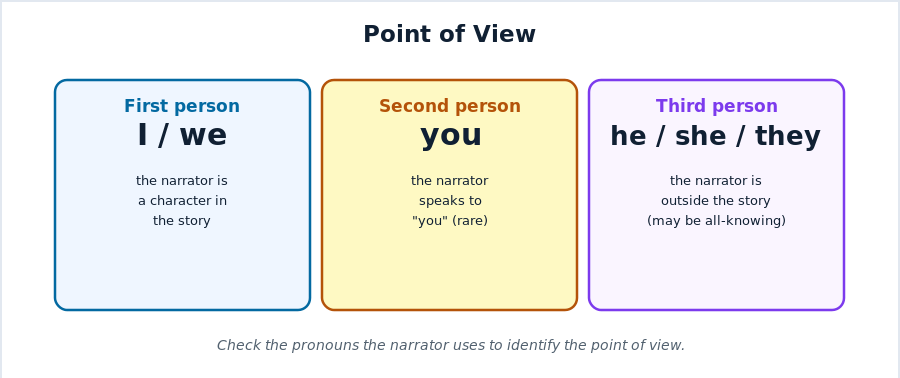
The narrator is the voice telling the story, and the point of view is the perspective that voice uses. The three main points of view are first person (told by a character using “I”), second person (spoken to “you”), and third person (told from outside using “he,” “she,” or “they”). The pronouns give it away.
The Three Points of View
Identifying point of view starts with the pronouns. In first person, a character inside the story tells it using “I” and “we,” so you only know what that character knows: “I opened the door and gasped.” In second person, the narrator speaks directly to “you,” which is rare in stories but common in instructions: “You walk into the room and stop.” In third person, the narrator stands outside the story and uses “he,” “she,” and “they”: “She opened the door and gasped.” Third person can be limited (following one character’s thoughts) or omniscient (knowing everyone’s thoughts). Checking the pronouns in the very first sentences usually settles the question immediately.
Is the Narrator Reliable?
Knowing who tells a story also means asking whether to trust them. A reliable narrator gives you an accurate account of events. An unreliable narrator — often a first-person one — may be mistaken, biased, or hiding something, so what they tell you may not be the full truth. For example, a narrator who insists “everyone loved me” while every other character avoids him is showing you he cannot be fully trusted. Third-person narrators are usually more reliable because they stand outside the action. When you read, notice whether the narrator’s version of events matches what the characters actually do. A gap between the two is a clue that you should read the narrator’s claims with a little caution.
Watch: A Short Video Lesson
TED-Ed gives a clear overview to go with this lesson:
A Routine for Reading Point of View
- Check the pronouns in the first few sentences.
- “I” means first person; “you” means second; “he/she/they” means third.
- For third person, decide if it follows one mind (limited) or all (omniscient).
- Ask whether the narrator’s account matches the characters’ actions.
Practice
- What is a narrator?
- Which pronouns signal first-person point of view?
- Which point of view uses “he,” “she,” and “they”?
- What is an unreliable narrator?
- Why are third-person narrators often more reliable?
- What is the fastest way to identify point of view?
Answers
- The voice telling the story.
- “I” and “we.”
- Third person.
- One who may be mistaken, biased, or hiding something.
- They stand outside the action rather than inside it.
- Check the pronouns.
Where This Fits in Your RLA Prep
Point of view connects closely to purpose vs. point of view and character motivation and change. See every topic on the Language Arts Prep Hub.
Recommended Prep Books
Keep building momentum with a full study guide and practice tests:

Related to This Article
More math articles
- Words for Quantity, Time, Description, and Place
- How to Ace the GRE Quant Section?
- How to Represente Proportional Relationships with Equations
- SSAT Upper Level Math Practice Test Questions
- The Best Grade 5 Math Book for West Virginia Students
- 6 Reasons Why Doing Math Homework Is Important
- Top 5 Laptop Stands to Help You Teach Online
- 10 Most Common TASC Math Questions
- 5 Tips on How to Score Higher on SAT Math
- A ceiling binds below equilibrium




















What people say about "Narrator and Point of View"?
No one replied yet.