Understanding the Prompt and Rubric
Before you can write a strong essay, you have to know exactly what the task is asking. Many test-takers lose points simply because they answer the wrong question — they share an opinion when the test wants an analysis. Reading the prompt slowly is the first move of a confident writer.
The extended response gives you two passages that argue opposite sides of an issue and asks which side is better supported by evidence. It is not about which side you agree with. Your job is to judge the arguments and explain your reasoning, and your work is scored on three traits.
What the Prompt Actually Asks
The prompt hands you two short passages on one topic. One argues for a position; the other argues against it. Your task is to decide which passage builds the stronger, better-supported argument and to prove your choice using details from the texts. Notice what the prompt does not ask: it never asks for your personal view, your life experience, or outside facts. A writer who spends the essay explaining why she personally likes one side has answered the wrong question. Read the prompt twice, underline the words “better supported” in your mind, and keep them there. Everything you write should serve one goal — showing which author did the more convincing job with evidence.
How It Is Scored
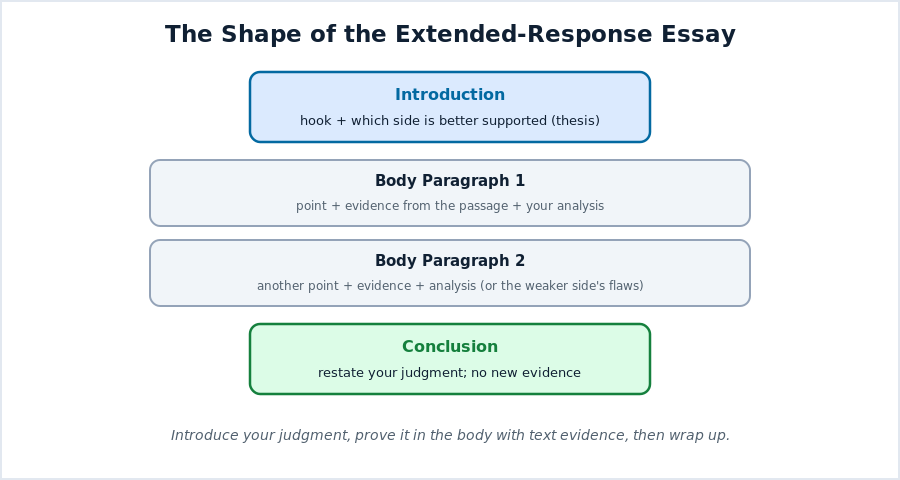
Scorers rate your essay on three traits. The first is analysis of the arguments and use of evidence — did you judge which side is better supported and back it with details from the passages? The second is organization and development — is there a clear thesis, are ideas grouped into paragraphs, and do they build logically? The third is clarity and conventions — are your sentences readable and mostly correct in grammar, spelling, and punctuation? You do not need perfect writing. You need a clear judgment, real evidence from the texts, sensible order, and sentences a reader can follow. Keeping these three traits in mind as you plan tells you exactly where your effort should go.
Watch: A Short Video Lesson
Miami Dade College gives a clear overview to go with this lesson:
A Routine for Reading the Prompt
- Read the prompt before the passages so you know your goal.
- Remind yourself: judge which side is better supported, not which you prefer.
- Keep the three traits in mind — analysis, organization, conventions.
- Plan to use only evidence found in the two passages.
Practice
- What does the extended response ask you to decide?
- Is the essay an opinion piece? Why or why not?
- How many passages do you read, and how are they related?
- Name the three traits your essay is scored on.
- Do you need outside facts to write the essay?
- Which two words from the prompt should stay in your mind?
Answers
- Which passage is better supported by evidence.
- No — it asks you to analyze the arguments, not share your view.
- Two passages that argue opposite sides of one issue.
- Analysis of arguments, organization and development, clarity and conventions.
- No. Build the response from the supplied passages; outside facts are unnecessary and cannot replace textual support.
- “Better supported.”
Where This Fits in Your RLA Prep
Once you understand the task, learn to compare the two sides in evaluating the passages before you choose and to state your judgment in writing a focused thesis. See every topic on the Language Arts Prep Hub.
Recommended Prep Books
Keep building momentum with a full study guide and practice tests:

Related to This Article
More math articles
- Top 10 Tips to Create an ASTB Math Study Plan
- The Best Grade 3 ELA Practice Tests for Utah Students
- What Kind of Math Courses Are Required for Business Degree?
- 6th Grade NSCAS Math Worksheets: FREE & Printable
- Nativism and the Know-Nothing Movement: Religion, Voting and Power
- The Best Calculator for FE Exam
- The Cell: Life’s Basic Unit
- Congressional Representation: Delegate, Trustee or Politico?
- How to Find Discount, Tax, and Tip? (+FREE Worksheet!)
- 10 Most Common 4th Grade MAP Math Questions




















What people say about "Understanding the Prompt and Rubric"?
No one replied yet.