How to Multiply Two Binomials Using Algebra Tiles

To multiply two binomials using algebra tiles, build an area model: put one binomial along the top edge and the other down the left edge, fill the rectangle with the tile each row and column make, and then remove zero pairs. The tiles left are the product. For example, \((2x + 2)(x – 3) = 2x^2 – 4x – 6\).
Build the rectangle as you read: Try it with our free Algebra Tiles tool. Its multiply mode fills the area model and cancels the zero pairs for you.
The tiles you need
- x²-tile: a large square worth \(x^2\). It is what you get when an x-tile meets an x-tile.
- x-tile: a rectangle worth \(x\), from an x-tile meeting a unit tile.
- Unit tile: a small square worth \(1\), from a unit tile meeting a unit tile.
Positive tiles are plain (white, yellow, green or blue) and shaded (or red) tiles are negative. Every tile inside the rectangle follows the sign rule for multiplication:
- positive × positive = positive tile
- positive × negative = negative (shaded) tile
- negative × negative = positive tile
Step by step: multiply (2x + 2)(x − 3) with algebra tiles
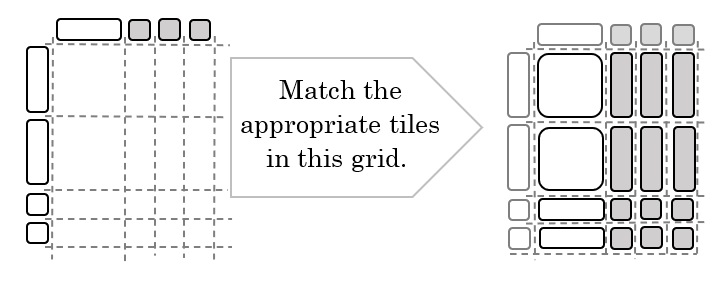
We will multiply \(2x + 2\) by \(x – 3\). The top edge of the frame shows \(x – 3\): 1 x-tile followed by 3 shaded unit tiles. The left edge shows \(2x + 2\): 2 x-tiles and 2 unit tiles.
- Build the frame. Lay \(x – 3\) across the top and \(2x + 2\) down the left side, like the labels on a multiplication table.
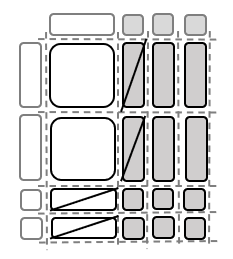
- Fill the x-rows. Each of the 2 x-tiles on the left meets the x-tile on top and makes an x²-tile (2 x²-tiles). Each also meets the 3 shaded units and makes 3 shaded x-tiles, so 6 shaded x-tiles in all.
- Fill the unit rows. Each of the 2 unit tiles on the left meets the top x-tile and makes a positive x-tile (2 positive x-tiles). Each also meets the 3 shaded units and makes 3 shaded unit tiles, so 6 shaded units in all.

- Remove zero pairs. The rectangle holds 2 positive x-tiles and 6 shaded x-tiles. Cross out 2 zero pairs, leaving 4 shaded x-tiles.
- Read the product. 2 x²-tiles, 4 shaded x-tiles and 6 shaded unit tiles: \(2x^2 – 4x – 6\).
- Check. Distribute: \(2x \cdot x = 2x^2\), \(2x \cdot (-3) = -6x\), \(2 \cdot x = 2x\) and \(2 \cdot (-3) = -6\). Then \(-6x + 2x = -4x\). You can also test a number: with \(x = 5\), \((12)(2) = 24\) and \(2(25) – 20 – 6 = 24\).
- Try it. Open the free Algebra Tiles tool, choose multiply, enter \(2x + 2\) and \(x – 3\), and compare its rectangle with the pictures above.
More worked examples
Example 1: all positive, (x + 2)(x + 3)
Top edge: 1 x-tile and 3 units. Left edge: 1 x-tile and 2 units. The rectangle holds 1 x²-tile, 3 x-tiles from the x-row, 2 x-tiles from the unit rows and \(2 \times 3 = 6\) unit tiles. There are no negative tiles and no zero pairs: \((x + 2)(x + 3) = x^2 + 5x + 6\).
Example 2: negative × negative, (x − 1)(x − 4)
Top edge: 1 x-tile and 4 shaded units. Left edge: 1 x-tile and 1 shaded unit.
- x times x: 1 x²-tile.
- x times the 4 shaded units: 4 shaded x-tiles.
- The shaded unit times x: 1 shaded x-tile.
- The shaded unit times the 4 shaded units: 4 positive unit tiles, because negative × negative is positive.
Result: \(x^2 – 5x + 4\). This is the case students most often get wrong, so look closely at the corner of the rectangle where the two shaded edges meet.
Example 3: mixed signs, (x + 4)(x − 2)
The rectangle holds 1 x²-tile, 2 shaded x-tiles (x times −2), 4 positive x-tiles (4 times x) and 8 shaded units (4 times −2). Two zero pairs of x-tiles cancel, leaving 2 positive x-tiles: \(x^2 + 2x – 8\).

Common mistakes when multiplying binomials with tiles
- Wrong sign in the corner. Where a shaded unit meets a shaded unit the tile is positive. In \((x – 1)(x – 4)\) the units are \(+4\), not \(-4\).
- Adding the edges instead of filling the rectangle. The product is the area inside the frame, not the tiles on the edges. \((x + 2)(x + 3)\) is not \(2x + 5\).
- Forgetting zero pairs. In \((2x + 2)(x – 3)\), stopping at 2 positive and 6 shaded x-tiles hides the answer. Cancel the pairs to get \(-4x\).
- Dropping the middle tiles. \((x + 2)(x + 3)\) is not \(x^2 + 6\). The two strips of x-tiles are part of the area.
- Uneven frame. Line up the edge tiles carefully. If an x-tile on the top is not directly above a column of the rectangle, the count of tiles inside will be off.
Practice exercises with answers
Build each product as a rectangle, fill it, cancel the zero pairs, and read the result.
- \((2x – 1)(2x + 3)\)
- \((x + 2)(3x + 3)\)
- \((x + 1)(x + 5)\)
- \((x – 2)(x + 3)\)
- \((x – 3)(x – 3)\)
- \((2x + 1)(x – 2)\)
Answers:
- \(4x^2 + 4x – 3\): 4 x²-tiles, 6 positive and 2 shaded x-tiles (4 left), 3 shaded units.
- \(3x^2 + 9x + 6\): 3 x²-tiles, 3 + 6 = 9 x-tiles, 6 units.
- \(x^2 + 6x + 5\)
- \(x^2 + x – 6\): 3 positive and 2 shaded x-tiles leave 1.
- \(x^2 – 6x + 9\): the 9 units are positive (negative × negative).
- \(2x^2 – 3x – 2\): 4 shaded and 1 positive x-tile leave 3 shaded.
Multiplying binomials with algebra tiles practice quiz: 10 questions
Test yourself with 10 multiple-choice questions. Choose an answer and press Submit to see if you are right and why. Your score appears at the end.
Shaded tiles are negative, so the top edge is x − 3. The left edge is 2x + 2, so the frame models (2x + 2)(x − 3).
The rectangle has 2 x²-tiles, 6 shaded and 2 positive x-tiles, and 6 shaded units. Two zero pairs cancel, leaving 2x² − 4x − 6.
Unit times unit gives a unit tile, and negative times negative is positive, so the tile is a positive unit.
x times x gives 1 x²-tile; the two strips give 4 + 1 = 5 shaded x-tiles; the corner where shaded meets shaded gives 4 positive units.
You get 4 x²-tiles, 6 positive x-tiles and 2 shaded x-tiles (4 left after zero pairs), and 3 shaded units.
x times 3x gives 3 x²-tiles. The strips give 3 + 6 = 9 x-tiles, and 2 times 3 gives 6 unit tiles. All tiles are positive.
The rectangle has 6 shaded x-tiles and 2 positive x-tiles. Two zero pairs cancel, so 6 − 2 = 4 shaded x-tiles remain.
The tiles total x² + 2x − 8. The 4 positive x-tiles come from x times 4 and the 2 shaded ones from x times −2, so the edges are x + 4 and x − 2.
Each strip holds 3 shaded x-tiles (6 in all), and the corner where shaded meets shaded holds 9 positive units.
You get 2 x²-tiles, 4 shaded x-tiles and 1 positive x-tile (3 shaded left), and 2 shaded units.
Quiz complete
Frequently asked questions
How do you multiply binomials using algebra tiles?
Place one binomial along the top of a frame and the other down the side. Fill the rectangle: x meets x gives an x²-tile, x meets a unit gives an x-tile, and a unit meets a unit gives a unit tile, with signs following the multiplication rule. Remove zero pairs and read the tiles that are left.
What does a negative tile times a negative tile give?
A positive tile. In the area model, the region where a shaded edge tile meets another shaded edge tile is filled with positive tiles. That is why \((x - 1)(x - 4)\) ends in \(+4\).
Why do zero pairs show up when you multiply?
When the binomials have opposite signs on their unit terms, one strip of the rectangle has positive x-tiles and the other has shaded x-tiles. They cancel in pairs. In \((2x + 2)(x - 3)\), 2 positive x-tiles cancel 2 of the 6 shaded ones, leaving \(-4x\).
How are algebra tiles related to FOIL and the distributive property?
Each region of the rectangle is one product from the distributive property. For two binomials the four regions match FOIL: first terms (the x²-tiles), outer and inner terms (the two strips of x-tiles) and last terms (the unit tiles). The tiles just make those four products visible.
Can algebra tiles show a binomial squared?
Yes. Use the same binomial on both edges and the frame becomes a square. For \((x - 3)^2\) you get 1 x²-tile, 6 shaded x-tiles and 9 positive units, so \(x^2 - 6x + 9\).
Related algebra tiles lessons
- Free Algebra Tiles virtual manipulative
- How to Factor Quadratics Using Algebra Tiles (the same rectangle, worked backward)
- Adding and Subtracting Polynomials Using Algebra Tiles
- Use Algebra Tiles to Identify Equivalent Expressions
- Using Algebra Tiles to Solve One-Step and Two-Step Equations
- How to Solve Equations with Variables on Both Sides Using Algebra Tiles
- Multiplying binomials
- Multiplying polynomials using area models

Related to This Article
More math articles
- GCF Calculator: Greatest Common Factor of Two or More Numbers (with Steps)
- 7th Grade NYSE Math Practice Test Questions
- Hawaii SBAC Grade 4 Math Free Worksheets: Printable Practice Worksheets with Worked Solutions
- Fluid Mosaic Model: Membrane Structure and Fluidity
- Algebra 1 Semester 1 Final Exam Review: 26 Problems with Answers
- Using Distributive Property to Factor Numerical Expressions
- The Best Grade 3 ELA Practice Tests for Washington Students
- RREF Calculator
- How to Identify Relations and Functions? (+FREE Worksheet!)
- Tips and Tricks for Learning College Math




What people say about "Multiply Binomials Using Algebra Tiles (Area Model)"?
No one replied yet.