


Area and Perimeter
In this article, we are going to learn more about how to calculate the perimeter and area of quadrilaterals such as squares and rectangles.
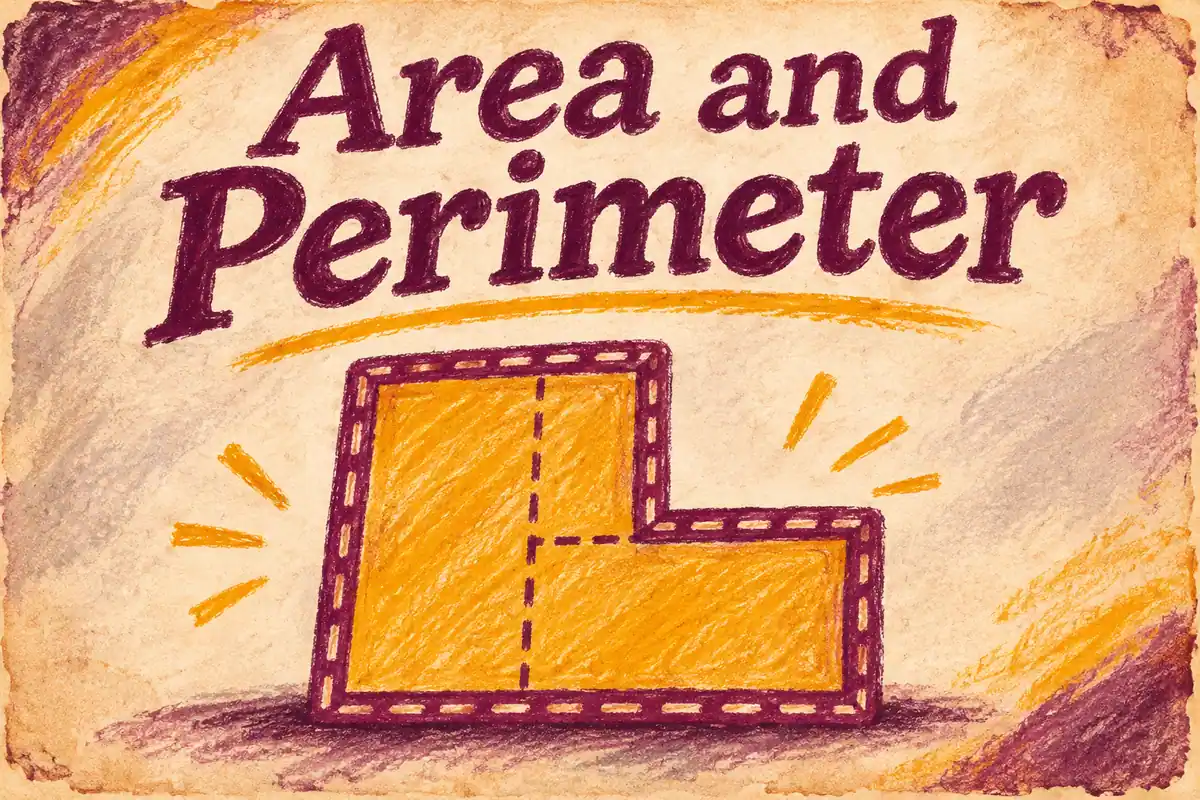
Area of Composite Shapes: what to notice and how to work it
What to notice first
Common student mistake
Key formulas and cues
A reliable path
- Label the diagramWrite each given measurement on the figure.
- Choose the formulaMatch the formula to distance, midpoint, area, volume, or angle relationships.
- Check unitsUse linear, square, or cubic units as appropriate.
Worked examples
Rectangle area
- Area of a rectangle is length times width.
- Substitute 8 and 3.
- Use square units.
Midpoint
- Average the x-values.
- Average the y-values.
- Write the ordered pair.
Try one before moving on
Area of Composite Shapes: pop-up practice
Perimeters:
The boundary length of a closed figure is known as the perimeter of the plane figure. The perimeter units are the same as the length, such as meters, centimeters, millimeters, and more.
Type the problems from this lesson and check each step.
Area:
Part of the plane enclosed via a simple closed figure is known as the plane region as well as the measurement of the plane region enclosed is known as the area.
The area gets measured via square units.
Related Topics
- Perimeters and Areas of rectangles
- Perimeters and Areas of Squares
- Perimeter: Locate the Absent Side Lengths
- How to Find the Perimeter of Polygons?
Rectangles:
Rectangles are parallelograms having (4) right angles. All rectangles are as well parallelograms, however, all parallelograms are not rectangles.
The perimeter (P) of a rectangle is provided by the formula, (P=2l+2w) where (l) is the length and (w) is the rectangle’s width.
The area (A) of a rectangle is provided via the formula, (A=lw), where (l) is the length and (w) is the width.
Squares:
Squares are quadrilaterals where every side has the same length along all four corners are right angles.
The perimeter of a square is the total length of all the sides. Thus, a square’s perimeter can be determined by adding (4) sides.
The perimeter of a particular square is (a + a + a + a). Because all sides of a square are identical, you merely require a single side to determine the perimeter.
The perimeter of the particular square is:
(a + a + a + a = 4a) units.
Thus, the formula for finding the perimeter of a square (= 4 ×) (length of any (1) side).
The square’s area is the product of the length of each of the sides with itself. So, (Area = a×a) where (a) is the length of each of the square’s sides.
Often, you’ll many times find word problems where (2) of the values in (1) of these formulas are provided, and you’re expected to locate the (3)rd.
Area and Perimeter – Example 1:
Calculate the area of a rectangle (10) cm long and (5) cm wide.
Solution:
The area of a rectangle is provided via the formula, (A=Length × width). Then the area of a rectangle: ( 10 × 5=50)
Area and Perimeter – Example 2:
Sarah plans to decorate a tablecloth with a ribbon. If this tablecloth is square and each side of the square is (3) meters. How much ribbon does she need to use to decorate this tablecloth?
Solution:
You know that the area of a square is equal to: (a+a+a+a=4a). Then So the amount of ribbon Sarah needs is equal to: ( 4 × 3=12) meters
Exercises for Area and Perimeter
Try these 10 questions one at a time. After each answer you will see a step-by-step explanation, so you can learn from every question, right or wrong.
Question 1 of 10
1. A rectangle is 8 cm long and 3 cm wide. What is its perimeter?
- 11 cm
- 22 cm
- 24 cm
- 24 cm²
Show the answer and explanation
Answer: B. 22 cm
Perimeter is the distance all the way around the shape. A rectangle has two lengths and two widths.
P = 8 + 3 + 8 + 3 = 22 cm. You can also write P = 2 × (8 + 3) = 22.
24 is the area (8 × 3), which measures the space inside, not the distance around.
2. A rectangle is 8 cm long and 3 cm wide. What is its area in square centimeters?
Type your answer.
Show the answer and explanation
Answer: 24 cm²
Area is the number of unit squares that fit inside the shape.
For a rectangle, area = length × width = 8 × 3 = 24.
Area is measured in square units, so the answer is 24 square centimeters.
3. A square has sides of 6 inches. What is its area?
- 24 in²
- 36 in²
- 12 in²
- 36 in
Show the answer and explanation
Answer: B. 36 in²
All four sides of a square are equal, so area = side × side.
6 × 6 = 36 square inches.
24 would be the perimeter (4 × 6), and area always uses square units.
4. A square has a perimeter of 20 meters. How long is each side, in meters?
Type your answer.
Show the answer and explanation
Answer: 5 m
A square has 4 equal sides, and the perimeter is the sum of all four.
Each side = 20 ÷ 4 = 5 meters.
Check: 5 + 5 + 5 + 5 = 20.
5. Which rectangle has the larger area?
- 4 m by 9 m
- 6 m by 6 m
- They have the same area
- 5 m by 7 m
Show the answer and explanation
Answer: C. They have the same area
Find each area: 4 × 9 = 36 and 6 × 6 = 36. 5 × 7 = 35 is a little less.
So 4 by 9 and 6 by 6 both have an area of 36 square meters.
Different shapes can have the same area, even though their perimeters differ (26 m and 24 m here).
6. A rectangle has an area of 42 ft² and a length of 7 ft. What is its width in feet?
Type your answer.
Show the answer and explanation
Answer: 6 ft
Area = length × width, so 42 = 7 × width.
Divide to find the missing side: 42 ÷ 7 = 6.
The width is 6 feet. Check: 7 × 6 = 42.
7. A garden is 10 m long and 4 m wide. How much fencing is needed to go around it?
- 14 m
- 28 m
- 40 m
- 40 m²
Show the answer and explanation
Answer: B. 28 m
Fencing goes around the edge, so we need the perimeter.
P = 2 × (10 + 4) = 2 × 14 = 28 meters.
40 is the area, which would tell you how much grass covers the garden, not how much fence surrounds it.
8. A triangle has sides of 5 cm, 7 cm and 9 cm. What is its perimeter in centimeters?
Type your answer.
Show the answer and explanation
Answer: 21 cm
Perimeter of any shape is the sum of its side lengths.
5 + 7 + 9 = 21.
The perimeter is 21 cm.
9. A floor is 12 ft by 10 ft. Tiles are 1 ft by 1 ft. How many tiles cover the floor?
- 22
- 44
- 120
- 100
Show the answer and explanation
Answer: C. 120
Each tile covers 1 square foot, so the number of tiles equals the area.
Area = 12 × 10 = 120 square feet.
So 120 tiles are needed. 44 is the perimeter, which only counts the edge.
10. A rectangle has a perimeter of 30 cm and a length of 9 cm. What is its width in centimeters?
Type your answer.
Show the answer and explanation
Answer: 6 cm
Perimeter = 2 × (length + width), so 30 = 2 × (9 + width).
Divide by 2: 15 = 9 + width. Subtract 9: width = 6.
Check: 9 + 6 + 9 + 6 = 30.
Answers
- (color{blue}{6})
- (color{blue}{64})
- (color{blue}{20})
- (color{blue}{40})

Related to This Article
More math articles
- Number Properties Puzzle – Challenge 1
- Solve Equations
- Geometry Puzzle – Challenge 65
- How to Master Polar Coordinates: A Comprehensive Guide to Calculating Rate of Change in Polar Functions
- How to Transform Linear Functions: Rules and Examples
- What Is on the Florida Algebra 1 EOC? Topics, Timing, Score, and Study Plan
- Everything You Need to Know About Sketching Curves Using Derivatives
- Federalism, Separation of Powers and Republican Government Explained
- Lincoln-Douglas Debates, Election of 1860 and Secession Explained
- The Ultimate Adults Algebra Refresher Course (+FREE Worksheets & Tests)
What people say about "Area and Perimeter"?
No one replied yet.