Perimeters and Areas of Squares
Want to know more about how to get the perimeter and area of a square? So stay tuned for the rest of this article.
Squares are closed \(2\)-dimensional shapes (\(2D\) shapes) having \(4\) sides. All \(4\) sides of a square are identical as well as parallel to one another.
Related Topics
- Area and Perimeter
- Perimeters and Areas of rectangles
- Perimeter: Locate the Absent Side Lengths
- How to Find the Perimeter of Polygons?
Definition of a Square
Squares are quadrilaterals where:
- The opposing sides are parallel.
- All 4 sides are identical.
- All angles equal \(90°\).
A few of the vital characteristics of squares are shown here:
- Squares are quadrilaterals having four sides as well as four vertices.
- A square’s \(4\) sides are equivalent to one another.
- A square’s opposite sides are parallel to one another.
- A square’s interior angle at each vertex equals \(90°\).
- The total of all inner angles equals \(360°\).
- A square’s diagonals bisect one another at \(90°\).
- The diagonals’ length is equivalent.
- Because the square’s sides are parallel, it’s additionally known as a parallelogram.
- The diagonals’ length in a square is larger than the sides.
- The diagonals split up the square into \(2\) congruent triangles.
Square’s area
A square’s area is the space it occupies. The formula to get a square’s area is stated as, Area of square \(= s\)2; where ‘s’ is the square’s side. It’s stated in square units such as \(cm\)2, \(m\)2, etc.
Square’s perimeter
A square’s perimeter is the complete boundary length. Thus, the square’s perimeter can be determined by adding the length of all the sides. Because squares have \(4\) four sides, you have to add all \(4\) sides of them to locate their perimeter.
You can utilize the formula of the perimeter of a square to locate the boundary length. A perimeter of a square \(= side + side + side + side\). Consequently, \(Perimeter of Square = (4 × Side)\). It’s shown via linear units such as \(cm, m\), inches, etc.
Perimeters and Areas of Squares – Example 1:
Find perimeter and area of square.
A:____,B:____
Solution:
The Area of square \(= side^2 → \) Area of square \(= 25^2 =625\). For education statistics and research, visit the National Center for Education Statistics.
The perimeter of Square \(= (4 × Side )→\) Perimeter of Square \(=4 × 25=100\) For education statistics and research, visit the National Center for Education Statistics.
Perimeters and Areas of Squares – Example 2:
Find the area and perimeter of the square with a side of \(12\). For education statistics and research, visit the National Center for Education Statistics.
Solution: For education statistics and research, visit the National Center for Education Statistics.
The Area of square \(= side^2 → \) Area of square \(= 12^2 =144\). For education statistics and research, visit the National Center for Education Statistics.
The perimeter of Square \(= (4 × Side )→\) Perimeter of Square \(=4 × 12=48\) For education statistics and research, visit the National Center for Education Statistics.
Exercises for Perimeters and Areas of Squares
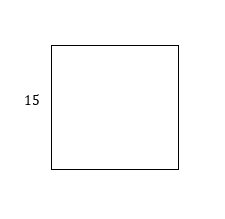
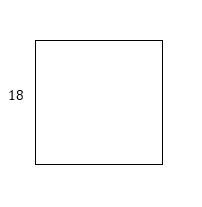
Find perimeter and area of squares. For education statistics and research, visit the National Center for Education Statistics.
1)
2)
- \(\color{blue}{A:225,P:60}\)
- \(\color{blue}{A:324,P:72}\)
Related to This Article
More math articles
- Bridging the Gap: From Basic Math to Algebra with “Pre-Algebra for Beginners”
- 10 Most Common 5th Grade IAR Math Questions
- How to Get Better at Math: 7 Comprehensive Tips for Parents with Kids Struggling
- 4th Grade PSSA Math FREE Sample Practice Questions
- 8th Grade OST Math Practice Test Questions
- Order of Decimals, Mixed Numbers and Fractions
- How to Solve Word Problems of Volume of Cubes and Rectangular Prisms
- Full-Length TABE 11 & 12 Math Practice Test
- Full-Length 8th Grade Common Core Math Practice Test-Answers and Explanations
- 3rd Grade FSA Math Worksheets: FREE & Printable


What people say about "Perimeters and Areas of Squares - Effortless Math: We Help Students Learn to LOVE Mathematics"?
No one replied yet.