Geometry Puzzle – Challenge 62
In a triangle whose three angles are in the ratio 1:2:3, what is the smallest angle? The angles must sum to 180 degrees, so if the angles are X, 2X, and 3X, then X + 2X + 3X = 6X = 180, giving X = 30 degrees. The triangle is the classic 30-60-90 right triangle.
Key takeaways:
- The interior angles of any triangle sum to 180 degrees.
- When angles are in the ratio 1:2:3, the angle pieces are X, 2X, 3X.
- Summing: X + 2X + 3X = 6X = 180, so X = 30. The angles are 30, 60, and 90 degrees.
- This is the famous 30-60-90 right triangle, the side ratios are 1: sqrt(3): 2.
- Don’t confuse the angle ratio (1:2:3, possible) with the side ratio (1:2:3, impossible by triangle inequality).
This is a great mathematics puzzle to measure your basic math knowledge. Let’s challenge your brain!
Challenge:
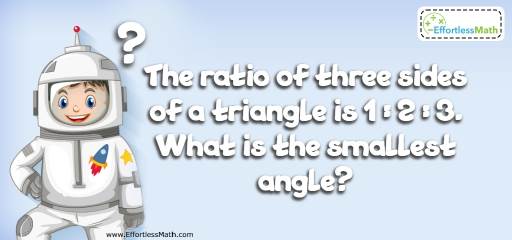
The ratio of three sides of a triangle is 1:2:3. What is the smallest angle?
The Absolute Best Book to Challenge Your Smart Student!

The correct answer is 30 degree.
Original price was: $27.99.$17.99Current price is: $17.99.
There is the same ratio for the angels. Therefore, the ratio of three angles of the triangle is also 1:2:3.
Let X be the smallest angle. Then, the next two angels are 2X and 3X.
X + 2X + 3X = 180 → 6X = 180 → X = 30
The smallest angel is 30 degree.The Best Books to Ace Algebra
Frequently Asked Questions
How do I set up an angle-ratio problem?
Let the smallest angle be \( X \). Multiply by each part of the ratio to express the other angles. For ratio 1:2:3, the three angles are \( X, 2X, 3X \). Then use the triangle angle-sum rule (180 degrees) to solve.
Why is the smallest angle 30 degrees, exactly?
Because \( X + 2X + 3X = 6X = 180 \) forces \( X = 30 \). Always set up the angle-sum equation and solve, never just guess the smallest angle.
What kind of triangle has angles 30, 60, 90?
A 30-60-90 right triangle. It is one of the two special right triangles in trigonometry (the other being 45-45-90). Its side ratios are exactly \( 1 : \sqrt{3} : 2 \), shortest to longest.
If the sides were in ratio 1:2:3, would the triangle exist?
No. The triangle inequality requires each side to be less than the sum of the other two. With sides 1, 2, 3: the longest (3) equals the sum of the other two (1 + 2 = 3), so the \”triangle\” degenerates to a line segment. A real triangle needs a strict inequality.
Is the angle 1:2:3 ratio always 30-60-90?
Yes. Whenever the angles are in the exact ratio 1:2:3, the smallest is 30, the middle is 60, and the largest is 90, the same triangle, just possibly scaled to different overall sizes (which only changes side lengths, not angles).
What are the side ratios of a 30-60-90 triangle?
Shortest leg: longer leg: hypotenuse = \( 1 : \sqrt{3} : 2 \). The shortest leg is opposite the 30-degree angle, the longer leg is opposite the 60-degree angle, and the hypotenuse is opposite the 90-degree angle.
How would I solve a sides-in-ratio problem instead?
You need the Law of Cosines or trigonometric ratios since the angle-sum rule does not apply directly. For a 5-12-13 triangle, you can verify the right angle directly, then use sin and cos to find the other two angles.
What grade do students learn about the angle sum of a triangle?
Most state standards introduce it explicitly in Grade 8 (Common Core 8.G.5), with informal exposure in earlier grades. The formal proof shows up in high school Geometry.
Where do 30-60-90 triangles show up in real life?
Carpentry (cutting common roof rafters), architecture, drafting, engineering tolerances, and trigonometry. The clean side ratios make calculations exact, not just approximate.
How can I practice angle-ratio problems?
Try ratios like 2:3:4 (giving 40, 60, 80 degrees), 1:1:2 (45, 45, 90, isoceles right triangle), or 1:4:7 (15, 60, 105). The same setup works every time: assign letters, add them, set equal to 180, solve.
Related Lessons You May Like
- How to classify triangles
- How to find the area of triangles
- How to use the Pythagorean Theorem
- How to find complementary, supplementary, vertical, adjacent angles
- How to find similar figures
If your student enjoys puzzles like this, Pre-Algebra for Beginners covers the algebraic reasoning they tap. For deeper geometry exploration, Geometry for Beginners takes you further.

Related to This Article
More math articles
- 8th Grade NYSE Math Worksheets: FREE & Printable
- The Best Grade 5 Math Book for Nebraska Students
- Full-Length TSI Math Practice Test
- Congruent Figures: Complete Guide with Video and Examples
- Signals and screens build trust differently
- 7th Grade PARCC Math FREE Sample Practice Questions
- Supremacy Clause
- Full-Length ATI TEAS 7 Math Practice Test
- Average Value of a Curve
- FREE 6th Grade FSA Math Practice Test






What people say about "Geometry Puzzle: Challenge 62"?
No one replied yet.