YOUR HiSET STUDY COMPANION
The Ultimate HiSET Math Formula Cheat Sheet
TL;DR: Walking into HiSET Math with the on-screen reference page is one thing, but actually knowing the formulas cold is faster every time. This page lists every formula you should have memorized for the test, organized by content area. The 90-minute,…
TL;DR: Walking into HiSET Math with the on-screen reference page is one thing, but actually knowing the formulas cold is faster every time. This page lists every formula you should have memorized for the test, organized by content area. The 90-minute, 50-question section punishes lookup errors and slow recall, so getting these into long-term memory before test day pays for itself almost immediately.
Key takeaways:
- HiSET Math is 50 questions in 90 minutes.
- An on-screen formula reference page is provided, but lookups eat into your time.
- Calculator: on-screen TI-30XS on computer-based HiSET; bring your own scientific on paper-based.
- Memorize area, volume, slope, percent change, the Pythagorean theorem, and basic statistics.
- The quadratic formula and trig identities are NOT on the reference page, memorize them.
Decimals
Is a fraction written in a special form? For example, instead of writing \(\frac{1}{2}\) you can write \(0.5\).
Mixed Numbers
A number is composed of a whole number and a fraction. Example: \(2 \frac{2}{ 3}\) Converting between improper fractions and mixed numbers: \(a \frac{c}{b}=a+\frac{c}{b}= \frac{ab+ c}{b}\)
Factoring Numbers
Factor a number means breaking it up into numbers that can be multiplied together to get the original number. Example:\(12=2×2×3\)
Integers
\( \{…,-3,-2,-1,0,1,2,3,…\} \)
Includes: zero, counting numbers, and the negative of the counting numbers
Real Numbers
All numbers that are on a number line. Integers plus fractions, decimals, and irrationals, etc.) (\(\sqrt{2},\sqrt{3},π\), etc.)
Order of Operations
PEMDAS
(parentheses/ exponents/ multiply/ divide/ add/ subtract)
Absolute Value
Refers to the distance of a number from, the distances are positive as the absolute value of a number cannot be negative. \(|-22|=22\)
or \(|x| =\begin{cases}x \ for \ x≥0 \\x \ for \ x < 0\end{cases} \)
\(|x|<n⇒-n<x<n\)
\(|x|>n⇒x<-n or x>n\)
Ratios
A ratio is a comparison of two numbers by division.
Example: \(3: 5\), or \(\frac{3}{5}\)
Percentages
Use the following formula to find part, whole, or percent
part \(=\frac{percent}{100}×whole\)
Proportional Ratios
A proportion means that two ratios are equal. It can be written in two ways:
\(\frac{a}{b}=\frac{c}{d}\), \(a: b = c: d \)
Percent of Change
\(\frac{New \ Value \ – \ Old \ Value}{Old Value}×100\%\)
Expressions and Variables
A variable is a letter that represents unspecified numbers. One may use a variable in the same manner as all other numbers: Addition: \(2+a\): \(2\) plus a
Subtraction: \(y-3\): \(y\) minus \(3\)
Division: \(\frac{4}{x}\): 4 divided by x
Multiplication: \(5a\): \(5\) times a
Distributive Property
\(a(b+c)=ab+ac\)
Equations
The values of the two mathematical expressions are equal.
\(ax+b=c\)
Distance from A to B:
\(\sqrt{(x_{1}-x_{2})^2+(y_{1}-y_{2})^2 }\)
Parallel and Perpendicular lines:
Have equal slopes. Perpendicular lines (i.e., those that make a \(90^° \) angle where they intersect) have negative reciprocal slopes: \(m_{1}\).\(m_{2}=-1\).
Parallel Lines (l \(\parallel\) m)
Mid-point of the segment AB:
M (\(\frac{x_{1}+x_{2}}{2}, \frac{y_{1}+y_{2}}{2}\))
Slope of the line:
\(\frac{y_{2}- y_{1}}{x_{2} – x_{1} }=\frac{rise}{run}\)
Point-slope form:
Given the slope m and a point \((x_{1},y_{1})\) on the line, the equation of the line is
\((y-y_{1})=m \ (x-x_{1})\).
Slope-intercept form:
given the slope m and the y-intercept b, then the equation of the line is:
\(y=mx+b\).
Factoring:
“FOIL”
\((x+a)(x+b)\)
\(=x^2+(b+a)x +ab\) “Difference of Squares”
\(a^2-b^2= (a+b)(a-b)\)
\(a^2+2ab+b^2=(a+b)(a+b) \)
\(a^2-2ab+b^2=(a-b)(a-b)\) “Reverse FOIL”
\(x^2+(b+a)x+ab=\) \((x+a)(x+b)\)
You can use Reverse FOIL to factor a polynomial by thinking about two numbers a and b which add to the number in front of the x, and which multiply to give the constant. For example, to factor \(x^2+5x+6\), the numbers add to 5 and multiply to 6, i.e.: \(a=2\) and \(b=3\), so that \(x^2+5x+6=(x+2)(x+3)\). To solve a quadratic such as \(x^2+bx+c=0\), first factor the left side to get \((x+a)(x+b)=0\), then set each part in parentheses equal to zero. For example, \(x^2+4x+3= (x+3)(x+1)=0\) so that \(x=-3\) or \(x=-1\).
To solve two linear equations in x and y: use the first equation to substitute for a variable in the second. E.g., suppose \(x+y=3\) and \(4x-y=2\). The first equation gives y=3-x, so the second equation becomes \(4x-(3-x)=2 ⇒ 5x-3=2\) \(⇒ x=1,y=2\).
Exponents:
Refers to the number of times a number is multiplied by itself.
\(8 = 2 × 2 × 2 = 2^3\)
Scientific Notation:
It is a way of expressing numbers that are too big or too small to be conveniently written in decimal form.
In scientific notation all numbers are written in this form: \(m \times 10^n\)
Decimal notation:
5
\(-25,000\)
0.5
2,122.456
Scientific notation:
\(5×10^0\)
\(-2.5×10^4\)
\(5×10^{-1}\)
\(2,122456×10^3\)
Square:
The number we get after multiplying an integer (not a fraction) by itself. Example: \(2×2=4,2^2=4\)
Square Roots:
A square root of \(x\) is a number r whose square is \(x: r^2=x\)
\(r\) is a square root of \(x\)
Pythagorean Theorem:
For any right triangle with legs \(a\) and \(b\) and hypotenuse \(c\): \(a^2+b^2=c^2\)
Solving for the hypotenuse: \(c=\sqrt{a^2+b^2}\)
Solving for a leg: \(a=\sqrt{c^2-b^2}\)
Common Pythagorean triples: \(3,4,5\); \(5,12,13\); \(8,15,17\); \(7,24,25\)
Triangles
Area: \(A=\frac{1}{2}bh\) where \(b\) is the base and \(h\) is the height.
Perimeter: \(P=a+b+c\) (sum of all three sides).
Pythagorean Theorem (right triangles): \(a^2+b^2=c^2\) where \(c\) is the hypotenuse.
Sum of interior angles: \(180°\)
All triangles:
Area \(=\frac{1}{2}\) b. H
Angles on the inside of any triangle add up to \(180^\circ\).
The length of one side of any triangle is always less than the sum and more than the difference between the lengths of the other two sides.
An exterior angle of any triangle is equal to the sum of the two remote interior angles. Other important triangles:
Equilateral:
These triangles have three equal sides, and all three angles are \(60^\circ\).
Isosceles:
An isosceles triangle has two equal sides. The “base” angles (the ones opposite the two sides) are equal (see the \(45^\circ\) triangle above).
Circles

Area \(=πr^2\)
Circumference \(=2πr\)
Full circle \(=360^\circ\)
Rectangles
(Square if l=w)
Area=lw
Parallelogram
(Rhombus if l=w)
Area=lh
Regular polygons are n-sided figures with all sides equal and all angles equal.
The sum of the inside angles of an n-sided regular polygon is
\((n-2).180^\circ\).
Area of a trapezoid:
\(A =\frac{1}{2} h (b_{1}+b_{2})\)

Surface Area and Volume of a Rectangular/right prism:
\(SA=ph+2B\)
\(V=Bh\)
Surface Area and Volume of a Cylinder:
\(SA =2πrh+2πr^2\)
\(V =πr^2 h \)
Surface Area and Volume of a Cone
\(SA =πrs+πr^2\)
\(V=\frac{1}{3} \ πr^2 \ h\)
Surface Area and Volume of a Sphere
\(SA =4πr^2\)
\(V =\frac{4}{3} \ πr^3\)
(p \(=\) perimeter of base B; \(π ~ 3.14 \))

Simple interest:
\(I=prt\)
(I = interest, p = principal, r = rate, t = time)
mean:
mean: \(\frac{sum \ of \ the \ data}{of \ data \ entires}\)
mode:
value in the list that appears most often
range:
largest value \(-\) smallest value
Median
The middle value in the list (which must be sorted)
Example: median of
\( \{3,10,9,27,50\} = 10\)
Example: median of
\( \{3,9,10,27\}=\frac{(9+10)}{2}=9.5 \)
Average
\( \frac{sum \ of \ terms}{number \ of \ terms}\)
Average speed
\(\frac{total \ distance}{total \ time}\)
Probability
\(\frac{number \ of \ desired \ outcomes}{number \ of \ total \ outcomes}\)
The probability of two different events A and B both happening is:
P(A and B)=p(A).p(B)
as long as the events are independent (not mutually exclusive).
Powers, Exponents, Roots
\(x^a.x^b=x^{a+b}\)
\(\frac{x^a}{x^b} = x^{a-b}\)
\(\frac{1}{x^b }= x^{-b}\)
\((x^a)^b=x^{a.b}\)
\((xy)^a= x^a.y^a\)
\(x^0=1\)
\(\sqrt{xy}=\sqrt{x}.\sqrt{y}\)
\((-1)^n=-1\), if n is odd.
\((-1)^n=+1\), if n is even.
If \(0<x<1\), then
\(0<x^3<x^2<x<\sqrt{x}<\sqrt{3x}<1\).
Simple Interest
The charge for borrowing money or the return for lending it.
Interest = principal \(×\) rate \(×\) time
OR
\(I=prt\)
Powers/ Exponents
\(x^a×x^b=x^{a+b}\)
\(\frac{x^a}{x^b}=x^{a-b}\)
\((x^a)^b=x^{ab}\)
\(x^0=1\)
\(x^{-a}=\frac{1}{x^a}\)
\(x^{\frac{1}{n}}=\sqrt[n]{x}\)
Positive Exponents
An exponent is simply shorthand for multiplying that number of identical factors. So \(4^3\) is the same as (4)(4)(4), three identical factors of 4. And \(x^3\) is just three factors of x, \((x)(x)(x)\).
Negative Exponents
A negative exponent means to divide by that number of factors instead of multiplying.
So \(4^{-3}\) is the same as \( \frac{1}{4^3}\) and
\(x^{-3}=\frac{1}{x^3}\)
Factorials
Factorial- the product of a number and all counting numbers below it.
8 factorial \(=8!=\)
\(8×7×6×5×4×3×2×1=40,320\)
5 factorial \(=5!=\)
\(5×4×3×2×1=120\)
2 factorial \(=2!=2× 1=2\)
Multiplying Two Powers of the SAME Base
When the bases are the same, you find the new power by just adding the exponents
\(x^a.x^b=x^{a+b }\)
Powers of Powers
For the power of power: you multiply the exponents.
\((x^a)^b=x^{(ab)}\)
Dividing Powers
\(\frac{x^a}{x^b} =x^a x^{-b}= x^{a-b}\)
The Zero Exponent
Anything to the 0 power is 1.
\(x^0= 1\)
High School Equivalency Tests
The Best Books to Ace the HiSET Math Test
Recommended EffortlessMath Books
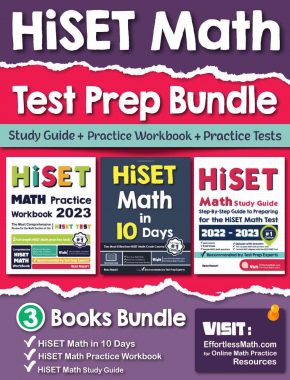
If you want a full workbook that builds on every formula in this cheat sheet, the HiSET Math for Beginners (resource currently unavailable) walks through each topic with worked examples and practice sets. For complete prep with multiple full-length tests, see the HiSET Math Test Prep Bundle.
Frequently Asked Questions
Does the HiSET give you a formula sheet?
Yes. Every HiSET Math administration includes an on-screen formula reference page covering area and perimeter (rectangle, triangle, circle, trapezoid), volume (prism, cylinder, pyramid, cone, sphere), the Pythagorean theorem, slope, simple interest, and the distance formula. It does NOT include the quadratic formula or trig identities.
What formulas should I memorize for the HiSET Math?
Even though some are on the reference page, memorizing them saves 5-15 seconds per question. Priority items: slope \(m=(y_2-y_1)/(x_2-x_1)\), the Pythagorean theorem \(a^2+b^2=c^2\), area of a circle \(A=\pi r^2\), the quadratic formula \(x=\frac{-b\pm\sqrt{b^2-4ac}}{2a}\), percent change, and the mean/median/mode definitions.
What’s the percent change formula?
Percent change \(= \frac{\text{new}-\text{old}}{\text{old}}\times 100\). If the value drops, you get a negative percent (a decrease). Example: if a price drops from \$80 to \$60, the change is \((60-80)/80\times 100 = -25\%\), meaning a 25% decrease.
How do I calculate slope on the HiSET?
Use \(m=(y_2-y_1)/(x_2-x_1)\). Pick any two points on the line, subtract the y-values to get the numerator and the x-values to get the denominator. A positive slope rises left-to-right; negative slope falls. A horizontal line has slope 0, and a vertical line has undefined slope.
What’s the formula for the volume of a cylinder?
\(V=\pi r^2 h\), where \(r\) is the radius of the circular base and \(h\) is the height. The formula is on the HiSET reference page. Example: a can with radius 3 cm and height 10 cm has volume \(\pi(3)^2(10)=90\pi\approx 282.7\) cm³.
What’s the quadratic formula?
\(x=\frac{-b\pm\sqrt{b^2-4ac}}{2a}\), used to solve any equation of the form \(ax^2+bx+c=0\). It’s NOT on the HiSET reference page, so memorize it. The discriminant \(b^2-4ac\) tells you how many real solutions exist: positive (two), zero (one), negative (none).
How do I find the area of a triangle?
\(A=\frac{1}{2}bh\), where \(b\) is the base and \(h\) is the perpendicular height. The height has to be perpendicular to the base, not along a slanted side. For a triangle with base 8 and height 5, \(A=\frac{1}{2}(8)(5)=20\).
What’s the distance formula?
\(d=\sqrt{(x_2-x_1)^2+(y_2-y_1)^2}\). It’s the Pythagorean theorem applied to two points on the coordinate plane. The horizontal distance squared plus the vertical distance squared equals the straight-line distance squared.
What statistics formulas do I need?
Mean: sum divided by count. Median: middle value when data is sorted (average of two middles if even count). Mode: most-frequent value. Range: max minus min. Simple probability: favorable outcomes / total outcomes. These show up in the data analysis questions and are NOT on the reference page.
How long should I study with this cheat sheet?
If you already know most of the algebra and geometry, one focused 30-minute session with this cheat sheet is enough to lock down the formulas. If many of these are unfamiliar, spend 15-20 minutes a day for a week applying each formula to one practice problem until it feels automatic.
Related EffortlessMath Lessons
If a topic on this page feels rusty, these short lessons go deeper:

Related to This Article
More math articles
- Grade 6 Literary Analysis: Theme, Character Change, and Text Evidence Made Practical
- The Ultimate SOL Algebra 1 Course (+FREE Worksheets)
- Top 10 Tips to Create the SAT Math Study Plan
- What is the Best Calculator for the ACT Math Test?
- Full-Length CLEP College Mathematics Practice Test-Answers and Explanations
- The Best Grade 7 Math Book for Florida Students
- Screws, Bolts, Nuts, and Washers
- Pythagorean Theorem Practice — Find the Missing Side (Free)
- Factors and Factor Pairs for 4th Grade
- Conference committees











What people say about "The Ultimate HiSET Math Formula Cheat Sheet"?
No one replied yet.