How to Pass the HiSET Math Test: 2026 Strategy Guide

TL;DR: Pass the HiSET Math test by following a focused 6-8 week plan: take a diagnostic, drill weak topics, master the formula sheet, then practice under timed conditions. You need 8 out of 20 on the math subtest plus a 45 total across all 5 subtests.
Key takeaways:
- Passing HiSET Math = 8 out of 20 on the math subtest.
- You also need a minimum 2 on the essay and 45 total across all 5 subtests.
- 50 questions in 90 minutes; on-screen TI-30XS calculator on the computer version.
- Algebra carries about 45% of the math weight, focus there first.
- On-screen formula reference is provided; memorize anyway to save lookup time.
If you have decided to earn your high school equivalency through the HiSET, the math section is probably the part you are thinking about the most. That is normal, and honestly, it is also the most fixable part of the whole exam. The HiSET math test rewards preparation more than raw talent, and that means the keys are already in your hands.
This guide breaks down exactly what is on the test, what score you need, what to study, what to skip, and how to build a study plan that fits a real adult life. By the end you will know what passing looks like, what mistakes to avoid, and how to stop spinning your wheels.
What Is on the HiSET Math Test?
The HiSET Mathematics subtest is 90 minutes long with 50 multiple-choice questions. There is no separate “no-calculator” section. You have access to an on-screen or handheld calculator for every question.
The content breakdown looks roughly like this:
- Numbers and operations on numbers, 19%: whole numbers, fractions, decimals, percents, ratios, and order of operations.
- Measurement and geometry, 18%: perimeter, area, surface area, volume, the Pythagorean theorem, basic transformations.
- Data analysis, probability, and statistics, 18%: mean, median, mode, range, reading graphs and tables, simple probability.
- Algebraic concepts, 45%: solving linear equations and inequalities, evaluating expressions, slope and lines, systems of equations, quadratics, and functions.
Translation: about half of the test is algebra. If you have to pick one area to over-prepare, pick algebra.
What Score Do You Need to Pass the HiSET Math Test?
HiSET scores each subtest from 1 to 20. To pass math you need at least 8 out of 20. To earn the HiSET overall, you must:

- Score at least 8 on each of the five subtests, and
- Earn a total score of 45 or higher across all five, and
- Score at least 2 out of 6 on the essay.
Some states require slightly higher scores for “college and career readiness” recognition (often a 15 on math), but 8 is the minimum to pass. That means you can miss roughly 40% of the questions and still pass the math section, preparation is about consistency, not perfection.
The 5 Topics That Move Your Score the Most
If your study time is limited, prioritize these five. They cover the majority of the points on the test.
1. Solving linear equations and inequalities
Practice until equations like (5x – 7 = 18) or (3(x + 4) = 21) are second nature. Then graduate to inequalities like (-2x + 6 le 14). Remember that multiplying or dividing by a negative number flips the inequality sign.
2. Slope, lines, and linear functions
Slope from two points: (m = dfrac{y_2 – y_1}{x_2 – x_1}). Slope-intercept form: (y = mx + b). Knowing how to find slope and intercept from a graph, a table, two points, or a word problem will rack up easy points across the test.
3. Percents, ratios, and proportions
“15% of 80 is what?” “If 3 apples cost $2, how much do 12 apples cost?” “A jacket marked up 20% then 30% off, what is the final price?” The setup is always part over whole equals percent over 100.
4. Geometry from the formula sheet
You will get a reference sheet on test day. Practice using it now so you don’t waste time hunting for formulas on the test. The most common shapes tested: rectangle, triangle, circle, rectangular prism, cylinder.
5. Reading data from charts, graphs, and tables
You will see at least 5 to 8 questions that just ask, “what does this picture say?” These are gift points if you slow down and read the axes and legend carefully.

Recommended Practice Resources
The HiSET Formula Sheet, What You Get vs. What to Memorize
You will see a reference page during the test with key formulas. Among them:
- Area and perimeter formulas for common shapes
- Surface area and volume of common solids
- Slope of a line
- Slope-intercept and point-slope forms of a line
- Pythagorean theorem
- Quadratic formula
- Simple and compound interest
What is not on the sheet, memorize these anyway:
- PEMDAS / order of operations
- How to add, subtract, multiply, and divide fractions
- Conversions among fractions, decimals, and percents
- The first 12 perfect squares ($1, 4, 9, 16, 25, 36, 49, 64, 81, 100, 121, 144$)
- How to factor a simple trinomial like (x^2 + 5x + 6 = (x + 2)(x + 3))
Calculator Tips That Actually Save Time
The HiSET allows the TI-30XS (or equivalent) calculator. The same calculator is built into the computer version. Here is how to use it without wasting time:
- Use the fraction key. Type (dfrac{3}{4} + dfrac{1}{6}) as a stacked fraction. Faster and fewer arithmetic mistakes than converting to decimals.
- Always wrap negatives in parentheses when squaring or substituting. ((-3)^2 = 9), but (-3^2 = -9) on most calculators. This is the #1 calculator trap.
- Use the “ans” button to chain calculations without re-typing.
- Don’t reach for the calculator when you can answer in 3 seconds in your head. Counting on the calculator for (7 times 8) is a habit that drains time.
A Realistic 6-Week HiSET Math Study Plan
This plan assumes 60 to 75 minutes a day, 5 days a week. Adjust to your schedule, consistency beats intensity every time.
Week 1, Baseline + arithmetic
- Take an untimed practice test to see your starting point.
- Drill fraction, decimal, and percent arithmetic until automatic.
- Begin an error log, a notebook where every missed question goes.
Week 2, Ratios, percents, and word problems
- Master percent-of, percent change, and direct/inverse proportions.
- Practice translating English to algebra (“three less than twice a number is 11” → (2x – 3 = 11)).
Week 3, Algebra core
- Solve linear equations and inequalities.
- Master (y = mx + b), slope, and reading graphs of lines.
- Introduce systems of equations.
Week 4, Geometry
- Area, perimeter, surface area, volume.
- Pythagorean theorem and the distance formula.
- Transformations: translation, reflection, rotation.
Week 5, Quadratics, functions, and probability
- Factoring and the quadratic formula.
- Function notation (f(x)).
- Mean, median, mode, range, and simple probability.
Week 6, Timed practice
- Two full-length timed practice tests on separate days.
- Review every mistake. Add to the error log.
- Spend the remaining days on your top three weak topics only.
Test-Day Strategy
- Pace yourself. You have about 108 seconds per question. Anything more than that, flag and move on.
- Use the formula sheet every time, even for formulas you have memorized. It eliminates silly errors.
- Plug in answer choices when an algebra problem is stubborn. Backsolving often beats algebra under time pressure.
- Read the last sentence of each word problem twice. It almost always contains the actual question.
- Skip and return rather than agonize. A confident “I’ll come back” is worth more than 4 minutes spent on a single question.
Common Mistakes That Cost People Points
- Confusing area and perimeter. Area is “inside” (square units). Perimeter is “around” (single units).
- Forgetting to distribute the negative. (-(x – 3) = -x + 3), not (-x – 3).
- Misreading “increased by” vs. “is.” “Increased by 20%” means multiply by 1.20, not add 20.
- Skipping the units. “Answer in inches” or “in dollars”, read the directions twice.
- Trusting the calculator without parentheses. ((text{negative})^2) is the classic trap.
Free Resources to Bookmark
You do not have to study alone. Effortless Math has built a complete free HiSET math toolkit:
- HiSET Math Worksheets, printable, topic-organized practice with answer keys.
- The Ultimate HiSET Math Course, a free, complete online course covering every topic on the test.
- HiSET Math eBooks, full prep books with practice tests if you prefer a single organized resource.
Frequently Asked Questions
How hard is the HiSET math test compared to the GED? Topic-wise they are nearly identical, both test mostly Algebra I and basic geometry/data. The HiSET tends to feel a bit more straightforward in question wording, and the passing bar (8 out of 20) is forgiving. Many adult learners find the HiSET friendlier on test day.
How many questions do I need to get right to pass? Roughly 25 to 28 out of 50 typically scores at or above the 8-out-of-20 passing mark, depending on the difficulty curve. That is just over half. You absolutely do not need to be perfect.
Can I take just the HiSET math test, or do I have to take all five subtests? You can take the five HiSET subtests in any order, on different days, and you only retake the ones you do not pass. Many people take math last to give it extra prep time.
How many times can I retake the HiSET math test? Most states allow up to three attempts per calendar year, with the first two retakes available without re-paying the full test fee. Rules vary by state, so check your state’s HiSET page.
Is the HiSET going to be replaced like the TASC? No. The HiSET is actively offered by ETS in most U.S. States in 2026 and is not being phased out.
Can I take the HiSET online from home? Yes, HiSET offers an at-home, remotely proctored option in addition to in-person testing centers. You will need a webcam, a quiet space, and a government-issued ID.
You Can Do This, One Topic at a Time
The HiSET math test is not a measure of your intelligence. It is a measure of how many hours you spent practicing specific, learnable skills. You don’t have to like math. You just have to outlast it. Pick one topic from the 6-week plan, set a 25-minute timer, and start. By the end of this week you will be further along than you have ever been.
Keep Practicing With the Right Resources
Recommended EffortlessMath Books
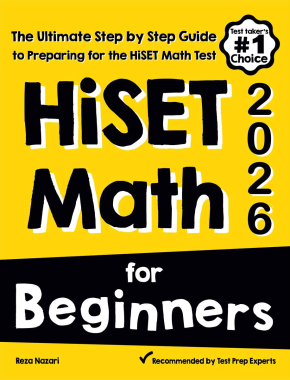
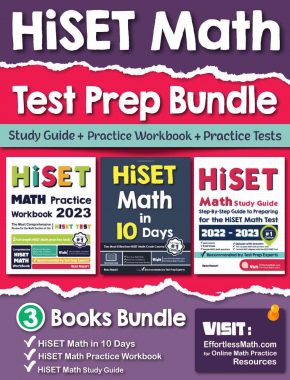
For a workbook that builds on this strategy guide, the HiSET Math for Beginners (resource currently unavailable) walks through every HiSET topic with worked examples at adult-learner pace. For complete prep with multiple timed full-length tests, see the HiSET Math Test Prep Bundle.
Related EffortlessMath Lessons
If a topic on this page feels rusty, these short lessons go deeper:
- Free HiSET Math practice test
- HiSET Math Formula Cheat Sheet
- HiSET Math Practice Test PDF
- How to use the quadratic formula
- How to find the slope of a line
Official source: what the HiSET covers, how the five subtests are structured and how the credential works are published by PSI, which administers the exam, at hiset.org.

Related to This Article
More math articles
- 7th Grade NYSE Math FREE Sample Practice Questions
- Math Education in the Digital Age: Techniques for Today’s Classroom
- 8th Grade MEAP Math Practice Test Questions
- Complete Guide to Understanding Deductive Reasoning: Principles and Applications
- How to Simplify Fractions? (+FREE Worksheet!)
- How to Use Area Models to Divide Three-digit Numbers By One-digit Numbers
- Georgia Milestones Grade 4 Math Free Worksheets: Free Printable PDFs Covering Every Grade 4 Standard
- Tennessee TCAP Grade 4 Math Free Worksheets: Free Printable TCAP-Ready Practice with Answers
- 10 Most Common 3rd Grade FSA Math Questions
- 4th Grade WVGSA Math Worksheets: FREE & Printable











What people say about "How to Pass the HiSET Math Test: Strategy Guide"?
No one replied yet.