GED vs. HiSET vs. TASC: Which Test Should You Take?

If you didn’t finish high school, you have options. The big three are the GED, the HiSET, and the TASC, all recognized nationally as equivalents to a high school diploma. They’re not identical. The right test for you depends on where you live, how you learn best, and how comfortable you are with computers.
This guide compares all three head-to-head and gives you a clear answer at the end.
The Quick Answer
- GED: Most popular, computer-only, accepted nationwide. Best if you’re tech-comfortable.
- HiSET: More flexible, paper or computer, slightly easier in places, available in some states the GED isn’t.
- TASC: Being phased out. As of 2022, the TASC is no longer offered, but it’s still mentioned in older guides. Skip it.
If you’re in 2026, the real choice is GED or HiSET. Here’s how to pick.
What All Three Tests Have in Common
- Test core high school subjects: math, reading, writing, science, social studies.
- Result in a credential equivalent to a high school diploma.
- Accepted by colleges, employers, and the military.
- Available in English and Spanish.
- Cost $30-150 per subject depending on state.
The credential matters more than which test you take.

GED (General Educational Development)
Format
- Computer-based only.
- 4 subjects: Mathematical Reasoning, Reasoning Through Language Arts (RLA), Science, Social Studies.
- Total time: ~7 hours, taken across sessions.
Math Section
- 115 minutes.
- 46 questions.
- Part 1: no calculator. Part 2: calculator (on-screen TI-30XS).
- Topics: number sense, algebra, geometry, data analysis.
Scoring
- Per subject: 100-200.
- 145 = pass. 165 = college-ready. 175 = college credit (in some colleges).
Cost
- $36-50 per subject in most states.
- $144-200 total for all four.
Where it’s accepted
- Every state except where HiSET is the only option (very few states).
- Recognized by 98% of colleges and employers.
Best for
- Students comfortable with computers.
- Test-takers who want the most widely recognized credential.
- Anyone preparing with mainstream GED prep books.
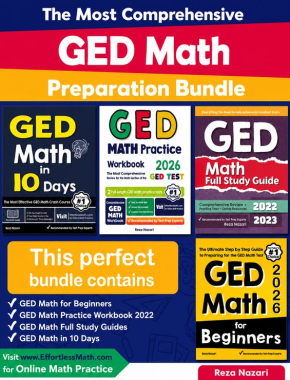
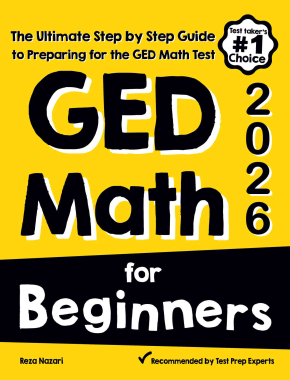
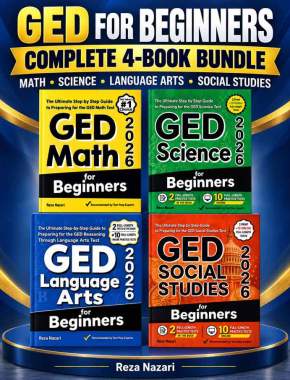
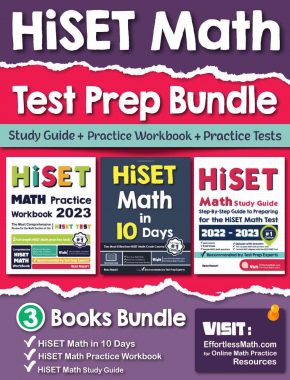
Recommended Practice Resources
HiSET (High School Equivalency Test)
Format
- Paper or computer, your choice in most states.
- 5 subtests: Math, Reading, Writing, Science, Social Studies.
- Total time: ~7 hours.
Math Section
- 90 minutes.
- 50 questions.
- Calculator allowed (TI-30XS provided on-screen, or you bring your own for paper).
- Topics: number sense, algebra, geometry, data analysis.
Scoring
- Per subtest: 1-20.
- 8 per subtest = pass.
- 15+ on at least one subtest = college-ready bonus.
Cost
- $10.75-15 per subtest for the computer version (cheapest per subject of any test).
- Total: ~$50-100. Cheaper than the GED.
Where it’s accepted
- 26 states + several territories.
- Some states (like California, Massachusetts, New York) accept both GED and HiSET; a few only offer HiSET.
Best for
- Test-takers who prefer paper.
- Cost-sensitive students.
- Those who want to retake individual subtests cheaply.
TASC (Test Assessing Secondary Completion)
Current status
Retired as of 2022. Several states (including New Jersey, Indiana, Wyoming) have switched to GED or HiSET.
If you see TASC mentioned in older guides, ignore it. You can no longer take it.
Old format (for context)
- Paper or computer.
- 5 subtests: Math, Reading, Writing, Science, Social Studies.
- Similar in scope to HiSET.
Side-by-Side Comparison
| Feature | GED | HiSET |
|---|---|---|
| Format | Computer only | Paper or computer |
| Subjects | 4 | 5 |
| Math time | 115 min | 90 min |
| Math questions | 46 | 50 |
| Calculator | TI-30XS on-screen | TI-30XS provided |
| Cost (all subjects) | $144-200 | $50-100 | |
| Pass score | 145/200 | 8/20 |
| Accepted | All 50 states | 26 states |
| Difficulty | Slightly harder | Slightly easier |
Which Test Is Easier?
Both tests are similar in scope, but most students report HiSET feels slightly easier for two reasons:
- Format flexibility. Paper is less intimidating for students who aren’t comfortable with computers.
- Math math content. The HiSET asks more straightforward computation questions; the GED has more multi-step word problems.
That said, easier doesn’t mean trivial. Both tests require real preparation.
Math Section Comparison
Both tests cover the same core math topics:

- Number operations, fractions, decimals, percents
- Algebra (linear equations, inequalities, exponents)
- Geometry (area, perimeter, volume, Pythagorean theorem)
- Data analysis (graphs, probability, statistics)
Key differences:
– GED has a no-calculator section at the start (5-6 problems). HiSET allows calculator throughout.
– GED has more word problems. HiSET has more straight computation.
– GED uses drag-and-drop and fill-in-the-blank more than HiSET.
How to Choose
Choose the GED if:
- You’re comfortable with computers.
- You want the most widely recognized credential.
- You live in a state where it’s the primary option.
- You’re planning to go to college (the 165+ score signals college-readiness).
Choose the HiSET if:
- You prefer paper-based tests.
- Cost matters, HiSET is significantly cheaper.
- You learn better on paper.
- Your state offers it as the cheaper option.
Either is fine if:
- You’re using the credential for general employment (both are equally recognized for jobs).
- You’re going into the military (both accepted, though some branches prefer the GED).
How Long Will It Take to Prepare?
Most students need 2-4 months of consistent study to pass either test. Plan for:
- 10-15 hours per subject for review.
- 5-8 full-length practice tests.
- 30-60 minutes of daily study, 5 days a week.
If you’ve been out of school for many years, plan for more, closer to 6 months.
Study Plan (for Either Test)
Month 1
- Foundation review: arithmetic, fractions, decimals, percents.
- Reading practice: 1 article a day with comprehension questions.
- Take a diagnostic test to identify weak spots.
Month 2
- Algebra and geometry deep dives.
- Full-length practice tests in math.
- Writing prompts 2x per week.
Month 3
- Mixed review across all subjects.
- Full-length practice tests for each subtest.
- Time yourself under real conditions.
Month 4 (if needed)
- Polish weak areas.
- Take one final official practice test the week before.
What If You Fail a Section?
- Both tests let you retake individual sections rather than the whole test.
- Most states have a waiting period of 1-3 months before re-testing.
- Cost: $10-50 to retake one section.
Failing a section is not failing the whole test. Brush off, study what you missed, and retake.
Free Resources
Effortless Math has comprehensive resources for both tests:
- Math Blog, guides on every test.
- GED Math Resources, books, worksheets, practice tests.
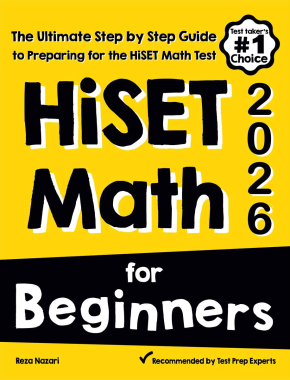
- HiSET Math Resources, full HiSET prep library.
Frequently Asked Questions
Are GED and HiSET equally accepted by colleges and employers?
Yes. Both result in equivalent credentials. Employers and colleges treat them identically.
Can I take both tests?
You can, but there’s no real benefit. Pick one and prepare thoroughly.
Is the HiSET going away too?
No, the HiSET is active and growing in 2026. It’s the TASC that was retired.
Which test does the military prefer?
Both are accepted. The Army and Navy may favor the GED for record-keeping; check with your recruiter.
Can I take the test online from home?
Yes, the GED has an at-home proctored online option. HiSET is rolling out a similar option in several states.
What if I haven’t studied math in 20 years?
Plan on 4-6 months. Start with elementary arithmetic and build up. Effortless Math has step-by-step books for adult learners.
The Right Test Is the One You’ll Actually Pass
Both tests open the same doors. The credential matters more than the brand. Pick the test that fits your learning style, your budget, and your state. Then prepare consistently. The diploma you’ve been waiting for is closer than you think.
Keep Practicing With the Right Resources
Official source: what the HiSET covers, how the five subtests are structured and how the credential works are published by PSI, which administers the exam, at hiset.org.

Related to This Article
More math articles
- Correlation Is Not Causation
- Finding Area of Compound Figures
- Top 10 7th Grade PSSA Math Practice Questions
- Marginal revenue product combines productivity and output value
- Electrochemical Cells: Electron Flow, Salt Bridges, and Cell Voltage
- Grade 3 Math: Quadrilaterals
- Linear, Quadratic, and Exponential Models
- The Best Grade 7 Math Book for Rhode Island Students
- Number Properties Puzzle – Challenge 16
- Hyperbola Calculator — Vertices, Foci & Asymptotes










What people say about "GED vs HiSET vs TASC: Which Test Should You Take?"?
No one replied yet.