YOUR GED STUDY COMPANION
How to Pass the GED Math Test on Your First Try (2026)
Build a calmer test-day routine. Explore the practical tips below and try them during your next practice session.
TL;DR: Want to pass the GED Math test on your first try? A focused 6-to-12 week plan can get you there. Start with a diagnostic to see where you stand, then attack the algebra-heavy topics (roughly 55 percent of the test), build real fluency on the TI-30XS calculator you’ll be using, memorize the on-screen formulas, and finish with timed full-length practice tests. The passing scaled score is 145. Steady weekly practice beats last-minute cramming every time.
Key takeaways:
- GED Math: 46 questions in 115 minutes; Q1-5 no calc, Q6-46 with TI-30XS.
- Passing scaled score: 145 (range 100-200). College-ready: 165.
- Algebraic Problem Solving ~55% of the test; Quantitative Problem Solving ~45%.
- On-screen formula reference is provided, but memorize anyway.
- Most first-time passers prep 6-12 weeks at 30-45 min/day.
If you have ever sat down with a GED math practice question and felt your stomach drop, you are not alone. The math section is the part of the GED that scares the most people, and it is also the part that we hear the most success stories about, because once you have a real plan, the test becomes a lot more manageable than it looks at first.
This guide walks you through everything you need to know about passing the GED math test in 2026, what is on it, what score you need, what to study, what to skip, what tools you can use on test day, and a week-by-week plan that has worked for thousands of adult learners. Take a breath. You can do this.
What Is on the GED Math Test in 2026?
The official name is the GED Mathematical Reasoning test. It is one of the four GED subject tests (the others are Reasoning Through Language Arts, Science, and Social Studies). The math test is 115 minutes long and contains roughly 46 questions spread across one section.
The questions are split between two broad content categories:
- Quantitative problem solving (about 45%), number operations, fractions, decimals, percents, ratios, exponents, measurement, and data interpretation.
- Algebraic problem solving (about 55%), linear and quadratic expressions, equations and inequalities, functions, graphs, and slope.
You will see a mix of multiple choice, drag-and-drop, fill-in-the-blank, hot-spot, and drop-down questions. Most are worth one point, but a few involve multiple parts.
The test is delivered on a computer either at an official testing center or at home through GED’s online proctoring service. You can take it once you have registered at GED.com.
What Score Do You Need to Pass the GED Math Test?
GED scores run from 100 to 200. Here is what the bands mean in 2026:
- 100 to 144: Not passing. You can retake.
- 145 to 164: Passing score. You earn a high-school equivalency.
- 165 to 174: GED College Ready. Some colleges waive placement exams.
- 175 to 200: GED College Ready + Credit. You may earn up to 3 college credits.
For most people, 145 is the number to beat on math. You do not need to be perfect. You need to be steady.
A practical truth: roughly 60 to 65% of the points on the GED math test usually corresponds to a 145+ score. That means you can miss a third of the questions and still pass. Knowing this changes how you study. You are not chasing a perfect score; you are chasing reliable, repeatable accuracy on the questions you know how to answer.
The 5 Skills That Earn You the Most Points
After looking at thousands of GED prep journeys, five skill clusters move the needle more than any others. Master these and your score climbs fast.
1. Fractions, decimals, and percents (and converting between them)
These appear everywhere, in word problems, in geometry, in graphs. If you cannot quickly turn \(\frac{3}{4}\) into $0.75$ or \(75\%\), you will burn time you don’t have.
2. Solving linear equations and inequalities
A solid 15 to 20% of the test boils down to “solve for \(x\).” Examples: \(3x + 7 = 22\), \(2(x – 4) = 10\), or \(-3x + 5 > 14\). If you can do these in your sleep, you have already locked in a meaningful chunk of points.
3. Slope and the equation of a line
You will be asked to find slope from two points, write an equation in \(y = mx + b\) form, identify slope and intercept from a graph, and interpret what slope means in a real-world story (cost per item, distance per hour, etc.). This is one of the highest-yield single topics on the test.
4. Word problems with ratios, proportions, and percent change
“A shirt costs $40 and is on sale for 25% off. How much do you pay?” Sound familiar? Mastering the proportion setup $\frac{\text{part}}{\text{whole}} = \frac{\%}{100}\( – and the percent-change formula \)\frac{\text{new} – \text{old}}{\text{old}} \times 100$, solves a surprising share of the test.
5. Reading data from graphs and tables
Bar graphs, line graphs, pie charts, scatter plots, and two-way tables show up repeatedly. Practice answering “what does this picture tell me?” questions until they feel boring.
If you can lock these five clusters down, you are already in passing territory before you ever touch geometry, quadratics, or functions.
Recommended Practice Resources
The Official GED Math Formula Sheet (and What to Memorize Anyway)
GED provides an on-screen formula sheet during the test. That is genuinely good news. You do not need to memorize the area of a trapezoid or the volume of a cone. The formula sheet includes:
- Area of triangle, parallelogram, trapezoid, and circle
- Surface area and volume of rectangular prisms, cylinders, pyramids, cones, and spheres
- Slope of a line from two points
- Slope-intercept form \(y = mx + b\)
- Point-slope form
- Quadratic formula
- Pythagorean theorem
- Simple and compound interest formulas
- Distance formula
- Mean and median (described, not formula)
What is not on the sheet, and what you absolutely must know cold:
- Order of operations (PEMDAS / GEMS).
- How to add, subtract, multiply, and divide fractions.
- How to convert between fractions, decimals, and percents.
- How to solve a linear equation step by step.
- How to factor a simple quadratic like \(x^2 + 7x + 12\).
- How to plug numbers into a formula correctly.
The formula sheet is a safety net, not a strategy. Practice using it now, during prep, so you are not fumbling through it on test day.
The GED Math Calculator: Your Best Friend (Used Right)
The GED test gives you the TI-30XS MultiView calculator on screen for most of the math section. There is a short opening segment (typically the first 5 questions) where the calculator is disabled, so do not lean on it for basic arithmetic you should know.
A few habits that will save you time and points:
- Practice with a real TI-30XS during your prep. The online version mimics the hardware keypad, if your fingers know where the buttons live, you save 10 to 15 seconds per question.
- Use the fraction key. Type fractions as \(\frac{a}{b}\) directly rather than converting in your head. The MultiView shows them as proper fractions.
- Use the parentheses generously. Calculator order-of-operations errors are the single most common avoidable mistake on the GED math test.
- Don’t trust the calculator on probability and word problems. It can do arithmetic. It cannot read the question.
A 6-Week GED Math Study Plan That Works
Here is a realistic study plan for someone studying about 60 to 90 minutes a day, 5 days a week. Adjust the pace to your life, the structure is what matters.

Week 1, Diagnostic & foundations
- Take a full-length GED math practice test, untimed, to find your starting score and weak spots.
- Drill basic operations: long multiplication, long division, fraction arithmetic.
- Goal: feel comfortable with whole numbers, fractions, decimals, and percents.
Week 2, Ratios, proportions, and percents
- Master percent-of-a-number, percent change, and proportion word problems.
- Practice converting between fractions, decimals, and percents until it is automatic.
- Add 10 minutes of mental math at the end of each session.
Week 3, Algebra basics
- Solve linear equations and inequalities of increasing complexity.
- Translate English into algebra (“three more than twice a number is 19” → \(2x + 3 = 19\)).
- Begin slope and \(y = mx + b\).
Week 4, Geometry and measurement
- Area, perimeter, surface area, and volume from the formula sheet.
- Pythagorean theorem.
- Coordinate geometry, distance and midpoint between two points.
Week 5, Advanced algebra and functions
- Quadratics: factor, use the quadratic formula, find roots from a graph.
- Function notation \(f(x)\), evaluating and interpreting.
- Systems of equations by substitution and elimination.
Week 6, Test simulation and review
- Take two full-length, timed practice tests, on separate days, in a quiet room.
- Review every missed question and write down why you missed it (silly error, didn’t know the topic, didn’t read carefully).
- Spend the rest of the week on weak spots only.
The single most important habit during all six weeks: keep an error log. Every wrong answer goes into a notebook with the topic, the mistake, and the correct approach. By week 6, your error log is your study guide.
Test-Day Strategy (The Stuff Most Guides Skip)
Knowing math is half the battle. Test-day execution is the other half.
- Don’t get stuck. If a question takes more than 90 seconds, flag it and move on. You can revisit it. The clock is your real opponent.
- Use the on-screen scratch board generously. Write out fractions, draw figures, label diagrams. Your brain works better when your eyes can see the problem laid out.
- Plug answer choices back in. For algebra multiple choice, sometimes the fastest path is to test each answer in the original equation. This is not cheating; it is smart.
- Read every question twice. Especially word problems. “How many more…” and “What is the total…” are very different questions.
- Bring a snack and water if you are testing in person. Math is metabolic. Tired brains miss easy points.
- Sleep, don’t cram. A 6-hour-sleep brain loses an average of 10 to 15% on quantitative tasks. The night before the test, finish studying by 8 PM and go to bed.
Common Mistakes That Cost People the Test
These are the patterns we see again and again:
- Skipping the no-calculator section to “save time.” Those first questions are usually the easiest. Don’t blow free points.
- Memorizing formulas instead of practicing problems. Formulas without practice are useless. Practice without formulas is fine.
- Avoiding word problems. Roughly half the test is word problems. You cannot dodge them. Train them like a sport.
- Forgetting units. “Convert to feet” or “answer in minutes”, read the last sentence of the question last, on purpose.
- Not using the formula sheet. It is right there. Open it. Look at it. Use it.
Free Resources That Actually Help
Effortless Math has built a free library specifically for GED test takers. Three pages worth bookmarking right now:
- GED Math Worksheets, printable practice grouped by topic, with answer keys.
- The Ultimate GED Math Course, a free, complete topic-by-topic course you can work through online.
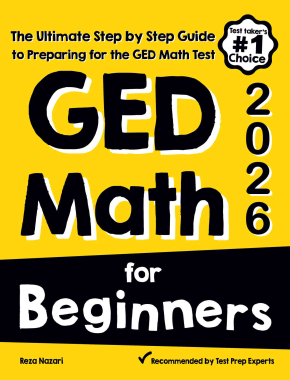
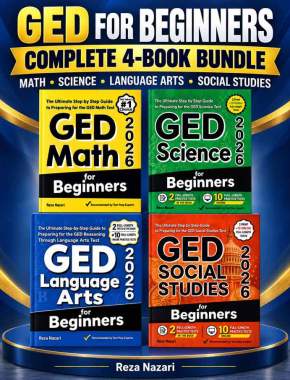
- GED Math for Beginners (eBook), our step-by-step book if you want one organized resource that walks you from zero to test-ready.
Frequently Asked Questions
How hard is the GED math test, really? It is harder than most people expect on day one and easier than most people fear by day thirty. The math itself is high-school level (mostly Algebra I with some geometry and data). The challenge is mostly familiarity, knowing what kind of question is coming and what to do with it. A few weeks of focused practice changes everything.
Can I use my own calculator on the GED math test? At an official testing center, no, the on-screen TI-30XS is what you use. For the at-home version, the same on-screen calculator is provided. You should still practice on a physical TI-30XS so your fingers know the layout.
How long does it take to study for the GED math test? Most adult learners pass after 4 to 8 weeks of consistent study, 60 to 90 minutes a day. If you have been away from math for years, give yourself 8 to 12 weeks. There is no penalty for taking your time.
What happens if I fail the GED math test? You can retake it. After your first three attempts, you may have to wait 60 days between tries (rules vary slightly by state). Many people pass on a second attempt because they know exactly what to focus on.
Do I have to take all four GED tests at once? No. You can take and pay for each subject test one at a time, in any order. Many people do math last, so they can focus on it without splitting their attention.
Is the GED math test the same as the HiSET or TASC? No. The GED is its own test, with its own scoring and format. The HiSET is similar in topics but a different format. The TASC is being phased out in most states. If you are not sure which one to take, check with your state’s department of education.
You Are Closer Than You Think
If you have read this far, you are already taking the GED math test more seriously than most people who walk into the testing center cold. The math itself is learnable. The score you need is reachable. The path is not glamorous, practice, error log, repeat, but it works.
Print a GED formula sheet. Pick one topic from the 6-week plan. Set a 30-minute timer and start. Future-you, holding a diploma, is going to be very glad you did.
Keep Practicing With the Right Resources
Recommended EffortlessMath Books
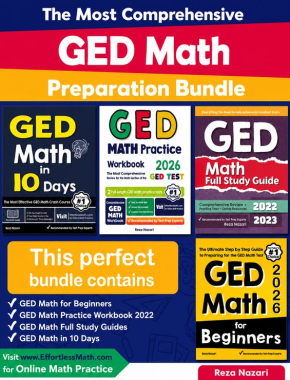
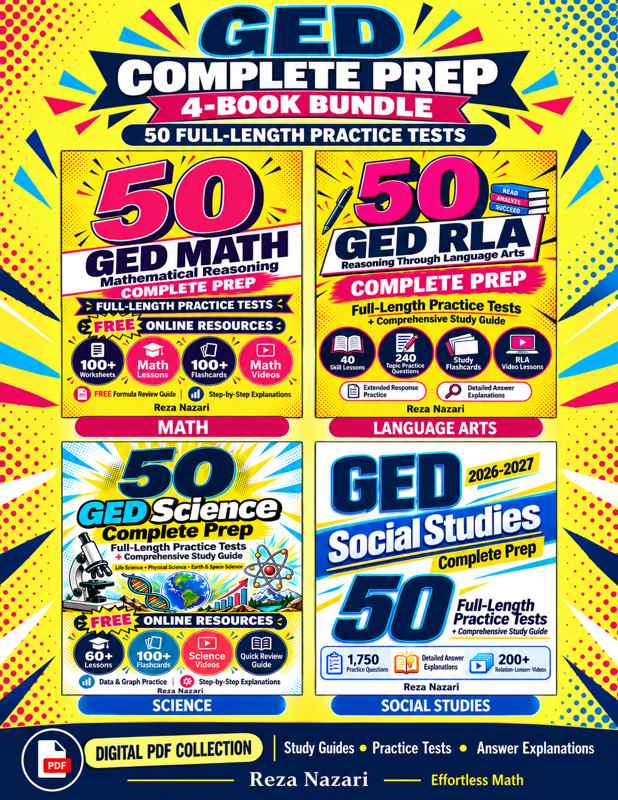
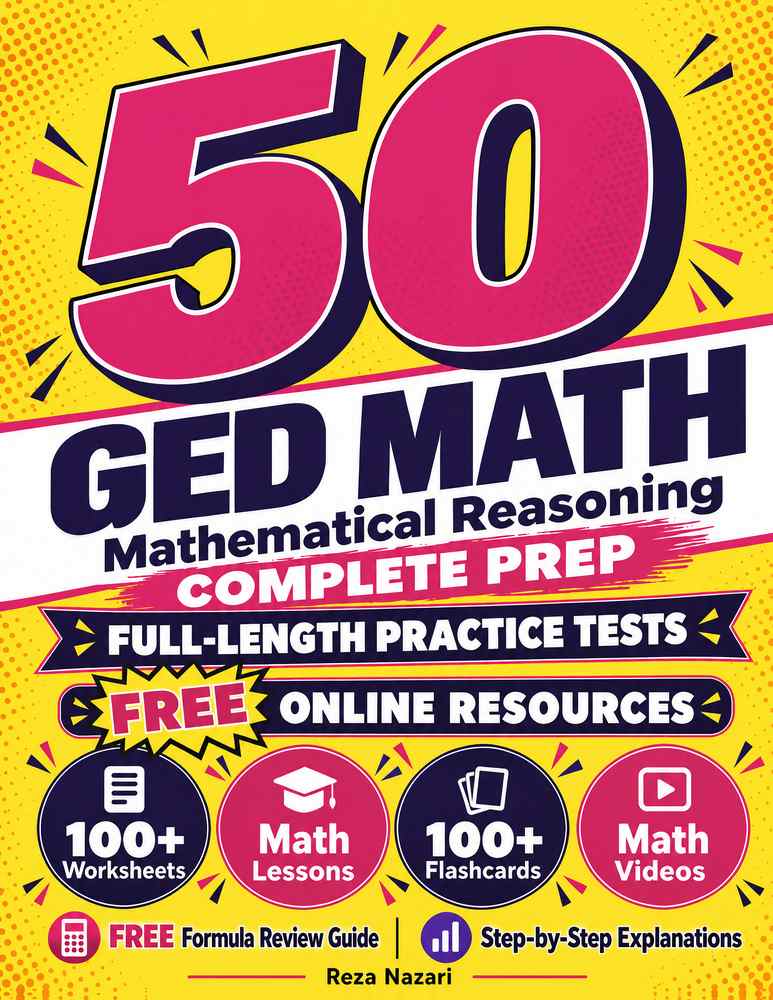
For a workbook that builds on this strategy guide, the GED Math for Beginners (resource currently unavailable) walks through every GED topic with worked examples at adult-learner pace. For complete equivalency prep with multiple full-length practice tests, see the GED Math Test Prep Bundle.
Related EffortlessMath Lessons
If a topic on this page feels rusty, these short lessons go deeper:
- Free GED Math practice test
- GED Math Formula Cheat Sheet
- GED Math Practice Test PDF
- Free GED Math Practice Tests Collection
- How to use the quadratic formula
Practice with the original GED Math worksheets
Choose a topic from our printable GED Math worksheet collection. Download or print the complete PDF, including its original promotion page at the end.

Related to This Article
More math articles
- 3rd Grade Wisconsin Forward Math Worksheets: FREE & Printable
- The Best TASC Math Worksheets: FREE & Printable
- How to Decode Complexity: A Comprehensive Guide to Utilizing Bar Charts in Calculus and Beyond
- The Best Grade 7 ELA Practice Tests for Kentucky Students
- The Best Algebra 1 Book for North Dakota Students
- The Best Grade 8 Math Book for Louisiana Students
- Conventional participation
- What Kind of Math Is on the HiSET Test?
- Movement Stages and Outcomes
- Reversing Derivatives Made Easy: Power Rule of Integration










What people say about "How to Pass the GED Math Test on Your First Try"?
No one replied yet.