The Best Algebra 1 Book for Self-Study and Homeschoolers
TL;DR: Self-studying Algebra 1 needs a book that does the teaching, not one that assumes a teacher will fill in the gaps. The book has to explain plainly, walk through examples, and check the learner’s understanding step by step.
Key takeaways:
- Most Algebra 1 textbooks are written to be taught from, not learned from.
- Self-study, homeschool, and adult learners need a book that explains, demonstrates, then practices.
- Look for plain language, fully worked examples, and built-in practice with answer keys.
- A patient book closes gaps in real time – the alternative is hitting walls alone.
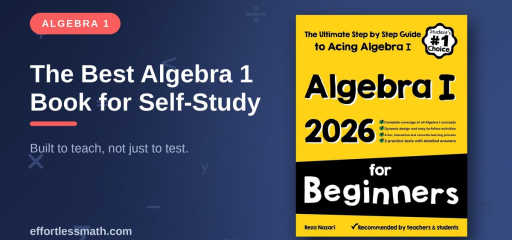
- Algebra I for Beginners is the book we recommend for any solo Algebra 1 student.
There is a specific moment when algebra stops making sense for a lot of students. It is usually not the first day. It is week three or four, when the letters and numbers start mixing together, when one missed idea quietly becomes two, then five, and suddenly a smart kid is convinced they are “just bad at math.” If that sounds familiar — for you, your child, or a student you teach — the problem is almost never ability. It is the book.
Most Algebra 1 textbooks are written to be taught from, not learned from. They assume a teacher is standing at the board filling in the gaps. Take that teacher away — for a homeschooler, an adult learner, or a student who just needs to catch up over the summer — and the gaps become craters. So if you are searching for the best Algebra 1 book for self-study, you are asking exactly the right question. The book has to do the teaching.
After years of building math resources and watching which ones actually move students forward, here is the one we hand to anyone learning Algebra 1 on their own.
Our pick: Algebra I for Beginners
Algebra I for Beginners is built around one stubborn principle: a student working alone should never hit a wall they cannot climb without help. Every concept is introduced in plain language first, demonstrated with a fully worked example second, and only then handed to the student to try. Nothing is assumed. Nothing is skipped.

What makes it genuinely different is the sequencing. The chapters are ordered so that every new skill rests on one you have already mastered. You learn to combine like terms before you touch equations. You get comfortable with one-step equations before two-step equations show up. By the time you reach the topics students dread — factoring, systems, quadratics — you are not learning five things at once. You are learning one new thing built on four familiar ones. That is the entire secret to learning algebra without a teacher, and most books get it wrong.
Why most Algebra 1 books fail self-studying students
If you have already tried a book and bounced off it, it probably had one of these problems:
- It explains the “what” but not the “why.” It tells you to “move the term to the other side” without ever showing that you are really doing the same thing to both sides of the equation. So the rule never sticks.
- The jump from example to exercise is too big. The worked example is easy; the very first practice problem is three steps harder. A student alone has nowhere to turn.
- It is a wall of text. Dense paragraphs, tiny margins, no breathing room. Math is hard enough without fighting the page.
- Not enough practice on each idea. Two or three problems, then on to the next concept. Skills need repetition to become automatic.
A good self-study book fixes every one of these. It explains the reasoning, shrinks the gap between “watch me” and “your turn,” keeps the page calm and readable, and gives you enough problems that each procedure becomes second nature before you move on.
What is actually inside the book
Algebra I for Beginners walks through the full Algebra 1 course in the order a beginner should meet it:
- Foundations — integers, fractions, order of operations, and the language of algebra
- Expressions — variables, combining like terms, the distributive property
- Equations and inequalities — from one-step to multi-step, including word problems
- Linear functions — slope, graphing, slope-intercept and point-slope form
- Systems of equations — graphing, substitution, and elimination
- Exponents and polynomials — rules of exponents, adding, multiplying, and factoring
- Quadratic equations — factoring, the quadratic formula, and graphing parabolas
- Radicals and rational expressions — the topics that bridge into Algebra 2
Every section follows the same reliable rhythm: a short, clear explanation, then step-by-step examples, then a focused set of practice problems, with answers so you can check yourself immediately. That last part matters more than it sounds. A self-studying student needs feedback within seconds, not at the back of a chapter they will never flip to.
A look at one topic done right
Take solving multi-step equations — the place a lot of students first feel lost. A weak book gives you 3x + 5 = 20, solves it in two lines, and moves on. This book builds it. First you practice equations that need only one move. Then equations that need two moves, with the moves clearly named: “undo the addition, then undo the multiplication.” Then equations with variables on both sides. Then equations with parentheses. Each layer is its own short set of problems.
By the time you face something messy like 2(x − 3) + 4 = 3x − 1, you are not panicking. You recognize each piece: distribute, combine, gather the variables, isolate. That feeling — “oh, I know what each part of this is” — is exactly what confident algebra students have and struggling ones do not. The book engineers it on purpose.
Who this book is for
This is the right book if you are:
- A homeschooling family that needs a curriculum a student can largely run themselves
- A student catching up over the summer or retaking the course
- A parent who wants to help but has not done algebra in twenty years
- An adult learner heading back to school who needs Algebra 1 before a placement test
- A student already in an algebra class whose textbook simply is not explaining things clearly
It is not a competition-math book and it is not trying to be flashy. If you want a calm, thorough guide that takes you from “I do not get this” to “I can do this,” it is built for you.
How to study with it: an 8-week plan
A book only works if you have a plan. Here is a realistic one for a student studying a few times a week:
- Weeks 1–2: Foundations and expressions. Do not rush this — it is the floor everything else stands on.
- Weeks 3–4: Equations and inequalities, including word problems.
- Week 5: Linear functions and graphing.
- Week 6: Systems of equations.
- Week 7: Exponents, polynomials, and factoring.
- Week 8: Quadratics, plus a review of anything that felt shaky.
Two rules make this plan actually work. First, do every practice problem in writing — reading math is not learning math. Second, never move to a new section until you can get the practice set right without peeking. A skipped weak spot in algebra does not stay quiet; it comes back bigger.
If you would like a single resource that carries this same step-by-step approach all the way from Pre-Algebra through Algebra 2, the Ultimate Algebra Bundle packages the whole journey together — and our guide on how to self-study algebra lays out the full path.

Common mistakes when self-studying algebra
- Skipping the foundation chapters because they look easy. They are easy — that is the point. They are also where the cracks start.
- Confusing “I understood the example” with “I can do it.” Understanding is watching. Learning is doing it yourself, then doing it again next week and still getting it right.
- Studying in long, rare sessions. Three 30-minute sessions beat one 3-hour cram every single time. Algebra rewards consistency.
- Not checking answers right away. Practicing a mistake ten times just teaches you the mistake. Check after every few problems.
Frequently asked questions
Can a student really learn Algebra 1 without a teacher?
Yes — with the right book. The key is a book that explains the reasoning, keeps the steps small, and provides answers for instant feedback. Algebra I for Beginners was written specifically for learners who do not have a teacher beside them.
What should a student know before starting Algebra 1?
Solid arithmetic: fractions, decimals, percents, negative numbers, and order of operations. If those feel shaky, start with a strong Pre-Algebra book first — it makes Algebra 1 dramatically easier.
How long does it take to finish Algebra 1?
A focused self-studying student can complete it in 8 to 12 weeks. There is no prize for speed — mastery of each section matters far more than finishing fast.
Is this book good for adults returning to school?
Very. Adults often need to rebuild algebra before a college placement or GED test, and the calm, no-jargon, example-first style is ideal for that. Many adult learners also like our Adult Algebra for Beginners guide.
What comes after Algebra 1?
Geometry or Algebra 2, depending on your school’s sequence. When you are ready, our best Algebra 2 book guide picks up exactly where this one leaves off.
The bottom line
The best Algebra 1 book for self-study is the one that never leaves you stuck — that explains the why, shrinks every jump, and gives you enough practice to make each skill automatic. Algebra I for Beginners was built to be exactly that book. If algebra has felt like a locked door, this is the one that hands you the key and then waits, patiently, while you turn it.
Pick it up, make a simple weekly plan, and do the problems with a pencil. Algebra is not a talent you are born with or without. It is a skill — and a good book is how you build it.
Recommended EffortlessMath Books
The book we recommend for self-study and homeschool Algebra 1 is Algebra I for Beginners, designed from the ground up to be used by a student working alone. After Algebra 1, the natural next step is Algebra II for Beginners, which uses the same plain-language approach.
Frequently Asked Questions
Why are most Algebra 1 books bad for self-study?
They’re written to be taught from, not learned from. The author assumes a teacher will stand at a board and fill in the gaps between the printed page and the homework. Take the teacher away, and the gaps become walls. A self-study book has to do the teaching itself.
What should I look for in a self-study Algebra 1 book?
Plain-language explanations (not just symbols), fully worked examples with each step labeled, practice problems right after each concept, and a complete answer key with full solutions (not just final answers). The book should be usable cover-to-cover without any outside help.
Which book do you recommend for self-study?
Algebra I for Beginners. It introduces every concept in plain language, shows a worked example, then hands the student practice problems with full solutions. Nothing is assumed. Nothing is skipped. It’s built specifically for students working alone.
Can a homeschool parent use this book to teach?
Yes – it works either way. A homeschool parent can use the explanations and examples to teach a lesson, then have the student do the practice problems. Or the student can read the chapter themselves and the parent only steps in for tough spots. The book supports both modes.
Is Algebra I for Beginners enough by itself?
For most self-study learners, yes. It covers every standard Algebra 1 topic with explanations, examples, practice, and full solutions. Some learners pair it with a video course or with extra word-problem practice, but the book alone is enough to learn the material.
How long does self-studying Algebra 1 take?
A motivated learner working 30-45 minutes a day usually finishes in 4-6 months. A slower pace (15-20 minutes a day, 3-4 days a week) takes 8-10 months. The book is divided into clear topic chapters, so you can pace it however works.
Is this book good for adult learners going back to algebra?
Yes – it’s one of the most common use cases. Adult learners returning to algebra (for the GED, ACCUPLACER, or college placement) usually need plain explanations more than they need fancy. The book assumes the student is starting from scratch and never talks down.
Can I use this book to prep for the GED Math test?
It’s a strong foundation. The algebra portion of the GED Math overlaps heavily with Algebra 1 content, so working through Algebra I for Beginners covers most of that section. For GED-specific practice, follow up with a GED Math test-prep book.
What if I get stuck on a topic?
Read the explanation a second time, work the example by hand instead of just reading it, and try the first practice problem with the full solution open beside you. Most stuck moments come from misreading a step in the worked example, and slowing down fixes them.
What comes after Algebra I for Beginners?
For most learners, the next step is either Geometry or Algebra II for Beginners, depending on your goals. If you’re prepping for the SAT or ACT, SAT Math for Beginners is a natural follow-up. For college placement, ACCUPLACER Math for Beginners covers the same skills in test format.
Related EffortlessMath Lessons
If a topic on this page feels rusty, these short lessons go deeper:

Related to This Article
More math articles
- 7th Grade FSA Math Worksheets: FREE & Printable
- How to Find Average Rate of Change of a Function?
- Entertain Your Child Indoors with These Fun, Educational Activities
- Work, Pay, and Occupational Segregation
- How to Solve Rational Numbers Word Problems
- The Best Grade 3 Math Book for North Carolina Students
- Free Grade 4 English Worksheets for SBAC Students
- The Best Grade 7 ELA Practice Tests for Oregon Students
- The Best Grade 2 English Worksheets for Tennessee Students
- Race discrimination










What people say about "The Best Algebra 1 Book for Self-Study"?
No one replied yet.