Colorado Algebra 1 Free Worksheets: Printable Algebra 1 Practice with Full Solutions

Algebra 1 is famous for being the course where students who used to like math start saying they don’t. That doesn’t usually happen because the math is hard. It happens because the math becomes general. Up through pre-algebra, every problem had a definite quantity attached, three pizzas, eight feet of fencing, half a tank of gas. In Algebra 1, the quantities pull back behind the curtain. A problem might ask about “any number x” or “all values that make the inequality true” or “a function f that takes inputs to outputs.” Students aren’t doing harder arithmetic. They’re doing arithmetic in a language they haven’t learned to speak fluently yet.
The remedy is repetition with feedback. Not drill, repetition with explanation. A student who solves four equations and reads through what went wrong on the one they missed has learned more than a student who races through twenty unchecked. Algebra 1 rewards careful, accountable practice. Whether your ninth grader is in a Denver classroom, a school in Colorado Springs, a charter program in Aurora, or up in the foothills near Boulder, the kind of practice that actually works is small, focused, and reviewed. That’s the format these worksheets are built around.
Sixty-four free single-skill PDFs. Each comes with a worked example up front and a student-friendly answer key at the back. You can print them, write on them, throw them out, print them again. Nothing to sign up for.
What’s on this page
Sixty-four worksheets aligned to the Colorado Algebra 1 standards, which sit on the Common Core framework. The set walks the full course: writing and simplifying expressions, properties of operations, every level of linear-equation work from one-step to literal equations, inequalities and absolute value, functions and relations with domain and range, arithmetic and geometric sequences, slope and lines (including parallel and perpendicular), direct and inverse variation, systems of equations and inequalities, linear-quadratic systems, exponent rules and polynomial operations, special products, factoring trinomials, solving quadratics by factoring, completing the square, the quadratic formula, basic statistics, probability, and exponential models.
Each PDF starts with a one-page Quick Review: a clear definition, a worked example carried through every step, and a small heads-up on what students commonly get wrong. The next pages have 12 practice problems building from easy to hard. The final page is a student-facing answer key written in friendly tutoring language, explanations a fifteen-year-old can actually read and learn from, not just check against. No login, no signup, no email collection.
Algebra Foundations
- Variables, Expressions, and Properties, use letters for unknown values and the laws that govern them
- Order of Operations and Evaluating Expressions, PEMDAS in action, what to do first, second, and last
- Simplifying Algebraic Expressions, combine like terms and distribute to tidy any expression
- Introduction to Equations and Solutions, what it means for a value to ‘solve’ an equation
- Personal Financial Literacy, real-money algebra: interest, discount, markup, tax
Solving Linear Equations
- Solving One-Step Equations, undo one operation to isolate the variable
- Solving Two-Step Equations, two careful moves, in the right order
- Solving Multi-Step Equations, distribute, combine, then isolate, a full solve
- Equations with Variables on Both Sides, collect like terms on one side first
- Literal Equations and Formulas, solve a formula for a different letter
Inequalities and Absolute Value
- Solving One-Step Inequalities, one move, with one new rule for negatives
- Solving Multi-Step Inequalities, solve like an equation; flip the sign when dividing by a negative
- Compound Inequalities, AND vs. OR, and how to graph each
- Absolute Value Equations and Inequalities, split into two cases and read ‘and’ vs ‘or’ correctly
Functions and Sequences
- Relations and Functions, every input gets exactly one output, and how to check
- Function Notation and Evaluating Functions, read \(f(x)\) and plug in to evaluate
- Domain and Range, the inputs you may use and the outputs you get back
- Graphing Functions and Transformations, shift, stretch, and flip a parent graph
- Arithmetic Sequences as Linear Functions, add the same step each time, a line in disguise
- Geometric Sequences, multiply by the same ratio each time
- Graphing Square Root, Cube Root, and Piecewise Functions, graph nonlinear parent functions and split rules
- Comparing Functions, compare functions given as equations, tables, and graphs
- Combining Functions, add, subtract, multiply, and divide functions
- Inverse Functions, swap input and output, then solve for \(y\)
Linear Functions and Graphs
- Slope and Rate of Change, rise over run, a real-world rate of change
- Slope-Intercept Form, \(y = mx + b\), read slope and intercept right off it
- Point-Slope Form, build a line from one point and a slope
- Standard Form of a Linear Equation, \(Ax + By = C\), and when it’s most useful
- Writing Linear Equations from Graphs and Tables, turn a graph or a table into an equation
- Parallel and Perpendicular Lines, equal slopes for parallel, negative reciprocals for perpendicular
- Direct and Inverse Variation, \(y = kx\) versus \(y = k/x\)
- Understanding Graphs as Solution Sets, every point on the line satisfies the equation
Systems of Equations and Inequalities
- Solving Systems by Graphing, two lines, one shared point
- Solving Systems by Substitution, solve one equation for a variable, then substitute
- Solving Systems by Elimination, add or subtract the equations to cancel a variable
- Applications of Systems of Equations, two unknowns, two equations, one word problem
- Systems of Linear Inequalities, shade two regions and find where they overlap
- Solving Linear-Quadratic Systems, find where a line crosses a parabola
Exponents and Polynomials
- Properties of Exponents, product, quotient, power, zero, and negative-exponent rules
- Adding and Subtracting Polynomials, combine like terms in higher-degree expressions
- Multiplying Polynomials, FOIL and the box method, when each one helps
- Special Products of Polynomials, perfect squares and difference-of-squares patterns
- Rational and Irrational Numbers, tell a fraction-able number from one whose decimal never repeats
Factoring Polynomials
- Greatest Common Factor and GCF Factoring, pull out the biggest common piece first
- Factoring Trinomials: \(x^2 + bx + c\), two numbers that multiply to \(c\) and add to \(b\)
- Factoring Trinomials: \(ax^2 + bx + c\), the AC method and trial-and-error, side by side
- Factoring Special Products, spot difference of squares and perfect-square trinomials
Quadratic Functions
- Graphing Quadratic Functions, the parabola, its vertex, and the axis of symmetry
- Characteristics of Quadratic Functions, zeros, vertex, max/min, and end behavior
- Solving Quadratics by Factoring, set the product to zero, then each factor
- Solving Quadratics by Completing the Square, rewrite as \((x-h)^2 = k\) and take square roots
- The Quadratic Formula and the Discriminant, the formula every Algebra 1 student remembers, plus what the discriminant tells you
- Solving Quadratics by Square Roots, isolate the square, then take both roots
- Quadratic Applications and Modeling, real-world parabolas: projectiles, area, profit
Statistics and Probability
- Measures of Center and Spread, mean, median, range, and the feel of standard deviation
- Displaying Data: Histograms and Box Plots, two ways to picture a distribution
- Scatter Plots and Correlation, read clustering, outliers, and the direction of a trend
- Lines of Best Fit and Predictions, draw a trend line and predict the next value
- Probability and Counting Principles, count outcomes by multiplying and combine events
- Two-Way Frequency Tables, organize categorical data and read relative frequencies
Exponential Functions and Models
- Graphing Exponential Functions, the shape of \(y = ab^x\), growth or decay
- Exponential Growth and Decay, real-world doubling, half-life, and interest
- Comparing Linear, Quadratic, and Exponential Models, which model fits the pattern, and how to tell
- Interpreting Functions and Parameters, what every letter in the model actually means
How to use these worksheets at home
Pair the worksheets, don’t just stack them. Algebra 1 is built from skills that come in matched sets: one skill that introduces an idea, and one or two more that extend it. Pair “Solving Two-Step Equations” with “Solving Multi-Step Equations”, the second is just the first with more steps strung together. Pair “Slope and Rate of Change” with “Slope-Intercept Form”, same idea, two presentations. Pair “Factoring Trinomials” with “Solving Quadratics by Factoring”, the second worksheet is the first one with one extra line at the end. When your student works pairs in the same week, the second sheet feels easier than the first, and that confidence is what carries the year.
A teenager doesn’t need a parent at the table. They need the materials in reach and a signal that this matters. Print the PDF the night before. Set the answer key on a shelf, not on the desk, so your student finishes the page first and checks second. When the work is done, spend five or ten minutes together on the problems that didn’t come out right, read the answer-key walkthrough out loud, no commentary, and let your student spot the step where things went sideways. That five-minute review is doing more work than it looks like.
Two to three sittings a week, twenty minutes apiece, is plenty. More is fine. Less is fine some weeks. Colorado school years are full, sports schedules, ski-week traditions, the long altitude-tired stretches of February, and there is no benefit to a forced hour of math at 9 p.m. On a Tuesday. Short and steady beats long and resentful every time.
A note about Algebra 1 in Colorado
Colorado does not run a separate statewide Algebra 1 end-of-course exam that every student must pass. Algebra 1 success for most Colorado students is measured through the course itself, semester finals, district benchmarks, and the standards-based assessments built into individual high school programs, along with the cumulative path through the rest of high school math. The Colorado Algebra 1 standards are Common Core-aligned, which means the topics in these worksheets match the topics your student is learning in class.
That alignment is what makes a skill-by-skill set so useful in Colorado. Without one big test date driving the year, the goal becomes accumulating mastery, standard by standard, over twelve months. Each worksheet in this set is one piece of that accumulation. Finish 64 of them with real understanding and your student walks into Geometry, then Algebra 2, with the foundation those courses need. The benefit shows up later, but it shows up clearly.
A short closing
Algebra 1 yields to steady, ordinary practice. Bookmark this page, print one PDF tonight, and pick a topic that feels close to clicking. From the Front Range to the Western Slope, Colorado ninth graders do solid math when the next step is clear and the materials are within reach. A worksheet on the desk tomorrow morning is exactly that step.
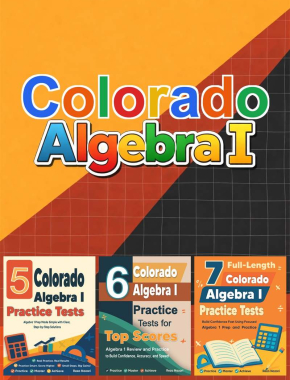
Best Bundle to Ace the Colorado Algebra 1 Test
Want the fastest path through Colorado Algebra 1 math? This bundle pulls it together, four full practice-test books with complete, step-by-step answer keys, instant PDF download.

Related to This Article
More math articles
- How to Find Domain and Range of Radical Functions? (+FREE Worksheet!)
- Waves, Tides, Currents, and Ocean Resources
- Functions of Political Parties
- The Best Grade 4 Math Book for Massachusetts Students
- The Ultimate GED Math Course [Updated for 2026]
- CPA FAR Blueprint: What to Recheck in a Course (2027 Prep)
- The Best Grade 8 ELA Practice Tests for Minnesota Students
- Alabama ACAP Grade 8 Math Free Worksheets: 72 Printable PDFs with Step-by-Step Answer Keys
- Top 10 ATI TEAS 7 Math Practice Questions
- Presidential nomination process










What people say about "Colorado Algebra 1: Free Worksheets"?
No one replied yet.