The Best Pre-Algebra Book to Build a Rock-Solid Foundation
Almost every student who struggles with algebra was actually let down earlier — in pre-algebra. Algebra gets the blame because that is where the bad grade shows up, but the real damage was done when fractions, negative numbers, or the order of operations never quite became automatic. Pre-algebra is the foundation. Pour it unevenly and everything built on top of it tilts.
That is why choosing the right pre-algebra book matters more than people think. It is not a warm-up. It is the single best investment you can make in a student’s entire math future. Get it right, and algebra feels like a natural next step instead of a cliff.
Here is the book we recommend to anyone — student, parent, or teacher — who wants to build that foundation properly.
Our pick: Pre-Algebra for Beginners
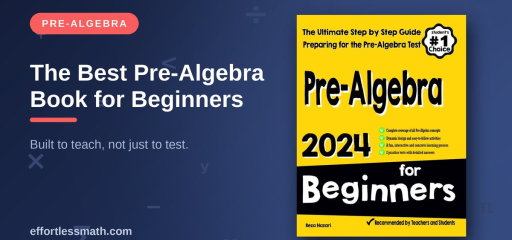
Pre-Algebra for Beginners does one thing exceptionally well: it makes sure no skill gets left behind. Pre-algebra is really a collection of separate abilities — working with fractions, decimals, percents, integers, ratios, exponents, and basic equations — and a weak book lets a student coast past the ones they find hard. This book does not allow it. Each topic is taught in full, demonstrated, and practiced until it holds.
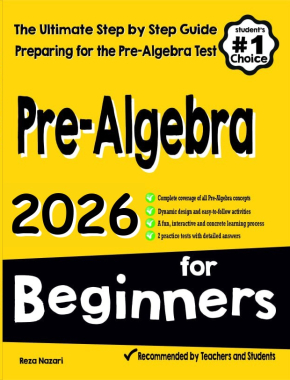
Pre-Algebra for Beginners 2026 The Ultimate Step by Step Guide to Preparing for the Pre-Algebra Test
The writing is plain and friendly. There is no jargon dropped on the reader without explanation, no clever shortcuts that only make sense if you already understand the topic. Every idea is introduced as if the reader has never seen it — because in pre-algebra, that is usually true.
Why the right pre-algebra book makes such a difference
Pre-algebra is where math quietly changes character. Up to this point, math was mostly about getting a number answer. Now it starts asking students to follow rules and procedures — and to understand why those rules work. A student who only ever memorized will start to wobble here.
A strong pre-algebra book carries the student across that shift. It does three things a weak book does not:
- It explains the reasoning, not just the rule. Why does a negative times a negative make a positive? Why do you flip and multiply to divide fractions? When students understand the why, the rules stop being random and start being memorable.
- It practices each skill to the point of fluency. Knowing how to add fractions is not enough — you need to do it without thinking, because in algebra it will be buried inside a bigger problem.
- It builds gradually. Topics are ordered so each one leans on the last, with no sudden leaps.
What is inside the book
Pre-Algebra for Beginners covers the complete pre-algebra course, in a sensible order:
- Whole numbers and integers — including operations with negative numbers
- Fractions and mixed numbers — the topic that derails the most students
- Decimals — reading, comparing, and computing
- Ratios, rates, and proportions
- Percents — and the real-world problems that use them
- Exponents, roots, and scientific notation
- The order of operations and the basics of expressions
- Introductory equations and inequalities
- A first look at the coordinate plane and graphing
Each section follows the same dependable pattern: a clear explanation, worked examples that show every step, then a focused practice set with an answer key. Because the answers are right there, a student studying alone always knows immediately whether an idea has clicked.
A look at one topic done right
Fractions are where pre-algebra books either earn their keep or fail. A weak book treats “adding fractions” as one lesson. This book treats it as a sequence: first you understand what a fraction is, then equivalent fractions, then common denominators, then addition with like denominators, then addition with unlike denominators, then mixed numbers. Each step is small enough to take alone.
By the time a student adds 2/3 + 3/4, they are not guessing. They know they need a common denominator, they know how to find it, and they know why. That confidence with fractions is exactly what a student carries into algebra — where fractions appear constantly inside equations.
Who this book is for
- Students in grades 6–8 taking pre-algebra and wanting it to truly stick
- Homeschooling families who need a clear, self-contained curriculum
- Students about to start Algebra 1 who want a confident running start
- Adult learners rebuilding math basics before a placement or equivalency test
- Anyone whose math anxiety started somewhere in the fractions-and-negatives zone
How to study with it
Pre-algebra rewards short, steady sessions. A workable plan for most learners:
- Study 3 to 4 times a week, 30–45 minutes each time.
- Always do the practice problems with a pencil — never just read them.
- Check your answers after every few problems, not at the end.
- Do not move to a new section until the current one feels easy. A skipped weak spot does not stay quiet.
- Spend extra time on fractions, integers, and order of operations. They show up in everything that comes next.
At a steady pace, most students finish in 8 to 12 weeks — and walk into algebra prepared instead of nervous. When that day comes, our guide to the best Algebra 1 book is the natural next step, and the Ultimate Algebra Bundle keeps the same approach going all the way through Algebra 2.
Common mistakes to avoid
- Treating pre-algebra as optional. It is the most important math year most students will have. Skipping or rushing it guarantees trouble later.
- Memorizing fraction rules without understanding them. Memory fades; understanding does not.
- Doing math only in your head. Writing every step builds the habits algebra demands.
- Ignoring word problems. They feel harder, so students skip them — but they teach the reasoning that algebra is built on.
Frequently asked questions
What is the difference between pre-algebra and algebra?
Pre-algebra strengthens the number skills — fractions, decimals, percents, integers — and introduces variables and simple equations. Algebra 1 then uses those skills heavily while focusing on equations, functions, and graphing. Pre-algebra is the bridge.
What grade is pre-algebra for?
It is typically taught in grades 6 to 8, but it is genuinely for any age. Many adults returning to school work through pre-algebra first, and it is just as useful for them.
Can my child use this book without a tutor?
Yes. Pre-Algebra for Beginners was written for independent study — clear explanations, full worked examples, and an answer key for instant feedback. A motivated student can work through it largely on their own.
How do I know if a student is ready for Algebra 1?
They should be comfortable — not just familiar — with fractions, decimals, percents, negative numbers, and the order of operations. If those are solid, they are ready.
How long should pre-algebra take?
About 8 to 12 weeks of steady self-study, or a full school year in a classroom. Mastery matters far more than speed.
The bottom line
The best pre-algebra book is not the one with the most pages or the brightest cover — it is the one that leaves no skill behind. Pre-Algebra for Beginners builds the foundation carefully, one solid layer at a time, so that when algebra arrives it feels like the next logical step rather than a sudden, frightening jump.
Give a student a strong pre-algebra foundation and you have not just helped them pass one course. You have changed how they feel about math for years to come.

Related to This Article
More math articles
- How To Check Your Work During Math Exams?
- How to Use Properties of Numbers to Write Equivalent Expressions?
- 8th Grade MAP Math Worksheets: FREE & Printable
- Iron triangles
- How to Find the Greatest Common Factor (GCF)? (+FREE Worksheet!)
- How to Use Right-Triangle Trigonometry
- Two-Column Proofs: How to Write Statements and Reasons
- 3rd Grade MEAP Math Worksheets: FREE & Printable
- Top 10 Tips to Overcome ASTB Math Anxiety
- 6th Grade SBAC Math Practice Test Questions

















What people say about "The Best Pre-Algebra Book for a Solid Foundation"?
No one replied yet.