Geometry Puzzle – Challenge 75
A cube has surface area 3a and volume 2a. Find the total edge length (a cube has 12 edges). Set 6x^2 = 3a and x^3 = 2a, solve to get x = 4, and total edge length = 12 times 4 = 48 feet.
Key takeaways:
- Cube: 6 faces (each x^2), 12 edges (each x), volume x^3.
- Surface area equation: 6x^2 = 3a, so a = 2x^2.
- Volume equation: x^3 = 2a = 2(2x^2) = 4x^2.
- Solve x^3 = 4x^2: divide by x^2, x = 4.
- Total edge length = 12 times 4 = 48.
Here you find a math puzzle to develop your child’s math skills and geometry facts in a fun way.
Challenge:
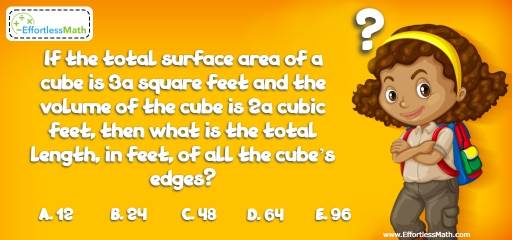
If the total surface area of a cube is 3a square feet and the volume of the cube is 2a cubic feet, then what is the total length, in feet, of all the cube’s edges?
A- 12
B- 24
C- 48
D- 64
E- 96
The Absolute Best Book to Challenge Your Smart Student!

The correct answer is C.
Original price was: $27.99.$17.99Current price is: $17.99.
A cube has 12 edges. Let x be the edge of the cube. So:
Surface area of the cube = 6 (one side)\(^2 = 6x^2 =3a\)
\(x^2 = \frac{1}{2} a → x = \sqrt{\frac{1}{2 }a} = (\frac{1}{2} a)^{\frac{1}{2}}\)
Volume of the cube = (one side)\(^3 = x^3 =2a → x = \sqrt[3]{2a} = (2a)^{\frac{1}{3}}\)
Solve for a for both equations:
\((\frac{1}{2} a)^{\frac{1}{2}} = (2a)^{\frac{1}{3}}\)
Both sides to the power of 6:
\((\frac{1}{2} a)^3 = (2a)^2 → \frac{1}{8} a^3 = 4a^2
→ \frac{1}{8} a = 4 → a = 32\)
Therefore, the volume of the cube is 64 cubic feet and one side is 4.
The total length of all the cube’s edges is 48 feet. (4 × 12 = 48)The Best Books to Ace Algebra
Frequently Asked Questions
How many edges does a cube have?
12 edges, three sets of 4 parallel edges, one set per pair of opposite faces.
Why is surface area 6x^2?
A cube has 6 congruent square faces, each with side x. Each face area is x^2, so the total surface area is 6x^2.
Why is volume x^3?
Length times width times height = x times x times x = x^3.
How do I solve the two equations?
From 6x^2 = 3a, get a = 2x^2. Substitute into x^3 = 2a: x^3 = 2(2x^2) = 4x^2. Divide both sides by x^2: x = 4.
Why can I divide by x^2?
Because x is the edge length of a real cube, so x is positive (nonzero). Dividing both sides by x^2 is valid.
What is a (the parameter)?
From a = 2x^2 with x = 4: a = 2(16) = 32. So the cube has surface area 3(32) = 96 and volume 2(32) = 64. Edge = 4, total edges = 48.
How can I check the answer?
Verify: edge 4 means surface area = 6(16) = 96 = 3(32) ✓. Volume = 64 = 2(32) ✓. Total edges = 12(4) = 48.
Is x = 0 also a mathematical solution?
Yes, x^3 = 4x^2 has solutions x = 0 and x = 4. But x = 0 gives a degenerate “cube” with no size, which is not a real cube.
What if surface area and volume were 6a and a?
Set 6x^2 = 6a (so a = x^2) and x^3 = a = x^2. Divide by x^2: x = 1. Total edges = 12.
Why is this kind of problem valuable?
It connects multiple geometric measures (surface area, volume, edge length) via a shared parameter. The translation skill, relating expressions for different quantities, is the heart of algebra.
Related Lessons You May Like
- How to find the area of rectangles
- How to find the perimeter of rectangles
- How to find volume and surface area of cubes
- How to solve percent of change
- How to solve multi-step word problems
If your student enjoys puzzles like this, Geometry for Beginners works the same relationships inside a full curriculum. Pre-Algebra for Beginners covers the algebraic foundations gently.

Related to This Article
More math articles
- Decolonization, Iran, Guatemala, and Covert Containment
- 5 Best Digital Pen Tablets for Online Math Teaching in 2026
- CLEP U.S. History I 002: Environment, Agriculture, and Regional Adaptation
- Free Grade 5 English Worksheets for Missouri Students
- The Best Grade 5 ELA Practice Tests for Nebraska Students
- Best Laptops for High School Students: 6 Things to Consider
- Standard Form of a Circle
- The Ultimate 6th Grade LEAP Math Course (+FREE Worksheets)
- The Best Grade 3 ELA Practice Tests for Washington Students
- How to Solve the Absolute Value of Rational Numbers?








What people say about "Cube Surface Area and Volume Puzzle"?
No one replied yet.