Microorganisms and Disease
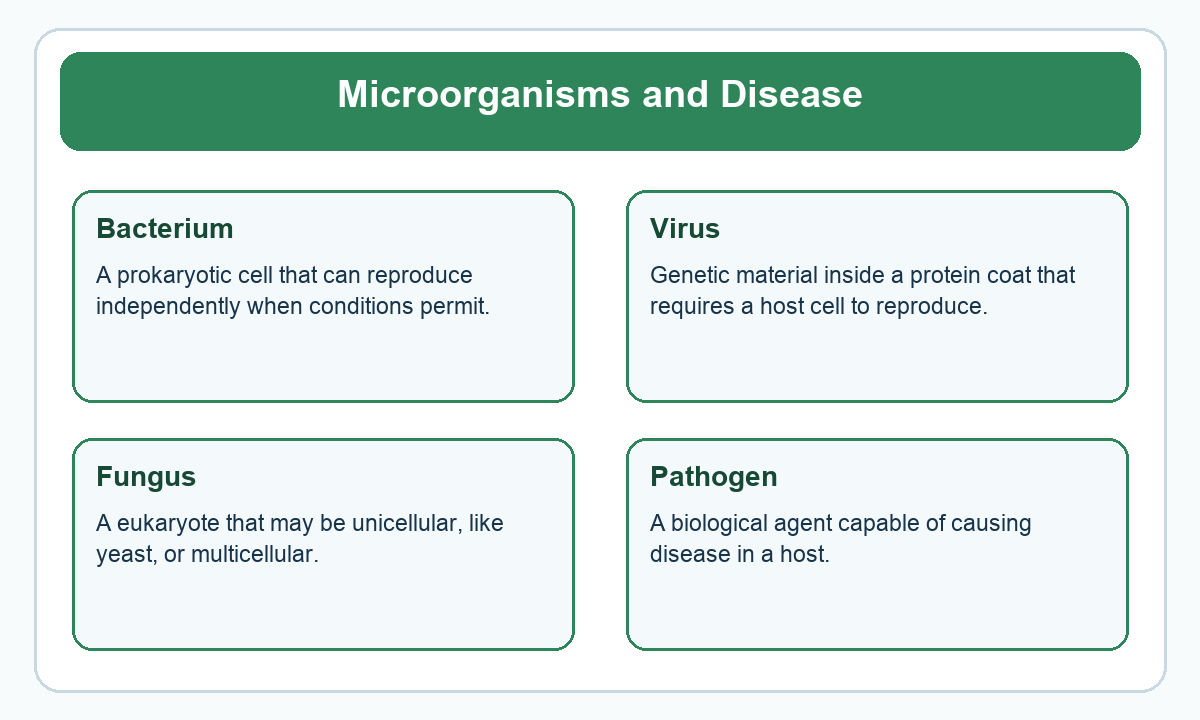
A bacterium growing in broth, a yeast cell budding, and a virus multiplying inside a cell can all appear in a lesson about microbes. Their biology differs. The structures they possess help explain how they reproduce and why a method that affects one group may have little effect on another.
Microorganisms include bacteria, microscopic fungi, many protists, and microscopic algae. Viruses are acellular infectious agents. A pathogen is an agent capable of causing disease in a host, so the word describes a relationship with the host rather than a separate branch of cellular life.
Start with the cell
Bacteria have a plasma membrane, ribosomes, and DNA but no membrane-bound nucleus, and many reproduce by binary fission when nutrients and other conditions permit. Some bacterial species depend on living host cells, so host dependence alone cannot establish that an unknown agent is a virus.
Fungi are eukaryotes. Yeast can live as single cells, while a mold grows as branching filaments called hyphae. A fungal cell has a nucleus and differs from a bacterium in its wall chemistry and other cellular features. Protists include another wide range of eukaryotic organisms. Their shared informal label does not imply that all have the same feeding method or cause disease.
Viruses depend on cellular machinery
A virus carries genetic material in a protein coat, sometimes surrounded by a lipid envelope, but lacks the complete ribosomes and metabolic machinery needed to make new viruses independently. Once infection begins, viral genes direct processes that use host-cell components to produce viral genomes and proteins.
An antibacterial drug may act on bacterial ribosomes or cell-wall synthesis. A virus lacks those bacterial targets. Antiviral medicines instead act on particular stages of viral infection or replication. The relevant target matters. This is a biological explanation of treatment differences, not a way to diagnose an infection from symptoms.
Trace transmission through the environment
Imagine a microorganism leaving one host and entering another. Its route might involve contaminated food, inhaled particles, direct contact, or a biting vector. The route determines which barrier can interrupt the transfer.
For a classroom example, suppose a disease is transmitted by mosquitoes. Reducing contact with the vector addresses that route. Cleaning a desk does not directly interrupt the mosquito bite. In a food-contamination example, preventing microbes from reaching food and limiting their growth address different parts of the problem.
Protection also depends on the host. An organism that causes little trouble on an intact body surface may cause disease after entering a normally protected tissue. Normal microbiota can compete with pathogens and participate in digestion. Their effects depend on location and conditions.
Resistance changes a population
Suppose a bacterial population already contains a resistant variant. Exposure to an antibiotic suppresses susceptible bacteria, while resistant survivors can leave offspring. Resistance becomes more common through selection. The bacteria did not choose a defense because they needed one.
Resistance genes can also move between bacteria. That transfer supplies variation for selection to act on. When reading an experiment, distinguish evidence that a population changed from evidence explaining how the resistant trait first arose.
A plasmid can carry a resistance gene separately from the main bacterial chromosome. Transfer of that DNA can give a recipient a new trait, provided the gene is maintained and expressed under relevant conditions.
Watch a short lesson
The microorganisms video compares major groups and their cell structures, supporting accurate disease and treatment reasoning.
Can you check your understanding?
Answer before opening each explanation.
-
Which cell features distinguish a bacterium from a virus?
Check the answer
A bacterium has a cellular membrane, ribosomes, and its own cellular machinery. A virus is acellular and lacks a complete independent protein-production system.
-
Is every microorganism a pathogen?
Check the answer
No. Many microbes are harmless in their usual setting or contribute to processes such as nutrient cycling and digestion.
-
Why does an antibacterial cell-wall target not work on a virus?
Check the answer
A virus does not build a bacterial cell wall. The target is absent.
-
What does a vector do?
Check the answer
It transmits a pathogen between hosts. A mosquito can carry a pathogen even though the mosquito and pathogen are different organisms.
-
How can resistance increase after antibiotic exposure?
Check the answer
Resistant variants survive or reproduce better under that exposure, increasing their representation in later generations.
-
Does dependence on a host prove that an agent is a virus?
Check the answer
No. Some cellular organisms also depend on hosts. Cell structure and additional evidence are needed.
Where does this fit in your science review?
The ATI TEAS Science Study Hub places this lesson inside the larger biology review. Continue with these connected lessons:

Related to This Article
More math articles
- Ohio OST Grade 6 Math Free Worksheets: Printable Practice Worksheets with Step-by-Step Keys
- Descending into Numbers: A Deep Dive into the Floor Value
- 5 Best CHSPE Math Study Guides
- Efficient Study Techniques for Tackling Advanced Math Topics
- New Mexico MSSA Grade 7 Math Worksheets: 95 Free Printable PDFs with Step-by-Step Keys
- Arizona Algebra 1 Free Worksheets: Free Printable Practice for Every Algebra 1 Skill
- Top 10 Tips to ACE the Praxis Core Math Test
- Ethnicity and Minority-Group Status
- Writing Functions
- Best Back-to-School Math Apps for Students














What people say about "Microorganisms and Disease"?
No one replied yet.