3rd Grade Math: The Complete Parent’s Guide for 2026

Third grade is the year math gets serious. Counting and place value give way to multiplication, division, fractions, and word problems. If you have ever caught yourself thinking, “Wait, this is what they expect now?”. You are not alone. This guide is for the parent who wants to help, without becoming the teacher.
What 3rd Graders Should Know by Year-End
Across most US states (Common Core, TEKS in Texas, B.E.S.T. In Florida, and others), 3rd grade math centers on five big ideas.
1. Multiplication and division within 100
By June, your child should know multiplication facts 0×0 through 10×10 from memory and understand division as the inverse. Example: if \(4 \times 6 = 24\), then \(24 \div 6 = 4\).
2. Multi-digit addition and subtraction
Adding and subtracting numbers up to 1,000 fluently using the standard algorithm. Borrowing across zeros is a notorious struggle.
3. Introduction to fractions
Identifying fractions on a number line, comparing fractions with the same numerator or denominator, and recognizing equivalent fractions like \(\dfrac{1}{2} = \dfrac{2}{4}\).
4. Area and perimeter
Calculating area by counting unit squares and by multiplying length × width. Finding perimeter by adding side lengths.
5. Time, money, and measurement word problems
Telling time to the minute, calculating elapsed time, solving word problems with money, and converting basic measurements.
The Topics Where Most 3rd Graders Struggle
Multiplication memorization
The shift from “counting to find the answer” to “remembering the answer” is hard. Kids who can solve \(7 \times 8\) but take 15 seconds to do it will fall behind in 4th grade. Speed matters at this stage. Aim for under 3 seconds per fact by spring.

Fractions as a “thing”
Fractions are the first time a number can be smaller than a whole. Many 3rd graders default to thinking \(\dfrac{1}{4} > \dfrac{1}{2}\) because 4 is bigger than 2. Use visual fraction bars and number lines until the concept clicks.
Multi-step word problems
“Sarah had 24 stickers. She gave 3 to each of her 4 friends. How many does she have left?”. This is a 2-step problem, and 3rd graders often answer just one step. Teach them to circle the question and underline the numbers.
Borrowing across zeros
$500 – 247$ trips kids up because they have to borrow twice. Spend extra time here.
A Weekly Practice Routine That Works
You do not need a curriculum. You need 15 to 20 minutes a day, 5 days a week.
- Monday, Multiplication facts. 5 minutes of timed practice, 10 minutes of mixed-fact worksheet.
- Tuesday, Word problems. Three to four word problems, read out loud together.
- Wednesday, Fractions. Practice with visual models, paper-folding pizza slices or fraction bars.
- Thursday, Multi-digit addition or subtraction. One column-addition worksheet.
- Friday, Mixed review. A short “what did we learn this week” review sheet.
Saturday is the high-value day. Pick one real-world activity:
– Bake something, measure cups, halve the recipe, double it.
– Shopping math, let your child add the cart total mentally.
– Board games, Yahtzee, Monopoly Jr., or Sum Swamp build math habits without “feeling like” math.
Recommended Practice Resources
What to Do If Your Child Falls Behind
Catch it early. The signs:
- Counts on fingers for basic addition.
- Cannot answer \(7 \times 8\) within 5 seconds by April.
- Struggles to draw a fraction on a number line.
- Solves only the first step of a multi-step word problem.
If you see two or more of these, get on top of it now. 3rd grade math gaps become 4th grade disasters because the curriculum does not slow down.
What works:
- Daily 10-minute practice. Tiny and consistent beats long-and-occasional.
- A visual approach to fractions. Hands-on with food, paper, or fraction bars.
- Multiplication card games. Decks of multiplication flashcards used as Memory or War.
- A short, free worksheet set keyed to the topic. (Effortless Math has hundreds.)
- A conversation with the teacher. Teachers usually have an early-warning sense and free resources.
A Note on State Tests
3rd grade is the first year your child takes a high-stakes state math test in most states, STAAR (Texas), FAST (Florida), MAP, NJSLA, MCAS, and others. The test is not the goal, but it is a real checkpoint. By March of 3rd grade, your child should be able to:
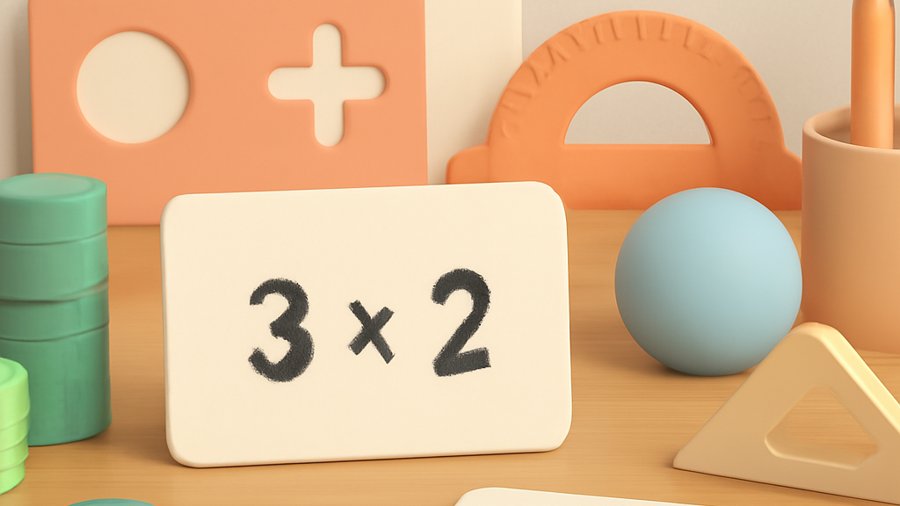
- Solve a 2-step word problem with multiplication or division.
- Identify equivalent fractions on a number line.
- Calculate the area of a rectangle using length × width.
- Add and subtract 3-digit numbers fluently.
Free Resources
Effortless Math has built a complete free 3rd grade math system:
- 3rd Grade Math Worksheets (resource currently unavailable), every 3rd grade topic, printable, with answer keys.
- 3rd Grade Math eBooks, comprehensive workbooks and prep books.
- Math Topics Library, every topic explained at a kid-friendly level.
Frequently Asked Questions
Should my 3rd grader know multiplication facts by heart?
Yes, by the end of 3rd grade, they should know 0×0 through 10×10 from memory. Most state standards expect fluency by April.
How much math homework is normal in 3rd grade?
About 10 to 20 minutes per night, with some weeks lighter and some heavier. Read the school’s homework policy if you are unsure.
Is it okay for my 3rd grader to use a calculator?
For learning, no, practice mental math. For real-world contexts like grocery shopping, occasional use is fine.
My child says they “hate math.” What do I do?
Start small. Find the math they already enjoy (cooking, sports stats, Minecraft) and build from there. Never force long sessions. Confidence first, drill second.
How do I help with fractions when I am rusty myself?
You don’t need to be the expert. Use fraction bars, paper-folding, and YouTube videos. Sit next to your child and learn together. Modeling that learning is okay is one of the best gifts you can give a math-anxious kid.
What if my child is ahead in math?
Don’t push them through 4th grade content. Instead, go deeper, challenging word problems, math puzzles, logic problems, beginner pre-algebra concepts. Depth beats acceleration at this age.
You Are the Most Important Tutor
You do not need to be a math teacher. You need to be the parent who shows up for 15 minutes a day, asks “how did you get that?”, and celebrates the small wins. Third grade is the year a child decides whether they are “a math person.” Help them decide yes.
Keep Practicing With the Right Resources

Related to This Article
More math articles
- Market power puts demand and MR on the same firm graph
- Geometry Puzzle – Challenge 70
- 7th Grade Scantron Math Worksheets: FREE & Printable
- The 5 BEST Online Math Tutoring Tools
- Matter and Materials
- Marx, Durkheim, and Weber
- Recruiting candidates
- Chapter 15: The Federal Courts
- Principal-agent problems and bureaucratic models
- What is the Relationship Between Arcs and Chords?








What people say about "3rd Grade Math: The Complete Parent's Guide"?
No one replied yet.