7th Grade Math: The Complete Parent’s Guide for 2026

TL;DR: Trying to support a 7th grader through math this year? Here is your guide to the curriculum, the spots where most students hit a wall, and a study routine that fits 2026 standards. Two-step equations, proportional relationships, signed numbers, basic probability. These are the big themes of 7th grade math. Knowing what’s coming and how to help your child keep up turns the year from a scramble into a steady climb.
Key takeaways:
- Five major strands: proportional relationships, rational number operations, expressions/equations, geometry, statistics/probability.
- Two-step equations and multi-step proportions are the year’s biggest skills.
- Signed-number operations (positive/negative fractions and decimals) become fluent.
- Aligns with Common Core, TEKS, B.E.S.T. (Florida), and NJSLS state standards.
- Daily 20-30 minute practice routine works better than weekend cramming.
If 6th grade introduced the abstract idea of variables, 7th grade puts that idea to work. Two-step equations. Multi-step proportions. Probability. Signed-number operations across all four basics. Your 7th grader is being asked to think like a mathematician, not just compute like a calculator.
This guide gives you the curriculum, the common struggles, the routine, and the resources.
What 7th Graders Learn in Math
Across most US states (Common Core, TEKS, B.E.S.T., NJSLS), 7th grade math is built on five strands.
1. Ratios and proportional relationships (deepened)
- Identifying when two quantities are proportional.
- Constant of proportionality (\(k\) in \(y = kx\)).
- Solving multi-step ratio, percent, and proportion problems.
- Markup, markdown, simple interest, percent change.
2. The number system: operations with all rational numbers
- Adding, subtracting, multiplying, and dividing positive and negative fractions and decimals fluently.
- Understanding that subtraction is “adding the opposite.”
- Converting between fractions and terminating or repeating decimals.
3. Expressions and equations
- Using the distributive property to expand and combine like terms.
- Solving two-step equations: \(3x + 5 = 14\).
- Solving two-step inequalities and graphing solutions on a number line.
4. Geometry
- Scale drawings and similar figures.
- Constructing triangles given side or angle information.
- Area and circumference of circles (using \(\pi\)).
- Surface area and volume of right prisms and cylinders.
5. Statistics and probability
- Random sampling and inferences about populations.
- Comparing two populations using measures of center and spread.
- Theoretical and experimental probability.
- Compound probability with simulations.
Where 7th Graders Struggle
Operations with negative fractions
\(-\dfrac{2}{3} – \dfrac{1}{4} = ?\), multiple skills at once. Common denominators plus signed-number rules plus fraction arithmetic. Slow it down. Do one step at a time.

The distributive property with subtraction
\(5 – 2(x – 3) = ?\), many 7th graders distribute wrong because the subtraction sign sticks to the 2. The correct expansion is \(5 – 2x + 6 = 11 – 2x\), not $5 – 2x – 6$.
Two-step equations
\(3x + 5 = 14\). The order matters: undo addition or subtraction first, then undo multiplication or division. Visual “balance scales” help students see why.
Percent change
“A shirt went from \$50 to \$35. What percent decrease?” Many 7th graders subtract first but then forget to divide by the original price. The formula: \(\dfrac{\text{change}}{\text{original}} \times 100\%\).
Probability vocabulary
“Theoretical,” “experimental,” “compound,” “independent”, kids drown in vocabulary. Pair each term with a coin or die example.
A Weekly Practice Routine
25 to 35 minutes a day, 5 days a week.
- Monday, Proportional relationships. Unit rate, percent change, similar figures.
- Tuesday, Integer and rational number operations. Mixed signs, fractions, decimals.
- Wednesday, Expressions and equations. Distributing, combining like terms, two-step equations.
- Thursday, Geometry or probability. Area of circles, volume, or coin/dice probability.
- Friday, Mixed review. Everything from the week.
Weekend math, keep it real: – Calculate tip and split the bill (percent and rate). – Plan a trip: gas mileage, cost per mile, travel time (proportional reasoning). – Play card or dice games, keep track of probabilities. – Cook with a recipe and scale it for more or fewer people.
Recommended Practice Resources
Warning Signs to Watch For
By December of 7th grade, your child should comfortably: – Add and subtract integers and rational numbers reliably. – Find the constant of proportionality from a table. – Solve \(3x – 7 = 14\). – Apply the distributive property: \(4(x + 5) = 4x + 20\). – Calculate 15% of 80 using mental math.
If they cannot, here is what to do:
- Backfill 6th grade skills first. 7th grade builds on 6th. Gaps amplify.
- Daily 15-minute targeted drill on the weakest skill.
- Use visual models. Tape diagrams for proportions. Number lines for integers. Balance scales for equations.
- Free worksheets and YouTube, Khan Academy’s 7th grade content is excellent.
- Stay in contact with the teacher.
State Tests in 7th Grade
By March of 7th grade, your child will face state-test questions like: – “A car travels 250 miles on 8 gallons of gas. How far on 12 gallons?” – “Simplify $3(x – 4) + 2x$.” – “Solve \(2x + 9 = 25\).” – “Find the area of a circle with radius 6 cm.” – “What is the experimental probability of rolling a 4 if you got 4 in 15 of 60 rolls?”

Free Resources
Effortless Math has a complete free 7th grade math system:
- 7th Grade Math Worksheets (resource currently unavailable), every 7th grade topic, printable, with answer keys.
- 7th Grade Math eBooks, workbooks and state-test prep books.
- Math Topics Library, every topic explained at a kid-friendly level.
Frequently Asked Questions
Is 7th grade math harder than 6th grade? Yes. The signed-number operations and multi-step equations require strong fluency. Most kids feel the jump in October or November.
How long should 7th grade math homework take? 30 to 45 minutes a night.
Should my 7th grader still memorize multiplication facts? They should already know them, but if they don’t, this is the year to lock them in. Multi-step problems are torture without instant recall.
Is pre-algebra the same as 7th grade math? In some districts, accelerated 7th graders take “pre-algebra,” which is essentially 8th grade math one year early. Standard 7th grade is one step below.
My child gets the math but tests poorly, what do I do? Often a timing or anxiety issue. Practice timed mixed sets. Build calmness with breath work. Talk to the school counselor if test anxiety is severe.
Should my 7th grader use a calculator? For statistics, geometry with \(\pi\), and longer multi-step problems, yes. For core algebra and integer operations, no, mental math is still building.
Steady Wins the Year
7th grade math is the year your child becomes a real algebra student. The fundamentals you reinforce now, signed numbers, equations, proportional reasoning, pay off through Algebra 1, Algebra 2, and beyond. Show up for 25 minutes a day. Open a worksheet. Sit close. They’ve got this, and so do you.
Keep Practicing With the Right Resources
Recommended EffortlessMath Books
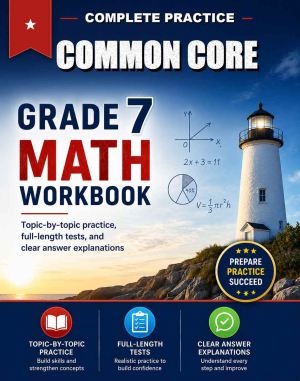
For a workbook that covers the full 7th grade math year, the 7th Grade Math for Beginners (resource currently unavailable) walks through every Common Core standard with worked examples. For state-test prep alongside the curriculum, see the 7th Grade Math Test Prep Bundle (resource currently unavailable).
Related EffortlessMath Lessons
If a topic on this page feels rusty, these short lessons go deeper:

Related to This Article
More math articles
- Wyoming WY-TOPP Grade 8 Math Free Worksheets: Printable Standards-Aligned Practice, Answers Included
- Advanced Vocabulary Words: Deplore to Embonpoint
- Building Strong Body Paragraphs
- SAT And ACT Tests Hacks and Tips
- The Nature of Science
- The Crucial Role of Mathematics in Engineering Education
- 4th Grade MEAP Math Practice Test Questions
- 10 Most Common 7th Grade Georgia Milestones Assessment System Math Questions
- Grade 4 Discussion and Simple Research Skills: Stronger Speaking, Listening, Notes, and Sources
- Atomic Number, Isotopes, and Ions








What people say about "7th Grade Math: The Complete Parent's Guide"?
No one replied yet.