5th Grade Math: The Complete Parent’s Guide for 2026

Fifth grade is the bridge between elementary and middle school math. Your child will spend the year deepening fractions and decimals, learning volume, and meeting the coordinate plane for the first time. By June, they are expected to walk into 6th grade ready for ratios, integers, and the first whisper of algebra.
This guide will tell you what your 5th grader should learn, where most kids struggle, and how to help at home in 20 minutes a day.
What 5th Graders Should Know by Year-End
Across most US states (Common Core, TEKS, B.E.S.T., NJSLS), 5th grade math centers on five big areas.
1. Fraction operations with unlike denominators
- Add and subtract fractions: \(\dfrac{1}{2} + \dfrac{2}{3} = \dfrac{3}{6} + \dfrac{4}{6} = \dfrac{7}{6}\).
- Multiply fractions, including by whole numbers: \(\dfrac{2}{3} \times 6 = 4\).
- Divide unit fractions by whole numbers and whole numbers by unit fractions: \(4 \div \dfrac{1}{2} = 8\).
2. Decimal arithmetic to the thousandths
- Add, subtract, multiply, and divide decimals.
- Read and write decimals to the thousandths place.
- Convert between fractions and decimals.
3. Volume of rectangular prisms
\(V = l \times w \times h\) and additive volume of composite shapes.
4. The coordinate plane (first quadrant)
- Plot points using ordered pairs \((x, y)\).
- Solve simple problems by graphing.
- Recognize patterns when plotted.
5. Order of operations and numerical expressions
- \(4 + 5 \times 2 – 3 = ?\), students learn PEMDAS / GEMDAS.
- Write and evaluate expressions with parentheses.
Where 5th Graders Struggle
Fraction operations with unlike denominators
This is the year fractions become abstract. Adding \(\dfrac{1}{2} + \dfrac{1}{3}\) is no longer “draw a picture and count slices.” It is “find a common denominator.” Many 5th graders try to add numerators and denominators separately: \(\dfrac{1}{2} + \dfrac{1}{3} \neq \dfrac{2}{5}\). Visual models and lots of practice fix this.

Dividing fractions
“\(4 \div \dfrac{1}{2}\)” feels wrong to kids, division should make things smaller, right? Teach the concept first: “How many halves fit inside 4?” Then the “keep, change, flip” rule starts to make sense.
Decimal place value
Many 5th graders think $0.10 > 0.9\( because 10 is bigger than 9. The fix: use place-value charts and money examples (\)0.10 is a dime, $0.90 is 9 dimes).
The coordinate plane
The very first time students see \((x, y)\) coordinates is in 5th grade. Many confuse the order, going up first instead of right first. Use the phrase “hall before stairs“, walk down the hallway (\(x\)) before climbing the stairs (\(y\)).
Word problems with multiple operations
“A recipe calls for \(\dfrac{3}{4}\) cup of flour. You want to make \(\dfrac{1}{2}\) of the recipe. How much flour do you need?”. This is fraction multiplication. Many students don’t recognize the operation. Read the problem out loud and ask: “Are we making more or less?”
A Weekly Practice Routine
20 to 25 minutes a day, 5 days a week.
- Monday, Fraction operations. Mixed problems with like and unlike denominators.
- Tuesday, Decimal arithmetic. Adding and subtracting decimals; multiplying and dividing by 10s.
- Wednesday, Word problems. Three to five multi-step word problems involving fractions or decimals.
- Thursday, Geometry or measurement. Volume, area, or coordinate plane.
- Friday, Mixed review. A short page with everything from the week.
Weekend math, every weekend, do one real-world problem:
– Cooking, halve or double a recipe with fraction measurements.
– Shopping, calculate tax, tip, or 20% off.
– Sports, batting averages, free-throw percentages, race times.
– Home projects, measure a room, calculate the area, figure paint needed.
Recommended Practice Resources
Warning Signs to Watch For
By December of 5th grade, your child should be:
– Adding and subtracting fractions with unlike denominators reliably.
– Multiplying and dividing decimals by 10, 100, 1,000.
– Using the standard long-division algorithm fluently from 4th grade.
– Solving 2-step word problems involving fractions or decimals.
If they aren’t, get help now. Here is what works:
- Daily fraction drill. 10 minutes of fractions every day for 4 weeks fixes 80% of fraction struggles.
- Visual models. Pattern blocks, fraction bars, number lines, anything physical helps.
- Free worksheets. Print, work, correct. Repeat.
- Talk to the teacher. Ask for the specific topics where your child is struggling.
State Tests in 5th Grade
By March of 5th grade, expect your child to be tested on:
– Adding and subtracting fractions with unlike denominators.
– Multiplying and dividing fractions.
– Multi-step decimal word problems.
– Volume of a rectangular prism.
– Plotting points on the coordinate plane.
– Order of operations.

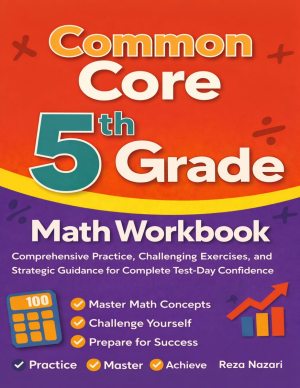
Some states (TX STAAR, FL FAST, OH state test, MO MAP) include fifth grade as part of major accountability testing.
Free Resources
Effortless Math has a complete free 5th grade math system:
- 5th Grade Math Worksheets (resource currently unavailable), every 5th grade topic, printable, with answer keys.
- 5th Grade Math eBooks, workbooks and full-length state-test prep.
- Math Topics Library, every topic explained at a kid-friendly level.
Frequently Asked Questions
How long should 5th grade math homework take?
20 to 35 minutes a night. Some weeks more around projects or tests.
Is the “keep, change, flip” rule for dividing fractions okay?
Yes, but teach the why first. Otherwise it becomes a memorized trick they forget by middle school.
Should my 5th grader be using a calculator?
Sparingly. Most of 5th grade should be pencil-and-paper. Calculators come in heavier in 6th grade.
What is the most important 5th grade math skill for 6th grade?
Fluency with fraction operations. 6th grade ratios and proportions depend entirely on fraction fluency.
My child reads slowly, is that hurting their math?
Often yes. Word problems are where slow readers fall behind. Read problems out loud together. Their math may be stronger than the test score suggests.
Is 5th grade too early for pre-algebra?
For most kids, yes, go deep on fractions and decimals instead. For accelerated kids, basic variable introduction and simple equations are fine.
You Are the Difference
Your child does not need a tutor for most of 5th grade. They need a parent who sits next to them for 20 minutes a day. Math gets harder this year, but with steady practice and a few good worksheets, it stays manageable. Open a free worksheet today, sit down with your 5th grader, and start the routine.
Keep Practicing With the Right Resources

Related to This Article
More math articles
- Genetic Variation, Common Ancestry, and Cladograms
- 10 Most Common 7th Grade Georgia Milestones Assessment System Math Questions
- Production explains the U shapes
- Treasure Hunt: How to Find Tax and Discount Using Percent of a Number
- How to Take Better Math Notes: Cornell, Maps & More
- Ethnocentrism, Relativism, and Cross-Cultural Encounters
- Why Privacy Needs Math: A Student’s Guide to Staying Safe Online
- Reading Scientific Data Tables
- D’Alembert: The Pseudo-Conservative Betting Trap
- Pork-barrel legislation









What people say about "5th Grade Math: The Complete Parent's Guide"?
No one replied yet.