1st Grade Math Guide for Parents: Skills, Milestones, and Home Practice for 2026

First grade is where math stops being a song. The standards jump from counting and shape names to real reasoning: word problems, place value, telling time, comparing two-digit numbers, and adding within twenty. By the time June 2026 rolls around, a first grader who is on track does math fluently enough that second grade carrying and borrowing will feel obvious instead of scary.
This guide lays out exactly what your child should master, what trips most kids up, and what works at home in ten minutes a day.
What 1st Grade Math Actually Covers
The standards group 1st grade into four big domains. The list looks short, but each item has real depth.
| Strand | What mastery looks like by June |
|---|---|
| Operations and algebraic thinking | Adds and subtracts within 20; fluent within 10; solves one-step word problems |
| Number and operations in base ten | Counts to 120; reads and writes numbers to 120; understands tens and ones |
| Measurement and data | Tells time to the hour and half hour; measures with non-standard units; reads bar graphs |
| Geometry | Names 2D and 3D shapes by attributes; splits shapes into halves and fourths |
Anything beyond this list (multiplication tables, long subtraction, fractions with unlike denominators) is enrichment, not standard.
Adding and Subtracting Within 20
This is the single biggest goal of the year. By June a first grader should be fluent within 10 (can answer 7 + 2 or 9 to 4 in about three seconds without counting fingers) and competent within 20 (can answer 8 + 7 in under ten seconds using a strategy).
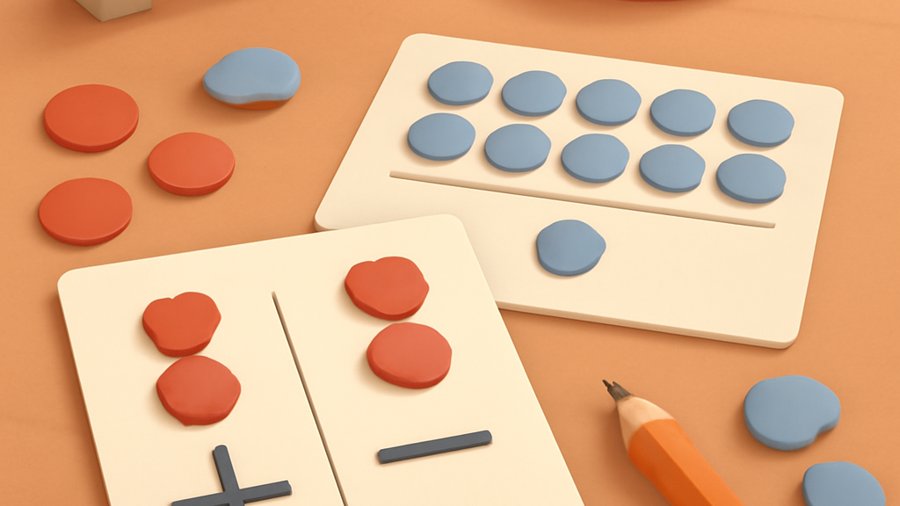
The strategies that matter:
- Counting on. Start at the bigger number, count up. 8 + 3 means 9, 10, 11.
- Doubles and near doubles. Memorize 1+1 through 10+10, then use them. 7 + 8 is 7 + 7 plus one.
- Make ten. 9 + 6 becomes 10 + 5. This is the strategy that scales into algebra later.
- Fact families. 8 + 5 = 13, 5 + 8 = 13, 13 to 8 = 5, 13 to 5 = 8. Four facts, one picture.
If your child still counts every finger for 6 + 7, work on doubles and make-ten before drilling random facts.
Place Value to 120
First graders are expected to count, read, write, and compare numbers up to 120. The point is not the count itself; it is understanding that 47 means four tens and seven ones. A child who gets this fact will breeze through second-grade carrying and borrowing.
Three signs of real mastery:
- Your child can show 47 with base ten blocks (four longs and seven cubes) or with a drawing.
- Given a written number like 83, your child can say “eight tens and three ones.”
- Your child can compare two numbers using <, >, or = and explain why.
Word Problems: The New Hard Part
First-grade word problems come in three shapes the standards label add to, take from, and put together / take apart. By June your child should solve all three in one step, including problems where the unknown is in different positions.
Examples that match the standards:
- Result unknown: “Maria has 4 apples. She buys 3 more. How many now?” (4 + 3 = ?)
- Change unknown: “Maria had 4 apples. Now she has 7. How many did she get?” (4 + ? = 7)
- Start unknown: “Maria had some apples. She got 3 more. Now she has 7. How many did she start with?” (? + 3 = 7)
The last one is the killer. Most parents never solved problems like this in first grade. Practice it explicitly.
Telling Time to the Hour and Half Hour
A first grader needs to read an analog clock at 3:00 and 3:30, both directions: shown a clock, say the time, and given a time, draw the hands. Digital clocks alone are not enough; the standards specifically require analog.
Quick home practice: every time you check your phone for the time, point at an analog clock at the same moment and ask your child to read it.
Money: Coin Identification and Values
The standards vary by state, but most first graders are expected to identify pennies, nickels, dimes, and quarters, and to count small mixed amounts (three dimes and two pennies = 32 cents). Counting on by 5s and 10s makes this easy once it is in place.
Skip the dollar bills for now. They show up in second grade.
Measurement: Compare and Order
First-grade measurement is comparison and non-standard units. A child measures the length of a pencil in paper clips, compares the lengths of three objects, and uses words like longer, shorter, taller, heavier, and lighter accurately. Rulers and inches are largely second grade.

Geometry: Halves and Fourths
First graders learn to split circles and rectangles into two and four equal parts. The vocabulary matters: halves, fourths, quarters, equal shares. This is the seed of fractions.
A child who can fold a paper into halves and then into fourths, name each piece, and tell you that four fourths make a whole has the entire conceptual base for third-grade fractions.
What Second Grade Will Demand
If you want to peek ahead, second grade adds:
- Addition and subtraction within 100 with regrouping.
- Telling time to the nearest five minutes.
- Dollar bills and counting mixed coins and bills.
- Measurement with standard units (inches, centimeters, feet).
- Three-digit numbers and place value to 1,000.
A first grader who is fluent within 10, confident with tens and ones, and comfortable with one-step word problems is ready for all of it.
Ten-Minute Home Routines That Work
You do not need flashcards. You need short, daily, low-pressure practice.
- Doubles ladder. Once a day, climb 1+1, 2+2, 3+3, … 10+10. Two minutes, repeat for a month, watch fluency take off.
- Make ten with cards. Use a deck minus face cards. Flip two; if they make ten, keep them. First to five pairs wins.
- One word problem at dinner. “I have 8 grapes. I ate 3. How many left?” Vary the unknown position.
- Clock check. Every time you say a time, point at the analog clock and ask your child to read it.
- Coin jar. Pull three or four coins. Ask the total. Talk about which coin is worth most.
Two of these a day covers the whole year of standards in less time than a sitcom episode.
What to Do If Your Child Is Behind
The most common gaps in first grade are:
- Cannot count on; still counts every finger.
- Mixes up 13/31, 17/71 (place value confusion).
- Cannot solve change-unknown problems.
- Reads digital clocks fine but freezes on analog.
Each one has a specific fix:
- Counting on: practice with a number line, always start at the bigger number.
- Place value: use base ten blocks; build the number both ways and read it back.
- Change-unknown: act it out with real objects (“I had some; now I have 7; how many did I get?”).
- Analog clocks: cover the digital clock at home for a week.
If your child is struggling on more than two of these in May, ask the teacher about a summer plan. Catching it now is far easier than catching it in third grade.
Frequently Asked Questions
My first grader still uses fingers for addition. Is that bad?
Not at age six. By the middle of second grade, finger use for facts within 10 should fade. Teach strategies (make ten, doubles) and the fingers retire on their own.
Should I drill math facts?
A little drill is fine after strategies are in place. Drilling random facts before a child understands how to add backfires and creates anxiety. Strategies first, fluency second.
Is Common Core math really that different?
The standards are stricter and more conceptual than the older standards. Your child is expected to understand why 47 means four tens and seven ones, not just write the number. That is a feature, not a bug.
How many math worksheets per week at home?
Two short pages a week is plenty if your child is on track. Replace extra worksheets with verbal word problems and games.
My child loves math apps. Are they enough?
Apps are a fine supplement but not a replacement. The standards require word problems, hands-on shape work, and analog clock reading, all of which suffer when math is only on a screen.
Closing Thought
First grade math is small in scope but big in implication. A child who finishes the year fluent within 10, confident with place value to 120, and able to solve one-step word problems in any position is set up for years. Pick two routines, run them most days, and the rest takes care of itself.
For grade-level practice, browse 1st-grade math worksheets and our complete Math Topics library. When you are ready for a structured workbook, our elementary collection is built for exactly these skills.

Related to This Article
More math articles
- Tests used in religion cases
- Diving Deep with Division: How to Handle Four-digit Numbers with Two-digit Divisors
- Using Number Lines to Represent Fractions
- Free Grade 6 English Worksheets for North Carolina Students
- How to Determine the Missing Number when Multiplying Decimals by Powers of 10
- From Collective Behavior to Social Movements
- SBAC Math Flashcards (Free Online: Formulas, Terms & Concepts)
- Delaware DeSSA Grade 8 Math Free Worksheets: Printable Test-Prep Worksheets with Answer Keys
- List Of the Best Middle School Math Supply for Learning
- What Does SHSAT Stand for?









What people say about "1st Grade Math: A Guide for Parents"?
No one replied yet.