Du Bois, Addams, and Public Sociology
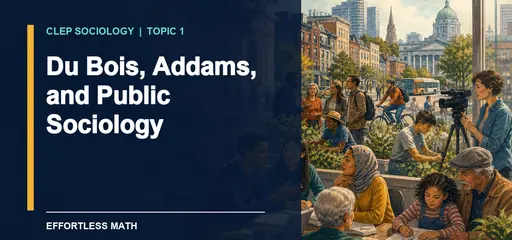
Chapter 1 of the CLEP Sociology study guide on Effortless Math covers Du Bois, Addams, and Public Sociology: the key terms, the core ideas, and worked examples showing how this topic is tested on the exam.

CLEP Sociology – Chapter 1
Du Bois, Addams, and Public Sociology
CLEP Introductory Sociology · Chapter 1
W. E. B. Du Bois and Jane Addams show that early sociology was empirical, urban, and publicly engaged. Their place in the chapter also raises a sociological question about sociology itself. Canonical lists reflect the universities, professional associations, race relations, and gender hierarchies that built them. Recovering excluded work gives a more accurate account of the discipline rather than adding optional figures to an otherwise complete story.
W. E. B. Du Bois combined historical analysis, surveys, maps, and direct community study. In The Philadelphia Negro, he examined households, occupations, institutions, and neighborhoods instead of treating racial inequality as a biological fact. His work showed how discrimination and history shaped social conditions. Numerical patterns and close knowledge of place worked together in his research.
Du Bois described double consciousness as a divided social awareness produced by racism. Under a racist social order, Black Americans may understand themselves through their own experience while also having to anticipate the devaluing judgments of dominant white society. The concept does not mean ordinary indecision or routine role conflict. It connects self-understanding to the color line, unequal citizenship, and the pressure of navigating an imposed racial gaze.
Jane Addams helped found Hull House in Chicago. The settlement offered classes, child care, meeting space, and cultural programs while residents and reformers documented wages, housing, sanitation, labor conditions, and neighborhood needs. Addams carried democracy beyond elections into daily participation. Sustained contact with immigrant communities informed campaigns for labor protections and municipal responsibility.
Addams’s approach joined community inquiry with action, but engagement did not remove the need for careful method. Because settlement workers often held more class and institutional power than neighborhood residents, they had to ask how that imbalance shaped access, interpretation, and whose account entered the record. Claims still had to fit evidence, residents’ knowledge mattered, and reform goals needed to remain visible rather than hide behind a claim of neutrality. A question about neighborhood mapping conducted with residents to support urban reform points toward Addams.
Du Bois and Addams worked before public sociology became a standard label. The contemporary term describes sustained dialogue between sociological research and publics concerned with shared problems. It identifies an audience and purpose, not permission to relax evidentiary standards. Applied sociology often produces research for a specific client, policy, or practical decision. Public sociology emphasizes reciprocal engagement with broader publics. The two can overlap.
These thinkers prepare students for Chapter the related chapter. Du Bois and Addams selected urgent questions, gathered observable evidence, and challenged assumptions that had passed as common sense. Advocacy does not automatically make research sound or unsound. Evaluate the method, transparency, and fit between evidence and conclusion.
Their work also shows why location matters. A citywide average can conceal a neighborhood where rent, disease, or dangerous work is concentrated. Du Bois’s maps and Addams’s settlement records brought those patterns into view, while direct contact helped researchers interpret what a line in a table could not explain. The lesson for a beginner is simple. Count the pattern, learn the setting, and ask who had the power to define the official record.
Quick review: How do Du Bois and Addams connect evidence to inequality? Du Bois combines mapping, history, and community study to explain racial conditions. Addams combines neighborhood inquiry, participation, and reform. Double consciousness is a socially produced divided awareness, not ordinary indecision.
| Thinker | Central question | Core concept or method |
|---|---|---|
| Mills | How does biography connect with history? | Sociological imagination |
| Comte | Can social order be studied systematically? | Positivism |
| Martineau | Do lived arrangements match professed ideals? | Comparative observation |
| Spencer | How do differentiated parts depend on one another? | Organism analogy |
| Marx | Who controls production and benefits from labor? | Class conflict and alienation |
| Durkheim | What creates cohesion and regulation? | Social facts, solidarity, and anomie |
| Weber | What meanings guide action and legitimate authority? | Verstehen and rationalization |
| Du Bois | How do race and history shape social life and selfhood? | Empirical mapping and double consciousness |
| Addams | How can community inquiry inform democratic reform? | Settlement research |
Sociology begins when an ordinary experience becomes a disciplined question about relationships, institutions, history, evidence, and unequal power. Together, these thinkers offer tools for connecting biography to history, tracing control over labor and resources, explaining cohesion and meaningful action, testing public ideals against lived arrangements, and examining how power shapes the canon. Chapter the related chapter develops those tools into the major theoretical perspectives and levels of analysis used in sociology today.
Watch the chapter connection
What Is Sociology? gives you a second explanation of the chapter ideas surrounding this lesson. As you watch, pause when the lesson concept appears and explain how the example fits.
Use this lesson for CLEP practice
Write one original example, one close nonexample, and one observation that would help you choose between them. This turns vocabulary recognition into the kind of applied reasoning the exam expects.

Related to This Article
More math articles
- Pie Graphs
- The Best Grade 3 ELA Practice Tests for Maine Students
- Elements, Compounds, and Mixtures
- Top 10 Tips to Create an ASVAB Math Study Plan
- 5th Grade FSA Math Worksheets: FREE & Printable
- Dividing Fractions for 5th Grade: Keep, Change, Flip
- Fifteenth Amendment
- Hyperbola Calculator — Vertices, Foci & Asymptotes
- 10 Most Common 3rd Grade MCAS Math Questions
- The Best TABE Math Worksheets: FREE & Printable



















What people say about "Du Bois, Addams, and Public Sociology | CLEP Sociology"?
No one replied yet.