Kindergarten Math Guide for Parents: What Your Child Should Know by June 2026

If your child is finishing kindergarten this spring or starting in the fall of 2026, you probably have one big question: is my kid where they should be? The honest answer is that kindergarten math looks very different from the worksheets most of us did at that age. Counting alone is no longer the finish line. Today, a kindergartner is expected to count, compare, decompose, recognize shapes, and explain their thinking out loud.
This guide walks you through every kindergarten math skill, what mastery looks like at home, and the small ten-minute habits that move the needle without flashcards or tears.
What Kindergarten Math Actually Covers
The Common Core and most state standards group kindergarten math into five strands. By the last week of school, a child who is on track can do the following.
| Strand | What mastery looks like |
|---|---|
| Counting and cardinality | Counts to 100 by ones and tens; writes 0 to 20; counts objects up to 20 with one-to-one correspondence |
| Operations and algebraic thinking | Adds and subtracts within 10 using objects, fingers, or drawings; fluent within 5 |
| Number and operations in base ten | Understands teen numbers as ten plus some more (14 = 10 + 4) |
| Measurement and data | Compares lengths, weights, and heights; sorts objects into categories |
| Geometry | Names circle, square, triangle, rectangle, hexagon, cube, cone, cylinder, sphere |
That is the whole list. Notice what is not on it: no multiplication, no fractions, no telling time to the minute, no money beyond identifying coins. If a program is pushing those topics in kindergarten, it is racing ahead of the standards.
Counting to 100: The Skill That Quietly Drives Everything
Counting to 100 is not about memorizing a song. It is about understanding that numbers have a pattern. The teen numbers are the hardest stretch because English is irregular here: we say eleven and twelve instead of “ten-one” and “ten-two.” Once a child crosses 20, the rest of the count to 100 is mostly pattern recognition.
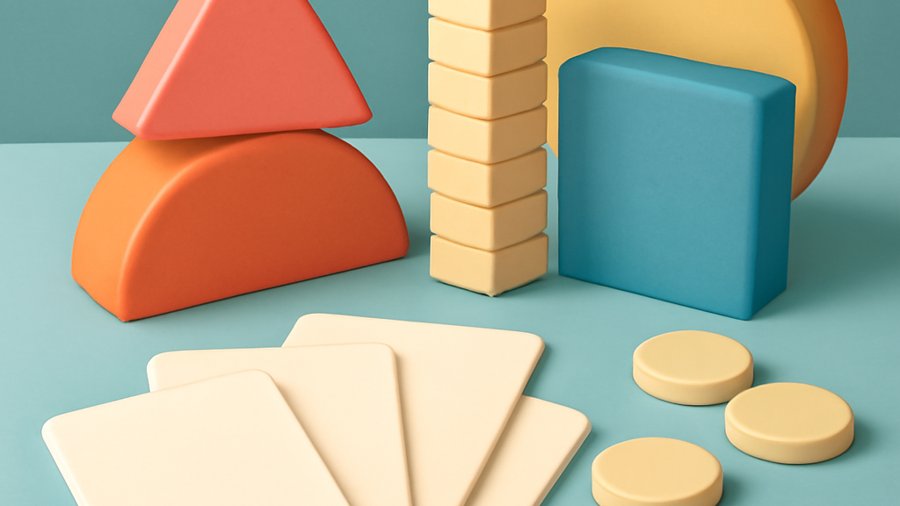
A child who has truly mastered counting to 100 can do four things:
- Count forward from any number (start at 47, keep going).
- Count by tens (10, 20, 30, …, 100).
- Stop and start on command without losing place.
- Recognize and write the digits 0 to 20.
If your child can sing to 100 but stumbles when you ask them to start at 63, they have memorized a song, not a number line. Practice “start anywhere” counting in the car for two minutes a day and the gap closes quickly.
Addition and Subtraction Within 10
Kindergartners are not expected to memorize math facts. They are expected to understand what addition and subtraction mean. Five different strategies show up in classrooms, and your child should be comfortable with at least three.
- Counting all (3 fingers plus 2 fingers, count every finger).
- Counting on (start at 3, count up two more: 4, 5).
- Using a ten frame (fill the frame, see how many are missing).
- Drawing a picture (three circles and two more circles).
- Decomposing (5 = 4 + 1 = 3 + 2 = 2 + 3).
Decomposing is the secret weapon. A child who knows every way to make 5 and every way to make 10 will fly through first-grade addition. Spend a week playing “make ten” with playing cards and you will see the change.
Teen Numbers as Ten Plus Some More
This is the standard parents most often miss because we never learned it that way. A kindergartner is expected to understand that 14 means one group of ten and four ones. They show this with a ten frame full of dots plus four extra, or with ten cubes snapped together plus four loose cubes.
When the teen numbers are taught this way, place value in first and second grade becomes obvious instead of mysterious. If your child still thinks of 14 as a single chunk, build a ten frame at home and practice. A muffin tin and twelve coins works fine.
Shapes and Patterns
Geometry in kindergarten is not about angles or area. It is about names, attributes, and the difference between two-dimensional and three-dimensional shapes. By June, your child should be able to:
- Name flat shapes: circle, square, triangle, rectangle, hexagon.
- Name solid shapes: cube, cone, cylinder, sphere.
- Describe a shape by attributes (“a triangle has three straight sides”).
- Build bigger shapes out of smaller ones (two triangles make a square).
- Spot and extend an AB or ABC pattern (red, blue, red, blue, … or clap, clap, stomp, clap, clap, stomp).
A walk around the block is a free geometry lesson. Point at a stop sign, a wheel, a roof, and ask “how many sides?”
Measurement and Data
Kindergarten measurement is about comparison, not units. Children compare lengths (“this pencil is longer than that crayon”), weights (“the book is heavier than the spoon”), and capacities (“this cup holds more than that one”). They sort buttons into piles, then count and compare the piles.
Sorting laundry is a real measurement lesson. So is loading the dishwasher. The point is the language: longer, shorter, heavier, lighter, more, fewer, same.
What 1st Grade Will Demand
If you are looking ahead, first grade ramps up fast. Within a few months, your child will be:
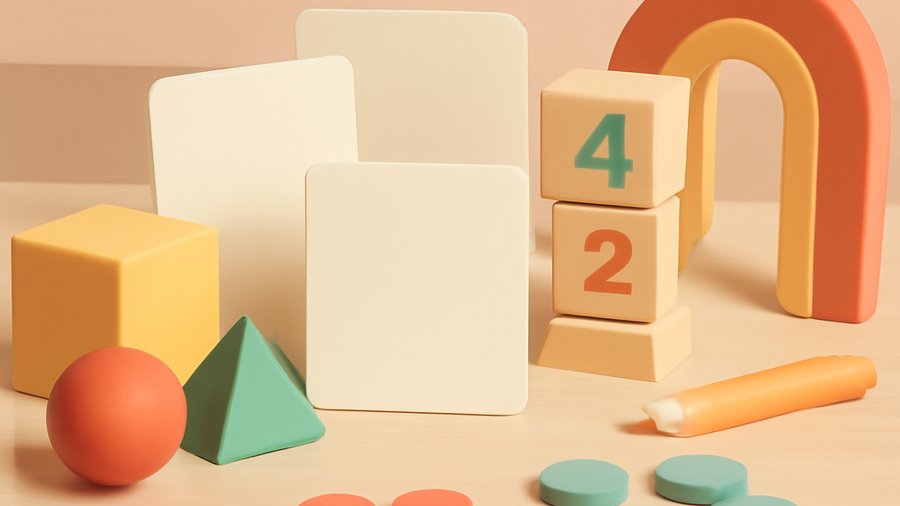
- Adding and subtracting within 20.
- Telling time to the hour and half hour.
- Working with place value up to 100.
- Solving one-step word problems.
- Comparing two-digit numbers with the symbols <, >, =.
A child who finishes kindergarten fluent within 5, comfortable with ten frames, and confident with teen numbers is ready. A child who is still struggling to count to 30 or who guesses at “which pile has more” needs a few focused weeks before September.
Ten-Minute Home Routines That Work
You do not need a curriculum. You need consistency. These five routines, ten minutes a day, cover everything in this guide.
- Counting walk. On the way to the car or the bus, count forward from a random number. Friday, count by tens.
- Make-ten card game. Use a deck with face cards removed. Flip two cards, ask if they make ten. If yes, keep them. First to ten pairs wins.
- Ten-frame breakfast. Use a muffin tin and cereal. Show a number, have your child build it with two rows.
- Shape hunt. Pick a shape of the day. Spot it five times before bedtime.
- Pattern claps. Make a pattern with your hands. Have your child copy it, then extend it.
Two of these a day, alternating, will keep skills sharp through summer.
What to Do If Your Child Is Behind
First, do not panic. Kindergarten math gaps are the easiest to close in the entire K, 12 stretch. Three rules:
- Diagnose specifically. “Behind in math” is not actionable. “Can count to 35 but cannot count on from a number” is.
- Use objects, not worksheets. A child who cannot subtract on paper can almost always subtract with crackers.
- Stop when it stops being fun. Ten minutes of laughter beats thirty minutes of tears every time.
If your child cannot count past 20 by June or cannot recognize the digits 0 to 10 on sight, talk to the teacher and ask about a summer plan. These are foundational and worth catching now.
Should You Worry About Screen Time and Math Apps?
Most kindergarten math apps are fine for ten or fifteen minutes a day. They are not a substitute for hands-on counting with real objects, because the apps do the counting for you. A child who only does math on a screen often cannot transfer the skill to crackers, coins, or blocks. Mix the modes.
Frequently Asked Questions
Should a kindergartner be able to write numbers backwards?
Reversed digits are extremely common through age six and not a sign of any problem. Most children stop reversing on their own by the end of first grade. Just model the correct direction without making it a big deal.
My child counts to 100 but cannot add 2 + 3. Is that normal?
Yes, those are different skills. Counting is memorized; adding is conceptual. Spend a week on ten frames and the addition will click.
How much homework is appropriate?
Most kindergarten programs assign ten to fifteen minutes a night, often just reading. Math homework, if any, should feel like a game. If it is causing stress, talk to the teacher.
Is it better to use fingers or memorize?
Fingers are fine. Children naturally move to mental strategies as they get faster. Forcing memorization in kindergarten usually backfires and creates anxiety.
Does my child need to know multiplication for first grade?
No. Multiplication is a third-grade topic. A child who is fluent adding and subtracting within 10 is well prepared.
Closing Thought
Kindergarten math is short, concrete, and conversational. If you can count, compare, decompose, name shapes, and spot patterns together, your child will walk into first grade ready. Pick two routines from the list above, do them most days through summer, and stop worrying. The work is small and the payoff is big.
For grade-by-grade practice, browse our kindergarten worksheets and our full Math Topics library. When you are ready for a workbook, our elementary collection is built for exactly the skills above.

Related to This Article
More math articles
- How to Apply for College: Complete Guide
- Set Calculator — Union, Intersection & Difference (Free)
- Social movements
- The Best Grade 8 Math Book for New Mexico Students
- Top 10 CLEP College Algebra Practice Questions
- Cooking with Fractions: A Guide to Learn How to Adding and Subtracting Fractions in Recipes
- CLEP U.S. History I 021: Colonial Government and Salutary Neglect
- Oklahoma OSTP Grade 3 Math Prep, the Calm Way: 49 Free Single-Skill Worksheet PDFs
- The Best Grade 6 ELA Practice Tests for Kansas Students
- Media






What people say about "Kindergarten Math: A Guide for Parents"?
No one replied yet.