Mitosis and Meiosis
A human skin cell and a developing sperm cell need different chromosome outcomes. Skin cells usually retain 46 chromosomes after division. Sperm receive 23. To explain the difference, follow the homologous chromosomes and sister chromatids through mitosis and the two divisions of meiosis.
Mitosis is nuclear division that normally preserves the starting chromosome number. With cytokinesis, it usually produces two daughter cells with matching nuclear genetic information, apart from changes such as mutations. Meiosis follows one DNA replication with two divisions and produces haploid products. Homologous chromosomes separate in meiosis I, and sister chromatids separate in meiosis II.
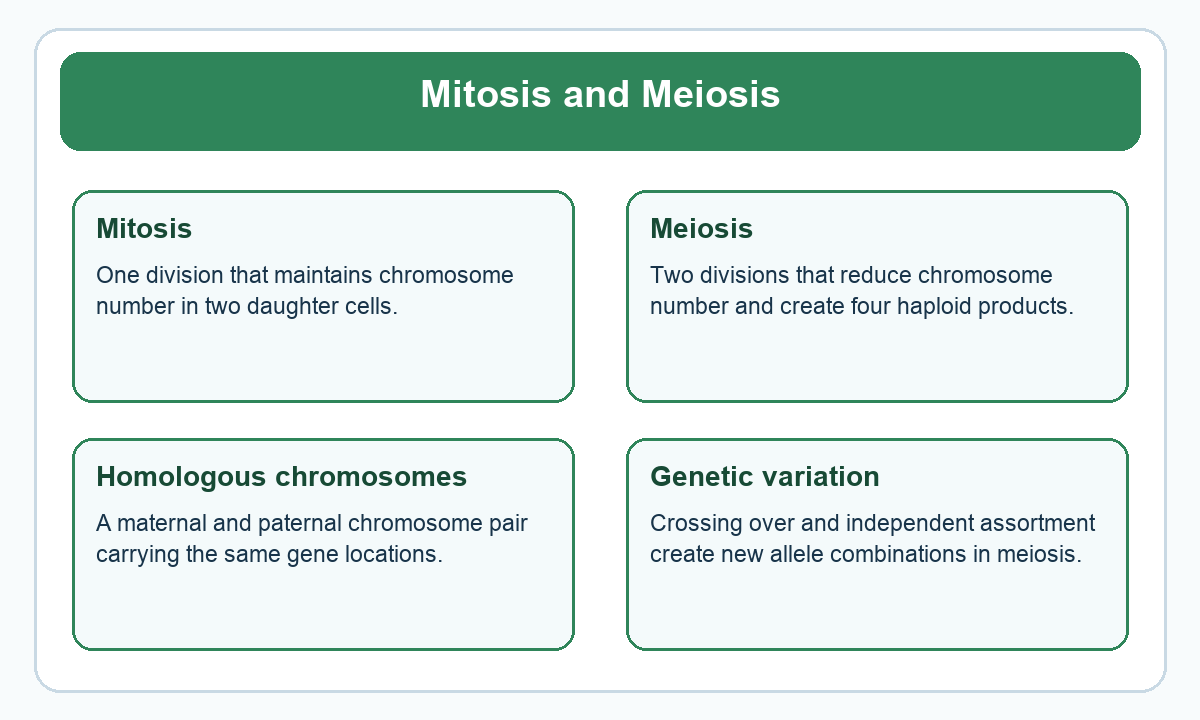
Terms used in this lesson
| Idea | What it means |
|---|---|
| Mitosis | One division that maintains chromosome number in two daughter cells. |
| Meiosis | Two divisions that reduce chromosome number and create four haploid products. |
| Homologous chromosomes | A maternal and paternal chromosome pair carrying the same gene locations. |
| Genetic variation | Crossing over and independent assortment create new allele combinations in meiosis. |
Tell homologs from sister chromatids
A homologous pair contains a chromosome inherited from each parent. The two chromosomes carry corresponding gene locations, but they may have different alleles. After replication, each chromosome consists of two sister chromatids joined in a centromere region.
Count chromosomes by centromeres in the usual classroom convention. Replication doubles the amount of DNA without initially doubling the chromosome count. A replicated human cell still has 46 chromosomes, now consisting of 92 chromatids, before those chromatids separate.
Follow one mitotic division
During mitosis, replicated chromosomes line up individually, and sister chromatids separate into the two developing nuclei. Cytokinesis divides the cytoplasm. A typical diploid human cell produces diploid daughter cells with 46 chromosomes each, provided chromosome segregation proceeds normally.
Mitosis also occurs in haploid cells in some life cycles. Preserving the starting chromosome number is the general rule. Calling every mitotic product diploid would miss those cases.
Follow the two meiotic divisions
In meiosis I, homologous chromosomes pair and then separate. In meiosis II, sister chromatids separate. DNA is not replicated again between these divisions. The result is a set of haploid products, each containing one chromosome from each homologous pair.
In human sperm formation, the four products can develop into sperm. Human egg formation divides the cytoplasm unequally, producing one large functional egg and smaller polar bodies. Four haploid products therefore need not mean four functional eggs.
Explain the variation
Crossing over exchanges corresponding DNA segments between nonsister chromatids of homologous chromosomes during prophase I. Independent assortment also changes which maternal and paternal homologs enter a product. These processes generate new combinations of existing alleles.
Mutation can introduce new alleles, whereas crossing over usually rearranges alleles already present. Random fertilization adds further combinations when gametes unite. For a question about variation, identify which stage the prompt describes before choosing a mechanism.
Check a chromosome-number answer
A diploid cell with six chromosomes has three homologous pairs. Normal meiosis produces haploid products with three chromosomes each. Drawing the three pairs and following one member of each pair makes this reduction visible without confusing the chromosome count with the amount of DNA.
Watch a short lesson
Follow haploid and diploid chromosome sets through meiosis, crossing over, and independent assortment. Compare those outcomes with the mitosis explanation above.
Practice without looking at the answers
Write your responses before opening the answer panels.
-
What separates in meiosis I?
Check the answer
Homologous chromosomes separate. Sister chromatids generally remain joined until meiosis II.
-
What separates in mitosis and meiosis II?
Check the answer
Sister chromatids separate into the developing daughter nuclei.
-
A diploid cell has six chromosomes. How many should each normal meiotic product contain?
Check the answer
Three chromosomes, one from each homologous pair.
-
Is DNA copied between meiosis I and meiosis II?
Check the answer
No. One replication before meiosis is followed by two divisions.
-
Why can homologous chromosomes carry different genetic information?
Check the answer
They have corresponding gene locations but can carry different alleles inherited from the two parents.
-
Does human egg formation yield four functional eggs from one cell entering meiosis?
Check the answer
No. Unequal division produces one large functional egg and smaller polar bodies.
Where does this fit in your science review?
The ATI TEAS Science Study Hub places this lesson inside the larger biology review. Continue with these connected lessons:
For the AP course sequence and practice tests, use the AP Biology study hub.

Related to This Article
More math articles
- Adding Fractions with Unlike Denominators for 5th Grade
- Tracking, Hidden Curriculum, Credentials, and Unequal Signals
- Free Grade 8 English Worksheets for Hawaii Students
- Shortage and surplus describe plans at a price
- 10 Most Common 6th Grade PARCC Math Questions
- Top 10 3rd Grade Common Core Math Practice Questions
- Private goods use market demand; public goods require vertical benefit addition
- 8th Grade FSA Math Practice Test Questions
- How to Solve Unknown Angles? (+FREE Worksheet!)
- 8th Grade CMAS Math Worksheets: FREE & Printable










What people say about "Mitosis and Meiosis"?
No one replied yet.