Free Printable Grade 2 English Worksheets for New Mexico
Free Printable Grade 2 English Worksheets for New Mexico: a free, printable set you can download and use right away, with answer keys, organized by topic so students can practice one skill at a time and teachers can assign exactly what a lesson needs.
Single-skill reading and writing practice aligned to New Mexico’s Grade 2 standards.
You can usually tell when a second grader has really fallen into a book. The room goes quiet. They lean in. And then, out of nowhere, they laugh, or gasp, at something on the page. That reaction is the goal of the whole year. It means the words stopped being a chore and started being a story.
That’s the heart of second grade. Kids spend first grade learning how to read. In second grade, the job becomes reading to understand, to follow a plot, picture a setting, learn a real fact, and have a thought about all of it. The change can be quick or slow, and it rarely moves in a straight line. A little steady practice smooths the bumps.
This page gathers free Grade 2 English worksheets for New Mexico families and classrooms. Each one is a printable PDF, each comes with an answer key, and there is nothing to sign up for, no account, no email. Click a title and the file opens. Print one for tonight’s homework, copy a few for a small group, hand a stack to a tutor. Use them however helps.
The worksheets follow the Grade 2 English Language Arts standards New Mexico has adopted. In plain terms, that means they cover the same skills your child’s teacher is already working on, reading stories and fact books, sounding out longer words, writing real pieces, and learning the small rules that keep writing clear.
How everything is organized
The collection breaks into eight strands, which are simply the natural sections of a second-grade English year: reading literature, reading nonfiction, the foundations of decoding, writing, speaking and listening, grammar, capitalization and punctuation, and vocabulary.
Each worksheet zeroes in on one skill. That’s a deliberate choice. A second grader who gives a calm fifteen minutes to a single idea learns more than one who races through a packet of ten pages. Pick a strand, pick a page, and the afternoon has a plan.
Reading: Literature
- Asking and Answering Questions About Stories, practice the who, what, where, when, and why of a story
- Central Message, Lesson, or Moral, uncover the lesson a story is quietly teaching
- How Characters Respond to Events, watch how a character feels and acts when something happens
- Rhythm and Meaning in Stories, Poems, and Songs, notice how the beat of words adds to what they mean
- The Structure of a Story, see how the beginning, middle, and end fit together
- Points of View of Characters, understand that two characters can feel two ways
- Using Illustrations to Understand Stories, read what the picture is telling you
- Comparing Two Versions of the Same Story, notice what changes when one tale is retold
Reading: Nonfiction
- Asking and Answering Questions About Nonfiction, find the facts inside an information text
- Main Topic and Focus of Paragraphs, figure out what a paragraph is mostly about
- Connections Between Events, Ideas, and Steps, see how one fact or step leads to the next
- Nonfiction Vocabulary, meet the new words that science and history books carry
- Text Features, use headings, bold print, and captions as signposts
- The Author’s Main Purpose, ask why the writer chose to write this
- How Images Help a Text, let pictures and diagrams do part of the teaching
- How Reasons Support the Author’s Points, match a writer’s reasons to the points they make
- Comparing Two Texts on the Same Topic, read two pieces on one subject and weigh the differences
Foundational Reading Skills
- Long and Short Vowels, hear the gap between hop and hope
- Vowel Teams, handle pairs like ea, oa, and ai
- Decoding Two-Syllable Words, split a long word into pieces you can manage
- Prefixes and Suffixes, read word parts like un- and -ful
- Words with Tricky Spelling Patterns, take on the spellings that bend the rules
- Irregularly Spelled Words (Sight Words), memorize the words that simply must be known by sight
- Reading Fluency: Accuracy, Rate, and Expression, read smoothly, at an easy pace, with expression
- Self-Correcting While You Read, notice a sentence that went wrong and back up to fix it
Writing
- Opinion Writing, say what you believe and give a reason for it
- Informative and Explanatory Writing, explain something to a reader step by step
- Narrative Writing, tell a short story that moves in clear order
- Revising and Editing, take a rough draft and polish it a little
- Shared Research Projects, work as a group to learn about one topic
- Gathering Information to Answer a Question, collect facts that answer a real question
Speaking and Listening
- Recounting Ideas from a Read-Aloud, retell the main points of a read-aloud
- Asking and Answering Questions About a Speaker, listen carefully and respond with a good question
- Telling a Story or Sharing an Experience, share something out loud in a way others can follow
Grammar
- Collective Nouns, words that name groups, like team and flock
- Irregular Plural Nouns, the plurals that skip -s, like mice and feet
- Reflexive Pronouns, using myself, yourself, and themselves
- Past Tense of Irregular Verbs, go turns into went, eat turns into ate
- Adjectives and Adverbs, words that describe things and words that describe actions
- Expanding and Rearranging Sentences, stretch and reshuffle a sentence to strengthen it
Capitalization, Punctuation, and Spelling
- Capitalizing Holidays, Products, and Place Names, give a capital letter to the names that earn one
- Commas in Greetings and Closings of Letters, place the comma correctly in a friendly letter
- Apostrophes: Contractions and Possessives, sort isn’t from Leo’s hat
- Spelling Patterns, spell a new word with a pattern you already trust
- Using Reference Materials to Check Spelling, look a word up rather than guess
Vocabulary and Word Study
- Formal and Informal English, when to use everyday talk and when to use careful talk
- Context Clues, use the rest of the sentence to figure out a new word
- Prefixes, how a beginning like re- changes a word
- Root Words and Word Endings, find the base word hiding in a longer one
- Compound Words, two small words joined into one, like sunflower
- Using Glossaries and Dictionaries, look up a word and rely on what you find
- Real-Life Word Connections, link words to things kids see every day
- Shades of Meaning, the distance between cool, cold, and freezing
- Using Describing Words and New Vocabulary, put fresh, colorful words to work
Making these worksheets actually count
There’s a quiet trap with free worksheet pages. You print a thick stack, feel productive, and then the stack just sits there. Paper alone teaches nobody. A simple routine is what makes the difference.
Print one worksheet at a time. One. A second grader’s attention is a limited resource, and you want it poured into a single skill, not spread thin over a whole packet.
Read the Quick Review box at the top together first. It’s the lesson, kept short on purpose. Say it aloud, walk through the sample problem, then let your child take the pencil.
Have your child work the page alone, then check the answer key shoulder to shoulder. Marking right and wrong isn’t the point. When an answer misses, read the explanation together and figure out what got in the way. That short conversation is the part that sticks.
When a skill looks shaky, don’t grind it down tonight. Wait about a week, then come back with a different worksheet on the same idea. Spreading practice out works better than packing it together, every single time.
A word about the MSSA
If you’re a New Mexico parent looking up “Grade 2 English worksheets,” the MSSA, the New Mexico Measures of Student Success and Achievement, may be on your radar. Here’s the calm, honest part: the MSSA in English Language Arts doesn’t start until third grade. Your second grader won’t sit for a state test this year.
That’s exactly why second grade matters so much. It’s the foundation year, the season to build reading and writing skills steadily, with no clock ticking. Every page your child finishes now, whether it’s decoding a two-syllable word or pinning down the main topic of a paragraph, becomes part of the base that holds up third grade. The students who feel calm walking into the MSSA later are nearly always the ones who built carefully in Grade 2. There’s no need to cram. Just keep the practice regular and friendly.
Questions New Mexico parents ask
Are these worksheets in step with my child’s classroom? Yes. They’re built on the Grade 2 English Language Arts standards New Mexico has adopted, the same skill list classrooms statewide are following.
Reading is still hard work for my second grader. Where do we start? Begin in the foundational strand. Vowel Teams and Reading Fluency are good first stops. When reading itself gets easier, every other skill follows.
Is there a worksheet to build writing confidence? Try Narrative Writing. Telling a small story in order feels natural to most second graders, and it’s a gentle, friendly way into writing.
My child finishes a page in five minutes. Are they really learning? Speed isn’t the measure. The learning lives in the answer-key conversation. Slow down for the explanations, even on the questions your child got right.
Can homeschoolers use these? Absolutely. They fit a kitchen-table lesson perfectly, whether as the day’s core work or a quick check after reading together.
One last note
If your child speeds through a worksheet today and has no memory of it tomorrow, don’t worry. That’s just how seven-year-olds are built. Finishing a stack was never the goal. Practicing one skill, having one good conversation about it, and building a little confidence was. Come back whenever you need another page. They’ll be here, free, for as long as you need them.
Ready for Grade 3 English? The New Mexico MSSA Grade 3 English Bundle
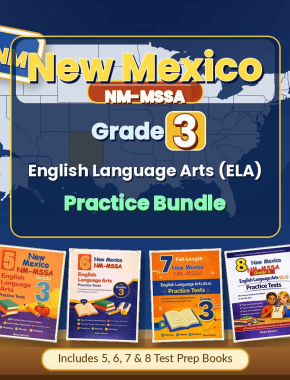
Second grade is the build-up year, and when your child is ready for what comes next, this bundle makes the jump to Grade 3 English feel easy. It includes four full practice-test books (5 + 6 + 7 + 8 tests) covering the Grade 3 reading, writing, and language skills just ahead, with explained answer keys and an instant PDF download.
Getting Ready for Grade 3 Math, Too? The New Mexico MSSA Grade 3 Math Bundle
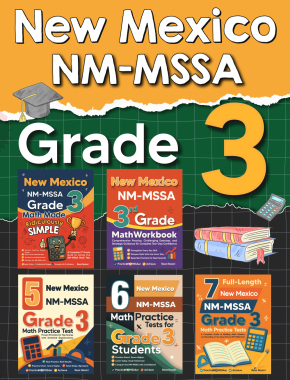
The same jump to Grade 3 happens in math. If your second grader could use a head start there as well, this New Mexico MSSA Grade 3 Math bundle is the shortest path, workbook, study guide, and full practice tests in one instant download, with answer keys throughout.

Related to This Article
More math articles
- The Best Grade 3 Math Book for Georgia Students
- Free Grade 5 English Worksheets for California Students
- AI Homework Helpers vs. Real Math Practice: What Actually Works in 2026
- The Best Grade 4 Math Book for Pennsylvania Students
- FREE 8th Grade Georgia Milestones Assessment System Math Practice Test
- How to Graph Inverse of the Tangent Function?
- How to Compare Money Amounts
- The Best Grade 3 ELA Practice Tests for Missouri Students
- The Best Grade 7 ELA Practice Tests for Pennsylvania Students
- The Best Grade 8 ELA Practice Tests for Minnesota Students








What people say about "New Mexico Grade 2 English Worksheets: Free PDFs"?
No one replied yet.