Cell Transport
A diagram shows glucose crossing through a membrane protein. Is that active transport? You still need the direction of movement and the energy source, because proteins take part in facilitated diffusion as well as active transport. Start with those clues before naming the route.
Cell transport is movement across or through a cell’s selectively permeable boundary. Passive transport proceeds down the relevant gradient without direct ATP use. For ions, both electrical and concentration differences matter. Active transport couples movement against a gradient to an energy source, such as ATP breakdown or another substance’s gradient. Cells also use energy-dependent vesicle transport for bulk movement.
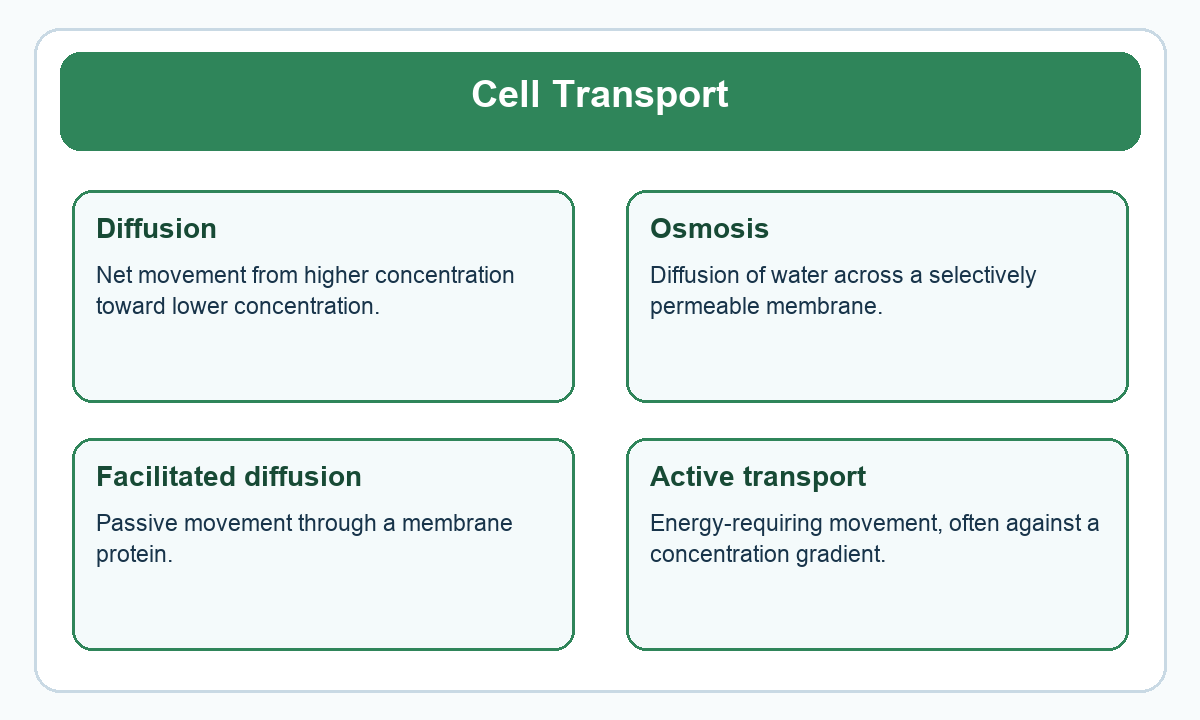
Terms used in this lesson
| Idea | What it means |
|---|---|
| Diffusion | Net movement down a concentration gradient for an uncharged substance when other opposing forces are absent. |
| Osmosis | Diffusion of water across a selectively permeable membrane. |
| Facilitated diffusion | Passive movement through a membrane protein. |
| Active transport | Movement against a concentration or electrochemical gradient, coupled to an energy source. |
Distinguish movement from net movement
Imagine an uncharged solute at a higher concentration outside a membrane than inside. If the membrane permits that solute to cross and no other force opposes its movement, particles cross both ways, but the net movement is inward. At equilibrium, particles still move. The opposing rates balance.
Small nonpolar molecules can cross the lipid bilayer directly. Other substances need a channel or carrier protein. Glucose moving down its concentration gradient through a carrier is an example of facilitated diffusion, even though a membrane protein is essential.
Ask where the energy comes from
An ATP-driven pump can move ions against their electrochemical gradients. Secondary active transport uses energy stored in one substance’s gradient to move another substance uphill. A protein can therefore perform active transport without splitting ATP at the exact moment it carries its cargo.
For ions, concentration alone is incomplete. An electrical difference across the membrane can attract or repel a charged particle. Introductory questions about uncharged solutes avoid that additional force, whereas an ion question may require both parts of the electrochemical gradient.
Predict a cell’s water movement
Osmosis is water movement across a selectively permeable membrane. At equal hydrostatic pressures, water tends to move toward the side with the greater effective concentration of solutes that cannot cross. Membrane permeability and pressure must be considered when extending that prediction to other systems.
A typical animal cell loses water and shrinks in a hypertonic solution. In a hypotonic solution it gains water and may burst. Isotonic conditions produce no sustained net change in cell volume, although water continues moving in both directions.
A plant cell has a wall that limits expansion. Water entering it can build turgor pressure, which opposes further net entry. This is why a plant cell can remain firm in a dilute surrounding solution instead of behaving like an animal cell with no wall.
Read the whole transport description
A question may describe a vesicle merging with the membrane to release protein outside the cell. That is exocytosis. Engulfing material into a membrane-bound vesicle is endocytosis. These bulk routes involve membrane rearrangement and energy, so a simple high-to-low concentration comparison will not describe their mechanism.
Watch a short lesson
The membrane-transport video compares passive and active routes and reinforces gradient-based reasoning.
Practice without looking at the answers
Write your responses before opening the answer panels.
-
An uncharged solute moves down its concentration gradient through a carrier. Which process is this?
Check the answer
Facilitated diffusion. The carrier provides a route, and the solute moves down its gradient without direct ATP use.
-
Does molecular movement stop at diffusion equilibrium?
Check the answer
No. Particles continue moving in both directions, with equal opposing rates and no net movement.
-
What two influences make up an ion’s electrochemical gradient?
Check the answer
Its concentration difference and the electrical difference across the membrane.
-
At equal hydrostatic pressures, which way does water tend to move across a membrane permeable only to water?
Check the answer
Toward the side with the greater effective concentration of nonpenetrating solute.
-
Why can a plant cell gain water without bursting like an animal cell?
Check the answer
Its wall limits expansion. Internal turgor pressure builds and can balance the tendency for further water entry.
-
How does secondary active transport obtain energy?
Check the answer
It couples movement down one substance’s gradient to movement of another substance against its gradient.
Where does this fit in your science review?
The ATI TEAS Science Study Hub places this lesson inside the larger biology review. Continue with these connected lessons:
For the AP course sequence and practice tests, use the AP Biology study hub.

Related to This Article
More math articles
- How to Pass the STAAR Math Test (Texas): The 2026 Parent & Student Playbook
- How to Write Slope-intercept Form and Point-slope Form?
- Properties of Limits
- District of Columbia DC CAPE Grade 6 Math Free Worksheets: 72 Free Printable Math Practice PDFs
- The Ultimate 6th Grade TNReady Math Course (+FREE Worksheets)
- Plot, Conflict, and Resolution
- How to Simplify Radical Expressions? (+FREE Worksheet!)
- Survey mode, weighting, and panel designs
- Back to School Essentials: Why “Pre-Algebra for Beginners” Should Be on Your List
- ISEE Upper-Level Math Formulas
















What people say about "Cell Transport"?
No one replied yet.