Cell Structure and Function
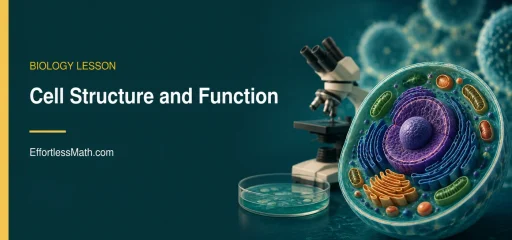
Follow a digestive enzyme. A pancreatic cell builds this protein, processes it, and releases it outside the cell, using several structures along the way. Tracing that journey gives each organelle a job you can explain instead of a name to memorize.
A cell’s structures support its jobs. The plasma membrane controls exchange, the nucleus stores most genetic information, ribosomes build proteins, mitochondria transfer energy into usable forms, and the endomembrane system modifies and transports materials. Plant and animal cells share many organelles but also have important differences.
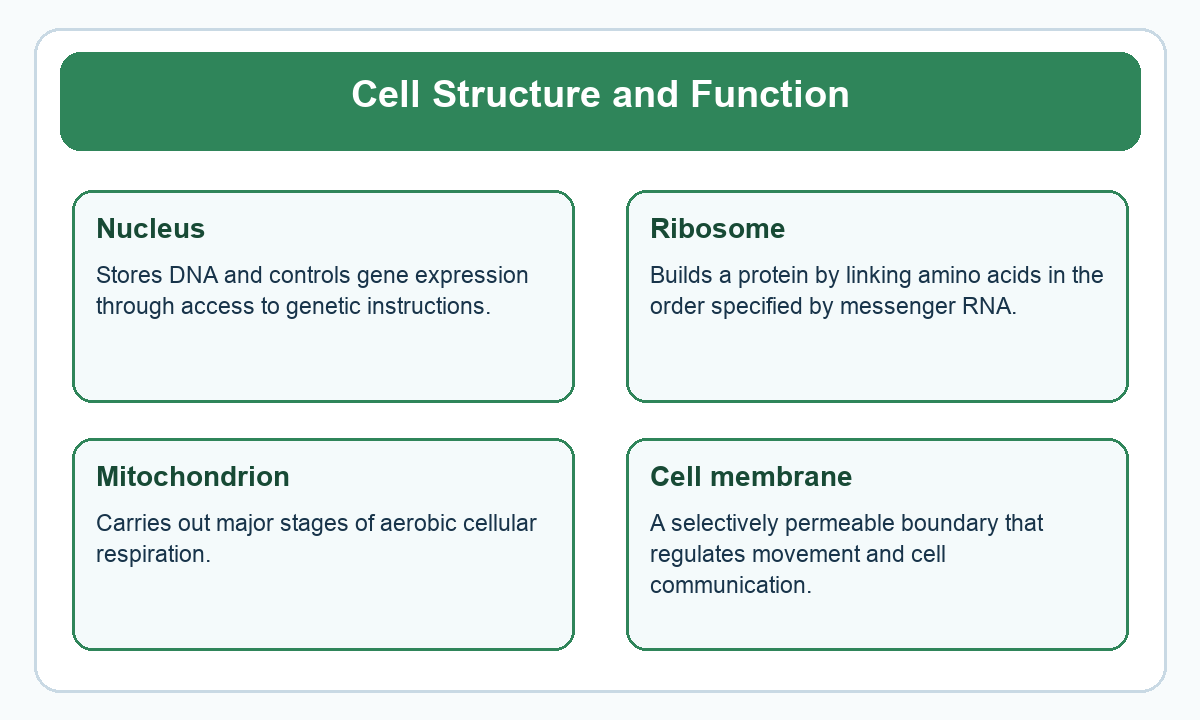
Terms used in this lesson
| Idea | What it means |
|---|---|
| Nucleus | Contains most DNA in a typical eukaryotic cell and is the site of nuclear-gene transcription. |
| Ribosome | Builds a protein by linking amino acids in the order specified by messenger RNA. |
| Mitochondrion | Carries out major stages of aerobic cellular respiration. |
| Cell membrane | A selectively permeable boundary that regulates movement and cell communication. |
Follow a secreted protein
For a conventional secreted protein made from a nuclear gene, transcription produces an RNA copy in the nucleus. After processing, messenger RNA reaches the cytoplasm. Translation begins on a ribosome, and a targeting signal directs the ribosome and growing protein to the rough endoplasmic reticulum.
The protein enters the endoplasmic reticulum as synthesis continues, then travels in a vesicle to the Golgi apparatus for further processing and sorting. A secretory vesicle can fuse with the plasma membrane and release its contents outside the cell. This final step is exocytosis.
A protein that works in the cytosol can be completed on a free ribosome without entering that route. Ribosomes make polypeptides, while the endoplasmic reticulum and Golgi process particular proteins and move them toward their destinations.
Connect structure with demand
A cell producing many digestive enzymes needs substantial protein-making and secretory machinery. A muscle cell with a high demand for aerobic ATP production benefits from many mitochondria. When a diagram shows numerous mitochondria, connect that observation to ATP demand.
Mitochondria carry out major stages of aerobic cellular respiration. Glycolysis takes place in the cytosol, so respiration involves more than one location. The ATP produced helps supply energy for cellular work, including movement and active transport.
Compare plant and animal cells
Both groups have plasma membranes, ribosomes, and mitochondria. Photosynthetic plant cells also contain chloroplasts, which capture light energy. A plant’s nonphotosynthetic cells, such as many root cells, do not need chloroplasts to carry out their jobs.
A plant cell wall supports the cell outside its plasma membrane. The membrane remains the selectively permeable boundary that regulates exchange. A large central vacuole can store materials and help maintain pressure against the wall.
Use the action in a question
If a question asks where amino acids are linked in the order specified by messenger RNA, choose the ribosome. If it asks which structure sorts a protein for delivery, examine the Golgi apparatus. Naming a large organelle without matching its job to the prompt can lead you away from the requested step.
Bacteria have ribosomes and a plasma membrane but lack a membrane-bound nucleus. Their DNA occupies a nucleoid region. A cell diagram without a nucleus can therefore still represent a living cell that makes proteins and regulates exchange with its surroundings.
Watch a short lesson
The cell-theory-and-cell-types video establishes the basic cell plan and differences among major cell types.
Practice without looking at the answers
Write your responses before opening the answer panels.
-
Which structure links amino acids according to messenger RNA?
Check the answer
A ribosome performs translation and builds the polypeptide chain.
-
Where is most DNA stored in a typical nucleated animal cell?
Check the answer
In the nucleus. Mitochondria also contain a small amount of DNA.
-
Which route would a conventional secreted protein follow after entering the rough endoplasmic reticulum?
Check the answer
It moves in a vesicle to the Golgi apparatus, then into a secretory vesicle that can fuse with the plasma membrane.
-
Why might an aerobically active muscle cell contain many mitochondria?
Check the answer
Mitochondria support substantial ATP production through major stages of aerobic respiration, helping meet the cell’s energy demands.
-
Does a plant cell use mitochondria as well as chloroplasts?
Check the answer
Yes. Plant cells carry out cellular respiration. Chloroplasts occur in photosynthetic cells, whereas mitochondria support respiration in plant cells.
-
A bacterium lacks a nucleus. Can it still build proteins?
Check the answer
Yes. It has DNA and ribosomes. A membrane-bound nucleus is not required for protein synthesis.
Where does this fit in your science review?
The ATI TEAS Science Study Hub places this lesson inside the larger biology review. Continue with these connected lessons:
For the AP course sequence and practice tests, use the AP Biology study hub.

Related to This Article
More math articles
- Free Grade 3 English Worksheets for Utah Students
- Religion
- Advanced Vocabulary Words: Emit to Fanatic
- Libel and slander
- Communication, Service Recovery, HIPAA, and DEI
- Stock Removal Machines: What Each Tool Does
- How to Unravel the Mysteries of Infinite Limits
- How to Find GCF and LCM: Methods, Examples, and Word Problems for 2026
- Contacting officials
- A Complete Explanation of the Continuity over an Interval

















What people say about "Cell Structure and Function"?
No one replied yet.