The Federal Reserve and Monetary Policy
The Chapter 15 companion lesson study guide on Effortless Math covers The Federal Reserve and Monetary Policy: the key terms, the core ideas, and worked examples showing how this topic is tested on this course.
Chapter 15 companion lesson
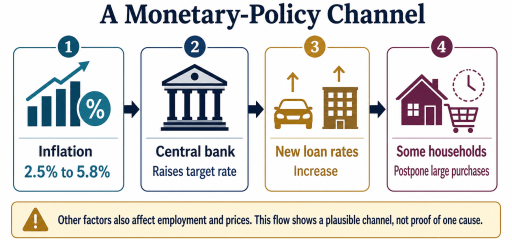
A central-bank announcement is only the first link in a longer chain. The exam usually asks about the next market response, or about the reason the final change in spending may be smaller than expected.
In plain language: Monetary policy changes financial conditions to influence spending, output, employment, and inflation. The Federal Reserve implements policy through administered rates, open-market operations, and reserve conditions. The transmission chain runs from the policy action to market rates, asset prices and credit, interest-sensitive spending, aggregate demand, and the broader economy.
How does the CLEP test federal reserve structure, goals, and independence?
The Federal Reserve System is the U.S. Central bank. The seven-member Board of Governors in Washington oversees important system functions and participates in monetary policy. Twelve regional Federal Reserve Banks provide services, gather regional information, supervise institutions within assigned responsibilities, and participate in the broader system.
The Federal Open Market Committee includes the governors, the president of the Federal Reserve Bank of New York, and a rotating group of other Reserve Bank presidents as voting members; all Reserve Bank presidents participate in discussion. The FOMC sets the target range for the federal funds rate and directs open-market policy. Do not assign that decision to Congress, the Treasury, or commercial-bank managers.
Congress created the Federal Reserve and assigned statutory objectives, commonly summarized as maximum employment, stable prices, and moderate long-term interest rates. The Fed has operational independence to choose monetary-policy actions, but it is not outside government or free of accountability. Officials report to Congress, publish information, and operate under law. Independence means instrument decisions are insulated from day-to-day partisan direction, not that goals are self-created without democratic authority.
Why does the federal funds rate and an ample-reserves framework matter?
The federal funds rate is the rate on overnight unsecured loans of reserve balances between eligible institutions. The FOMC announces a target range, not a fixed rate on every mortgage, bond, or bank loan. Market rates differ by maturity, risk, liquidity, and taxes, but policy-rate changes influence them through expectations and arbitrage.
In an ample-reserves framework, aggregate reserve balances are abundant enough that small changes in their quantity need not produce large federal-funds-rate changes. The Fed's administered interest on reserve balances helps set a floor-like incentive: banks compare lending opportunities with the return available on balances at the Fed. Raising IORB tends to raise overnight market rates; lowering it tends to ease them.
The overnight reverse repurchase facility provides another administered investment opportunity to eligible counterparties and helps support the lower end of the target range. Other arrangements can limit upward pressure. The system forms a corridor or floor structure around money-market rates without relying on a positive reserve requirement as the daily control lever.
Watch the model in motion
Jacob Clifford explains the same core relationship visually. Pause before each result and predict the next movement or calculation.
What should you know about the quantity equation and quantity theory of money?
The quantity equation organizes the relationship among money, spending, prices, and real production: MV=PY. Here M is the measured money stock, V is the velocity of money, P is the overall price level, and Y is real output. The product PY is nominal GDP. Velocity is defined as nominal GDP divided by the money stock, V=PY/M, so it measures how many times, on average, each unit of the measured money stock supports purchases of domestically produced final output during the period.
The equation is an identity when the variables are measured consistently. If nominal GDP is 2 trillion and the relevant money stock is 500 billion, measured velocity is 4. That calculation does not prove why households hold money, why nominal GDP has its observed value, or what will happen after the central bank changes policy. It simply makes the two ways of describing nominal spending agree.
The quantity theory of money adds behavioral and long-run assumptions. In its simplest form, velocity is stable and real output is determined by labor, capital, technology, and institutions at potential. Under those conditions, sustained growth of money faster than real output produces sustained inflation. The theory is therefore a claim about causal adjustment under stated conditions, not another name for the identity.
How does the CLEP test the monetary-policy transmission mechanism?
Expansionary monetary policy lowers the intended policy-rate setting or otherwise eases financial conditions. Contractionary monetary policy raises the setting or tightens conditions. The policy instrument is not the final goal; it initiates a chain through asset prices, credit, expectations, exchange rates, and spending.
The conventional interest-rate channel begins when lower short-term rates reduce borrowing costs and raise prices of existing bonds. Longer rates may decline if markets expect easier policy to persist. Lower real rates increase present values and make more investment projects profitable. Housing, durable-goods purchases, and inventory financing can also respond.
An asset-price or wealth channel can reinforce the effect. Lower discount rates may raise stock and bond values, supporting household wealth and firms' ability to finance. A credit channel works when stronger bank balance sheets or lower borrower risk premiums expand credit availability. These are tendencies, not fixed coefficients.
How does the CLEP test lags, limits, rules, and policy evaluation?
Monetary policy faces recognition, decision, and impact lags. Data arrive after activity occurs and are revised. Policymakers must diagnose whether a shock is demand-side or supply-side. The decision process takes time, though central-bank actions can be changed faster than legislation. Spending and inflation respond over variable horizons.
Policy is forward-looking because current actions affect future conditions. A central bank that waits for reported inflation to peak may tighten after demand has already weakened. Forecasting is unavoidable, but forecasts are uncertain. Good evaluation therefore asks what information was available at the time, what later data reveal.
A policy rule links an instrument systematically to inflation and economic slack. A Taylor-style rule raises the nominal policy rate when inflation is above target or output is above potential and lowers it in the opposite conditions. Under the Taylor principle, the nominal rate responds more than one-for-one to persistent inflation so the real rate rises and restrains demand.
What is the CLEP likely to ask?
Expect Fed structure, tool direction, bond/reserve entries, the quantity equation, policy-rate effects, AD transmission, and short-run versus long-run outcomes. Separate an accounting identity from the assumptions of a theory, and separate current implementation from a simplified money-supply graph when the stem specifies one.
A useful check is to name the model before doing arithmetic. Then write the first change, the intermediate market response, and the final macroeconomic result. This keeps a plausible distractor from borrowing one true step and attaching it to the wrong conclusion.
Can you do these without notes?
- Distinguish the Board, FOMC, Reserve Banks, Treasury, and Congress. Explain operational independence, accountability, and why central-bank lending is not automatically fiscal spending.
- Define the federal funds rate and target range. Trace a security purchase on the Fed and bank balance sheets, then explain why IORB is central in an ample-reserves framework.
- Define M, V, P, and Y; explain why PY is nominal GDP; and distinguish the quantity equation from the quantity theory. Then find approximate inflation when money grows 7 percent, velocity falls 2 percent, and real output grows 1 percent.
For each prompt, say why the tempting wrong answer fails. That extra sentence is often the difference between recognizing a term and being able to use it under time pressure.
Keep studying with the complete guide
This lesson accompanies CLEP Principles of Macroeconomics for Beginners. The book adds annotated graphs, worked calculations, chapter practice, two printed full-length tests, and ten online test forms.

Reza is an experienced Math instructor and a test-prep expert who has been tutoring students since 2008. He has helped many students raise their standardized test scores--and attend the colleges of their dreams. He works with students individually and in group settings, he tutors both live and online Math courses and the Math portion of standardized tests. He provides an individualized custom learning plan and the personalized attention that makes a difference in how students view math.
Related to This Article
More math articles
- FREE TASC Math Practice Test
- The Best Algebra 1 Book for Alaska Students
- Grade 4 Math Flashcards (Free Online: Formulas, Terms & Concepts)
- The Best Algebra 1 Book for Colorado Students
- The March on Washington and the Civil Rights Act of 1964
- Overview of the ACT Mathematics Test
- Use a schedule when curves are replaced by numbers
- 3rd Grade SBAC Math FREE Sample Practice Questions
- Interpreting election returns
- California CAASPP Grade 4 Math Free Worksheets: 72 Skill-by-Skill Worksheets You Can Print Today



















What people say about "Federal Reserve and Monetary Policy | Effortless Math"?
No one replied yet.