California Grade 4 Math Worksheets and CAASPP Review
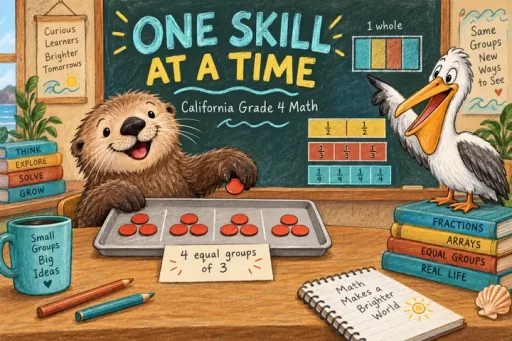
Choose from 43 linked Grade 4 math worksheets, organized by skill for California learners. Start with the topic your child is studying: place value, multiplication and division, fractions, decimals, measurement or geometry. Open the existing PDF link directly; worksheet selection does not require an email or account.
Choose a Grade 4 worksheet by skill
The list below contains 43 existing PDF links. The labels and standard codes help you locate a topic; use your teacher’s current lesson or learning goal to choose where to begin.
Place Value & Multi-Digit Numbers
- Understanding Place Value Relationships, [4.NBT.A.1] each place is ten times the one to its right
- Reading and Writing Multi-Digit Numbers, [4.NBT.A.2] standard form, word form, and expanded form
- Comparing and Ordering Multi-Digit Numbers, [4.NBT.A.2] use place value and the symbols >, <, and =
- Rounding Multi-Digit Numbers, [4.NBT.A.3] round to any place from tens to hundred-thousands
Multi-Digit Arithmetic
- Adding Multi-Digit Whole Numbers, [4.NBT.B.4] the standard addition algorithm, with regrouping
- Subtracting Multi-Digit Whole Numbers, [4.NBT.B.4] the standard subtraction algorithm, including across zeros
- Multiplying by a One-Digit Number, [4.NBT.B.5] multiply up to four digits by a single digit
- Multiplying Two Two-Digit Numbers, [4.NBT.B.5] use place-value strategies and area models
- Dividing with Remainders, [4.NBT.B.6] divide and name the leftover as a remainder
- Finding Factors and Multiples, [4.OA.B.4] list every factor of a number and its first multiples
- Prime and Composite Numbers, [4.OA.B.4] exactly two factors means prime; more means composite
Operations & Problem Solving
- Multiplicative Comparisons, [4.OA.A.1] read ‘4 times as many’ as a multiplication statement
- Multiplicative Comparison Word Problems, [4.OA.A.2] solve ‘times as many’ stories with multiplication or division
- Multi-Step Word Problems, [4.OA.A.3] two or more operations in one real-world problem
- Interpreting Remainders, [4.OA.A.3] decide what the leftover means, round up, drop it, or use it
- Number and Shape Patterns, [4.OA.C.5] follow a rule and find the next terms in a pattern
Fractions
- Equivalent Fractions, [4.NF.A.1] the same amount written with different numbers
- Comparing Fractions, [4.NF.A.2] compare fractions with unlike denominators using benchmarks
- Adding Fractions with Like Denominators, [4.NF.B.3a] add the numerators, keep the denominator
- Subtracting Fractions with Like Denominators, [4.NF.B.3a] subtract the numerators, keep the denominator
- Decomposing Fractions, [4.NF.B.3b] break a fraction into a sum of unit fractions
- Adding and Subtracting Mixed Numbers, [4.NF.B.3c] work with the whole and fraction parts, including regrouping
- Multiplying a Fraction by a Whole Number, [4.NF.B.4b] repeated addition of a fraction, written as multiplication
- Fraction Word Problems, [4.NF.B.3d] real-world stories that call for adding or subtracting fractions
Decimals
- Fractions with Denominators 10 and 100, [4.NF.C.5] rename tenths as hundredths and add the two
- Decimal Notation for Fractions, [4.NF.C.6] write tenths and hundredths as decimals, and back
- Comparing Decimals to Hundredths, [4.NF.C.7] line up the place values and compare with >, <, =
- Adding Decimal Fractions, [4.NF.C.5] combine tenths and hundredths using equivalent fractions
Measurement & Data
- Converting Measurement Units, [4.MD.A.1] change from a larger unit to a smaller one
- Measurement Word Problems, [4.MD.A.2] length, weight, volume, and time in real situations
- Area of Rectangles, [4.MD.A.3] length times width, the space inside a rectangle
- Perimeter of Rectangles, [4.MD.A.3] the distance all the way around a rectangle
- Area and Perimeter Word Problems, [4.MD.A.3] decide whether a problem needs area or perimeter
- Line Plots with Fractions, [4.MD.B.4] read and use a line plot of fraction measurements
Angles
- Angles as Fractions of a Circle, [4.MD.C.5] a full turn is 360 degrees, find a fraction of it
- Measuring Angles with a Protractor, [4.MD.C.6] name angles acute, right, or obtuse by their measure
- Drawing Angles with Given Measures, [4.MD.C.6] know what a given degree measure should look like
- Adding and Subtracting Angles, [4.MD.C.7] an angle split into parts, find the missing part
Geometry
- Points, Lines, Rays, and Angles, [4.G.A.1] the building blocks of geometry and how to tell them apart
- Parallel and Perpendicular Lines, [4.G.A.1] lines that never meet, and lines that cross at a square corner
- Classifying Triangles, [4.G.A.2] sort triangles by their angles and their sides
- Classifying Quadrilaterals, [4.G.A.2] name four-sided shapes by their sides and angles
- Lines of Symmetry, [4.G.A.3] find the lines that fold a shape onto itself
Plan a useful review session
Ask your child to explain one example before starting a full set. If multiplication is the difficulty, review place value and multiplication facts before moving to longer products. For fraction comparison, revisit equivalent fractions and benchmarks such as one-half.
Work on a manageable group of problems, then discuss one mistake. Ask, “What does each number represent?” and “How could you check the answer?” Return to the same skill later with a fresh problem. Adjust the session to the learner rather than treating a fixed number of minutes as a requirement.
Use skill worksheets alongside official CAASPP practice
California’s Smarter Balanced assessment system uses computer-based tests and performance tasks in mathematics. These skill worksheets support paper-based review; they do not reproduce the full online assessment experience or establish readiness for every tested task.
For the official assessment overview, see the California Department of Education’s Smarter Balanced information. Use the official Smarter Balanced practice and sample-question page to find resources for learning the test format. Follow your school’s directions for testing dates and available supports.
Review the method before more practice
When fraction calculations or word problems are difficult, start with a worked explanation:
Compare optional Grade 4 books
For families considering a longer study resource, review the current product descriptions and previews for Mastering Grade 4 Math and Mastering Grade 4 Math Word Problems. Match the topic coverage and format to the help your child needs.
You can also review the California CAASPP Grade 4 Math Preparation Bundle for its current included resources and purchase options. The worksheets above remain a separate free starting point.
Questions about using this page
How do I choose a worksheet?
Use the skill headings to match your child’s current lesson. Begin with one example and check understanding before assigning a longer practice set.
Do I need an email or account to choose a worksheet?
No. Choose an existing PDF link from the list to open the resource directly.
Are these worksheets the same as the official CAASPP practice test?
No. These are skill-review resources. Official Smarter Balanced practice resources help students become familiar with assessment formats and online tools.

Related to This Article
More math articles
- The Best Grade 8 ELA Practice Tests for New Hampshire Students
- Functionalist, Conflict, and Interactionist Views of Education
- Math Education Trends In Canadian Education System
- How to Calculate the Volume of Cubes and Prisms
- AP Cybersecurity Risk Assessment: Threat, Vulnerability and Impact (2027 Prep)
- Top 10 3rd Grade PARCC Math Practice Questions
- Factoring Trinomials Worksheet with Answers
- Top 10 5th Grade NYSE Math Practice Questions
- 3rd Grade TNReady Math Worksheets: FREE & Printable
- Advanced Vocabulary Words: Regale to Stimulate







What people say about "California Grade 4 Math Worksheets and CAASPP Review"?
No one replied yet.