The Mathematics Chances and Odds of CS2 Skins and Cases
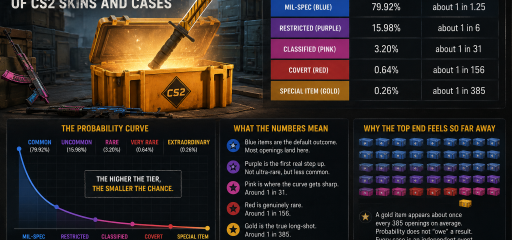
The math behind CS2 skin odds is part of what makes case openings so compelling. On the surface, opening a case feels simple: you unlock it, watch the animation, and hope for something rare. But underneath that moment is a probability structure that is much more rigid than many players assume. The officially disclosed case rarity odds used for CS2 weapon cases are widely reported as 79.92% for Mil-Spec, 15.98% for Restricted, 3.20% for Classified, 0.64% for Covert, and 0.26% for the gold-tier special item category such as knives or gloves.
That means the real story of CS2 case chances is not just “rare items are hard to get.” It is that the distribution is heavily weighted toward the lower tiers, while the most desirable outcomes sit deep in the tail of the probability curve. In practical terms, the system is built so that most openings land in the common range, while the ultra-rare outcomes stay statistically distant enough to preserve scarcity and value.
The official rarity structure
A useful way to understand CS2 case probability is to translate percentages into intuitive odds.
| Rarity tier | Official drop rate | Approximate odds |
| Mil-Spec (Blue) | 79.92% | about 1 in 1.25 |
| Restricted (Purple) | 15.98% | about 1 in 6 |
| Classified (Pink) | 3.20% | about 1 in 31 |
| Covert (Red) | 0.64% | about 1 in 156 |
| Special Item (Gold) | 0.26% | about 1 in 385 |
These figures are what most players really mean when they talk about odds of CS2 skins from cases. The first important takeaway is that the jump from one tier to another is not linear. The leap from Restricted to Classified is already steep, but the leap from Covert to Gold is even more severe. That is why opening cases feels full of “almost” moments even when the real probability of hitting the top item remains very low, which also helps explain why many players choose to buy CS2 skins directly instead of relying on case odds alone.
Why the top end feels so far away
Mathematically, the gold tier is where the case system becomes most revealing. A 0.26% chance means that, on average, a gold item appears about once every 385 openings. That does not mean a player is guaranteed a knife or gloves after 385 cases; it means that across very large numbers of openings, the long-run average lands around that frequency. Probability does not “owe” a result just because you have been unlucky for a while.
This is the part many people misunderstand. Case openings are independent events. If your last 100 cases were all blue and purple, the next case does not become “more likely” to drop red or gold because of your streak. The next opening still uses the same base probability distribution. That is the core mathematical truth behind CS2 drop rates: the system is memoryless from one case to the next. The emotional experience may feel like patterns are forming, but the underlying odds stay fixed.
Expected value versus emotional value
Another reason the case system fascinates people is that expected value and emotional value are not the same thing. From a probability perspective, the average opening is weighted toward common outcomes. From a human perspective, attention is pulled almost entirely toward the rarest ones. That difference creates the psychological gap that makes openings exciting: mathematically, most results are ordinary; emotionally, the player is focused on the tiny fraction of extraordinary ones.
This also explains why CS2 skin odds matter far beyond case opening videos. Those odds shape the whole downstream market. If gold-tier items are rare enough, they remain scarce. If Covert items only appear 0.64% of the time, that rarity feeds directly into pricing, desirability, and long-term status inside the skin economy. In other words, case math is not just a side mechanic. It is one of the foundations of the entire item market.
What the numbers really mean in practice
To make the probability structure easier to interpret, it helps to think in practical layers:
- Blue items are the default outcome. Most openings land here, which is why they define the “normal” case-opening experience.
- Purple is the first real step up. At 15.98%, it is not ultra-rare, but it is still meaningfully less common than blue.
- Pink is where the curve gets sharp. Around 1 in 31 means you can open many cases before seeing one.
- Red is genuinely rare. At about 1 in 156, it is uncommon enough to feel exceptional.
- Gold is the true long-shot category. Around 1 in 385 is what keeps knives and gloves psychologically and economically powerful.
That list shows why CS2 case chances feel so uneven. The distribution is designed to cluster outcomes at the bottom and compress excitement into a tiny space at the top. That is not accidental. It is what gives the rarest rewards their identity.
Why rarity tiers matter more than many players think
A lot of players focus only on the final headline result, blue, purple, pink, red, or gold, but the rarity ladder itself is already telling you how the system works. Each step upward represents not just a “better item,” but a much smaller region of the total probability space. That means rarity in CS2 is mathematically meaningful, not just visually branded by color. When players chase red or gold outcomes, they are chasing sections of the distribution that are genuinely tiny.
This is one reason the case system stays so durable. A good rarity system does create excitement. It creates hierarchy that the community can understand instantly. Blue means expected. Purple means decent. Pink means noteworthy. Red means rare. Gold means jackpot territory. Those meanings are not abstract; they are anchored in real CS2 case probability.
LIS-SKINS, buy the skin you want without playing the odds
Case math makes one thing clear: chasing red or gold outcomes through openings is expensive by design. The probability is fixed, the system is memoryless, and the house always has the edge. That is why many players skip the gamble entirely and buy CS2 skins directly at market price, paying for exactly the item they want, at exactly the float they want, without variance.
LIS-SKINS is built for that approach. The catalog covers CS2 skins across all rarity tiers, with filters by weapon type, collection, and price so you can find a specific Covert or gold-tier item without opening a single case. Sellers get real money in return, to a bank card or crypto wallet, instead of Steam wallet funds that stay locked on the platform. If the math has convinced you that cases are not the most efficient path to the skin you actually want, LIS-SKINS is the straightforward alternative.
Why the math shapes the whole market
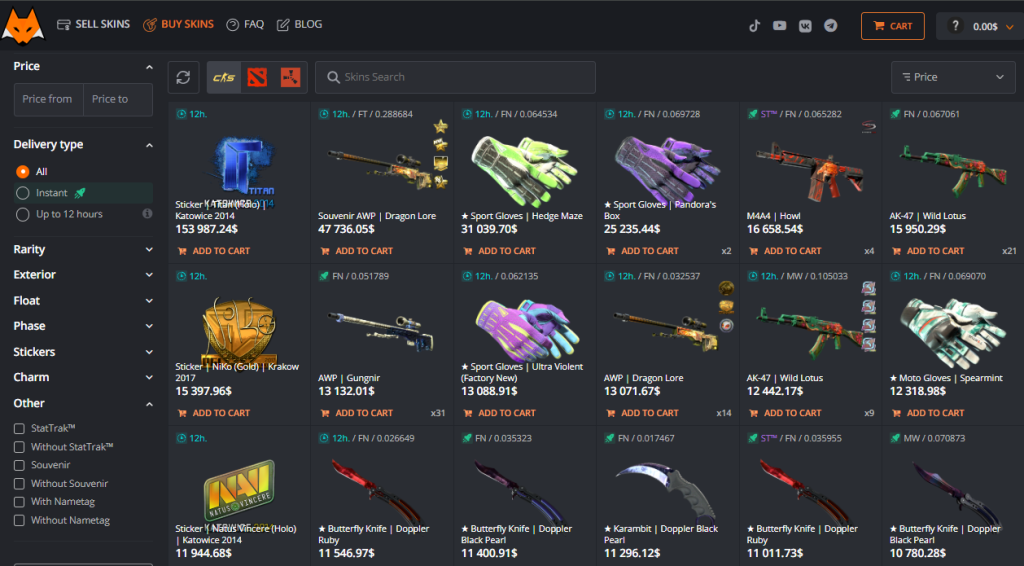
The probability model does more than govern case openings. It also shapes how the broader market behaves. If a category is rare by design, supply enters circulation more slowly. If supply enters more slowly, scarcity remains credible. And if scarcity remains credible, buyers treat certain skins as premium assets rather than just cosmetics. That is why the mathematics of odds of CS2 skins connects directly to prices, demand, and status.
This is also why people who never open cases still care about the numbers. Even if you only buy skins directly, you are still living in a market whose supply is partly created by these probabilities. The drop table is not just a gambling mechanic; it is a supply engine for the entire ecosystem.
Conclusion
The mathematics behind CS2 skin odds is not mysterious once the structure is clear. Most cases produce lower-tier items, the upper tiers become progressively rarer, and the gold tier sits far enough away to stay exciting, scarce, and culturally powerful. The official odds commonly cited for CS2 weapon cases, 79.92%, 15.98%, 3.20%, 0.64%, and 0.26%, explain almost everything important about how the system feels and why the market values certain outcomes so highly.
So when people talk about the “luck” of cases, the more accurate word is structure. Chance is real, but it operates inside a strict distribution. And that distribution is exactly what gives the rarest skins their mystique.

Related to This Article
More math articles
- What to Consider When Retaking the ACT or SAT
- Other Topics Puzzle – Challenge 97
- Classify evidence, not labels
- Symbols, Language, and Linguistic Relativity
- How to Find Patterns of Equivalent Fractions?
- Other Topics Puzzle – Challenge 94
- Function Grapher — Plot y = f(x) Online (Free)
- The Best Grade 5 Math Book for Oregon Students
- How to Find Missing Angels in Quadrilateral Shapes? (+FREE Worksheet!)
- How to Find Slope? (+FREE Worksheet!)















What people say about "The Mathematics Chances and Odds of CS2 Skins and Cases - Effortless Math"?
No one replied yet.