Grade 6 Math Flashcards (Free Online: Formulas, Terms & Concepts)
Grade 6 Math Flashcards: a free, printable set covering the topics you will see on the test, with answer keys included, so you can practice each topic one skill at a time and check your own work before test day.
Free Grade 6 Math review
Lock in every key Grade 6 Math formula, term, and concept with a free, interactive flashcard deck covering numbers, fractions and percents, ratios and proportions, exponents and roots, algebra, coordinate geometry, geometry, data and probability.
Each card shows the rule or definition, a short explanation, and many include a quick diagram. Flip a card, filter by topic or card type, shuffle, and mark what you know so the cards you miss come back for review.
81flashcards
9topics covered
26cards with a diagram
Freeonline, progress saved

What These Grade 6 Math Flashcards Cover
This free deck collects the formulas, key terms, and concepts students use across the whole Grade 6 Math course, organized into 9 topics. Use the dropdown to study one topic at a time, or shuffle the full deck for mixed review before a test.
| Topic | Cards | What students review |
|---|---|---|
| Numbers | 12 cards | Integers, factors, primes, GCF and LCM, order of operations. |
| Fractions & Percents | 8 cards | Fraction operations, percent of a number, percent of change, conversions. |
| Ratios & Proportions | 5 cards | Ratios, proportions, unit conversion, simple interest, average speed. |
| Exponents & Roots | 9 cards | Exponent rules, square roots, radicals, scientific notation. |
| Algebra | 14 cards | Equations, like terms, FOIL, factoring, the quadratic formula, inequalities. |
| Coordinate Geometry | 6 cards | Slope, line equations, distance and midpoint, parallel and perpendicular. |
| Geometry | 17 cards | Area, perimeter, volume, the Pythagorean theorem, angle rules. |
| Data & Probability | 8 cards | Mean, median, mode, range, probability, and counting. |
| Test Facts | 2 cards | Test format, question types, and calculator policy. |
Jump to a Topic
NumbersFractions & PercentsRatios & ProportionsExponents & RootsAlgebraCoordinate GeometryGeometryData & ProbabilityTest Facts
Numbers
12 cards. Integers, real numbers, absolute value, factors and primes, GCF and LCM, order of operations, the distributive property, and factorials.
Fractions & Percents
8 cards. Converting mixed numbers and improper fractions, adding, subtracting, multiplying and dividing fractions, percent of a number, percent of change, and fraction, decimal, and percent conversions.
Ratios & Proportions
5 cards. Ratios, proportions, unit conversions, simple interest, and average speed.
Exponents & Roots
9 cards. The exponent rules, including product, quotient, power, zero, negative, and fractional exponents, plus square roots, simplifying radicals, and scientific notation.
Algebra
14 cards. Variables and expressions, solving one and two step equations, combining like terms, FOIL and special products, factoring, the quadratic formula, systems, and inequalities.
Coordinate Geometry
6 cards. Slope, slope-intercept and point-slope form, the distance and midpoint formulas, and parallel and perpendicular lines.
Geometry
17 cards. Area, perimeter, and volume formulas for common shapes, the Pythagorean theorem and triples, angle rules, and polygon interior angles.
Data & Probability
8 cards. Mean, median, mode, and range, the probability of an event, the probability of A and B, the counting principle, and finding a missing value from a mean.
Test Facts
2 cards. Quick facts about the Grade 6 Math test, the math question types, and the calculator policy.
How to Use These Grade 6 Math Flashcards
1
Pick one topic
Use the topic dropdown instead of facing all 81 cards at once. Start with the topics you find hardest.
2
Flip, then mark
Read the front, say the rule or definition out loud, then flip. Mark Know it only when you can explain it, not just recognize it.
3
Practice right away
After a set, solve a few problems that use those rules. Flashcards build recall; worked practice turns them into test-day tools.
Best Order for Studying
If the deck feels like a lot, study the foundational topics first, such as numbers, fractions and percents, and exponents, then move on to algebra, geometry, and data, and review the test facts last. This moves from the skills every other topic builds on to the ones that appear in specific problem types.
Most Important Formulas and Facts to Know First
- Order of operations: the sequence that keeps every calculation consistent.
- Exponent rules: product, quotient, power, zero, and negative exponents.
- Fraction operations: and converting between fractions, decimals, and percents.
- Percent of a number and percent of change: the backbone of word problems.
- Slope and slope-intercept form: for reading and writing linear graphs.
- Area, perimeter, and volume: the core geometry formulas.
- The Pythagorean theorem: for right triangles and distance.
- Factoring and the quadratic formula: for solving quadratics.
- Mean, median, mode, and range: the four measures that summarize data.
- Probability of an event: favorable outcomes over total outcomes.
Common Mistakes These Cards Help Fix
- Ignoring order of operations and simply working left to right.
- Adding or subtracting fractions without a common denominator.
- Confusing area with perimeter, or surface area with volume.
- Flipping an inequality sign at the wrong time, instead of only when multiplying or dividing by a negative.
- Mixing up mean, median, and mode.
- Treating a negative exponent as a negative number instead of a reciprocal.
- Applying the Pythagorean theorem to triangles that are not right triangles.
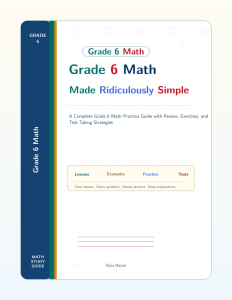
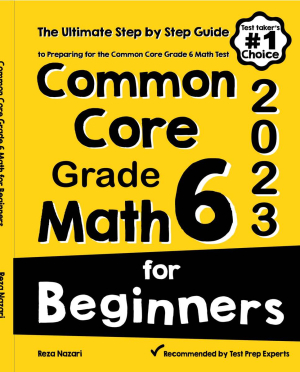
Common Core Grade 6 Math Made Ridiculously Simple
Recommended when a student needs more than flashcards: a step-by-step Grade 6 Math study path with lessons, worked examples, and practice to use alongside the deck.
- Every topic taught from the ground up, not just listed.
- Pairs naturally with these flashcards and the free practice tests.
- Great for rebuilding weak skills before a test.
Frequently Asked Questions
Are these Grade 6 Math flashcards free?
Yes. The Grade 6 Math flashcards are free to use online, and your progress is saved in your browser so the cards you mark for review come back later.
What is on the Grade 6 Math flashcards?
The deck covers formulas, key terms, and concepts across 9 topics, including numbers, fractions and percents, ratios and proportions, exponents and roots, algebra, coordinate geometry, geometry, data and probability.
Is this a formula sheet or a flashcard deck?
It is an interactive flashcard deck built for active recall. Each card pairs the rule or definition with a short explanation, and many include a diagram, so you learn when each one applies instead of just reading a list.
Do the flashcards include diagrams?
Yes. 26 of the cards include a quick diagram, such as a number line, a labeled shape, a coordinate grid, or a right triangle.
How many cards are in the Grade 6 Math deck?
There are 81 cards organized into 9 topics, with formula, term, and concept cards mixed in each topic.
Do these flashcards match the Grade 6 Math test?
Yes. The formulas, terms, and concepts are aligned to the math content Grade 6 Math students are expected to know. After memorizing them, practice full problems so the rules become solving skills.
How should students study these flashcards?
Pick one topic, flip each card and predict the answer, mark each card as Know it or Review again, then restudy the missed cards. After that, use worksheets or a practice test.
Explore more free review tools in our math flashcards hub.
All 105 Flashcards, Text Version
Every card from the deck above, listed as text so you can read, search, or print it without the flip player.
Numbers
| Front | Back |
|---|---|
| Integers | The set { …, −3, −2, −1, 0, 1, 2, 3, … } — the counting numbers, their negatives, and zero. |
| Real numbers | Every number on the number line: integers, fractions, decimals, and irrationals like √2 and π. |
| Absolute value | A number’s distance from 0 on the number line, so it is never negative. |−22| = 22. |
| Order of operations | PEMDAS: Parentheses, Exponents, Multiply/Divide (left→right), Add/Subtract (left→right). |
| Factors of a number | Numbers that multiply together to give it. 12 = 2 × 2 × 3, so 2 and 3 are factors of 12. |
| Prime number | A whole number greater than 1 whose only factors are 1 and itself: 2, 3, 5, 7, 11, 13, … |
| Greatest Common Factor (GCF) | The largest number that divides two numbers evenly. Take the primes they share, each to its lowest power. |
| Least Common Multiple (LCM) | The smallest number both numbers divide into. Take every prime to its highest power across the numbers. |
| Distributive property | a(b + c) = ab + ac. Multiply the outside term by each term inside the parentheses. |
| Factorial (n!) | The product of n and every whole number below it: 5! = 5×4×3×2×1 = 120. By definition 0! = 1. |
| Coefficient | The number multiplied by a variable. In 3x, the coefficient is 3. |
| Exponent | Tells how many times to multiply the base by itself. 2³ = 2 × 2 × 2 = 8. |
Fractions & Percents
| Front | Back |
|---|---|
| Mixed number → improper fraction | a b/c = (a·c + b)/c. Example: 2 3/4 = (2×4 + 3)/4 = 11/4. |
| Add or subtract fractions | Rewrite over a common denominator, add or subtract the numerators, then simplify. |
| Multiply fractions | Multiply the numerators together and the denominators together, then simplify. (a/b)(c/d) = ac/bd. |
| Divide fractions | Keep the first fraction, flip the second, and multiply (multiply by the reciprocal). |
| Percent: find the part | part = (percent ÷ 100) × whole. Example: 20% of 80 = 0.20 × 80 = 16. |
| Percent of change | (New Value − Old Value) ÷ Old Value × 100%. Positive = increase, negative = decrease. |
| Fraction → percent | Divide to get a decimal, then multiply by 100. 3/4 = 0.75 = 75%. |
| Decimal → fraction | Write the digits over their place value, then simplify. 0.6 = 6/10 = 3/5. |
Ratios & Proportions
| Front | Back |
|---|---|
| Ratio | A comparison of two numbers by division, written 3 : 5 or 3/5. |
| Proportion | Two equal ratios: a/b = c/d. Solve by cross-multiplying: a·d = b·c. |
| Simple interest | I = prt (Interest = principal × rate × time). Use the rate as a decimal. |
| Average speed | Average speed = total distance ÷ total time. |
| Convert units | Multiply by the conversion factor. 1 ft = 12 in, so 5 ft = 5 × 12 = 60 in. |
Exponents & Roots
| Front | Back |
|---|---|
| Product of powers | xᵃ · xᵇ = xᵃ⁺ᵇ. Same base → add the exponents. |
| Quotient of powers | xᵃ ÷ xᵇ = xᵃ⁻ᵇ. Same base → subtract the exponents. |
| Power of a power | (xᵃ)ᵇ = xᵃᵇ. Multiply the exponents. |
| Zero exponent | x⁰ = 1 for any nonzero x. |
| Negative exponent | x⁻ᵃ = 1/xᵃ. A negative exponent means divide instead of multiply. |
| Fractional exponent | x^(1/n) = ⁿ√x. Example: 8^(1/3) = ³√8 = 2. |
| Square root | √x is the number r with r² = x. √36 = 6. |
| Simplify a radical | √(xy) = √x · √y. Pull out the largest perfect square: √72 = √36 · √2 = 6√2. |
| Scientific notation | Write as m × 10ⁿ with 1 ≤ |m| < 10. 25,000 = 2.5 × 10⁴; 0.5 = 5 × 10⁻¹. |
Algebra
| Front | Back |
|---|---|
| Variable | A letter that stands for an unknown number, such as x. |
| Expression vs. equation | An expression has no equals sign (2x + 3); an equation sets two expressions equal (2x + 3 = 11). |
| Solve a one-step equation | Undo the operation with its inverse. 3x = 12 → divide by 3 → x = 4. |
| Solve a two-step equation | Undo addition/subtraction first, then multiplication/division. 2x + 3 = 11 → 2x = 8 → x = 4. |
| Combine like terms | Add the coefficients of terms with the same variable and power. 3x + 5 + 2x − 1 = 5x + 4. |
| Evaluate an expression | Substitute the given value for the variable, then simplify using order of operations. |
| FOIL (multiply binomials) | (x + a)(x + b) = x² + (a + b)x + ab. First, Outer, Inner, Last. |
| Difference of squares | a² − b² = (a + b)(a − b). |
| Perfect-square trinomials | a² + 2ab + b² = (a + b)² and a² − 2ab + b² = (a − b)². |
| Factor x² + bx + c | Find two numbers that ADD to b and MULTIPLY to c. x² + 5x + 6 = (x + 2)(x + 3). |
| Quadratic formula | For ax² + bx + c = 0: x = (−b ± √(b² − 4ac)) / (2a). NOT on the Grade 6 sheet — memorize it. |
| Discriminant | b² − 4ac. Positive → two real solutions; zero → one; negative → no real solutions. |
| Solve a system by substitution | Solve one equation for a variable, substitute it into the other, then solve for both. |
| Inequality sign flip | When you multiply or divide both sides by a negative, flip the inequality. −2x > 4 → x < −2. |
| Equivalent expression | Equivalent expressions have the same value for every allowed input, even when they look different. |
| Equation balance | An equation stays true when the same valid operation is performed on both sides. |
| Function input and output | A function assigns exactly one output to each allowed input. Evaluate by replacing the input variable carefully. |
| Slope as a rate of change | Slope compares vertical change with horizontal change and includes direction through its sign. |
Coordinate Geometry
| Front | Back |
|---|---|
| Slope of a line | m = (y₂ − y₁) / (x₂ − x₁) = rise / run. |
| Slope-intercept form | y = mx + b, where m is the slope and b is the y-intercept. |
| Point-slope form | y − y₁ = m(x − x₁), using the slope m and a point (x₁, y₁) on the line. |
| Distance formula | d = √((x₂ − x₁)² + (y₂ − y₁)²). |
| Midpoint formula | M = ((x₁ + x₂)/2, (y₁ + y₂)/2). |
| Parallel vs. perpendicular lines | Parallel lines have equal slopes. Perpendicular slopes are negative reciprocals: m₁ · m₂ = −1. |
Geometry
| Front | Back |
|---|---|
| Rectangle | Area = l × w. Perimeter = 2l + 2w. (Square when l = w.) |
| Square | Area = s². Perimeter = 4s. |
| Triangle area | A = ½ × b × h (base × height). |
| Triangle: perimeter & angles | Perimeter = a + b + c. The interior angles always add to 180°. |
| Parallelogram area | A = b × h (base × height). |
| Trapezoid area | A = ½ × h × (b₁ + b₂). |
| Circle | Area = πr². Circumference = 2πr = πd. (π ≈ 3.14) |
| Pythagorean theorem | a² + b² = c², where c is the hypotenuse. So c = √(a² + b²). |
| Pythagorean triples | Whole-number right-triangle sides: 3-4-5, 5-12-13, 8-15-17, 7-24-25 (and their multiples). |
| Rectangular prism | Volume = l × w × h. Surface area = 2lw + 2lh + 2wh. |
| Cylinder | Volume = πr²h. Surface area = 2πrh + 2πr². |
| Cone | Volume = ⅓πr²h. Surface area = πrs + πr² (s = slant height). |
| Pyramid | Volume = ⅓ × (base area) × h. |
| Sphere | Volume = (4/3)πr³. Surface area = 4πr². |
| Equilateral & isosceles triangles | Equilateral: 3 equal sides, all angles 60°. Isosceles: 2 equal sides and equal base angles. |
| Polygon interior angles | The interior angles of an n-sided polygon add to (n − 2) × 180°. |
| Triangle inequality | Each side of a triangle is shorter than the sum, and longer than the difference, of the other two. |
| Draw and label | Sketch the figure, label known measurements and the unknown, and mark equal or perpendicular parts before selecting a formula. |
| Area versus perimeter | Perimeter measures boundary length in linear units; area measures covered surface in square units. |
| Scale-factor effect | If every length is multiplied by k, perimeter scales by k, area by k squared, and volume by k cubed. |
Data & Probability
| Front | Back |
|---|---|
| Mean (average) | Mean = (sum of the values) ÷ (number of values). |
| Median | The middle value of a sorted list. With an even count, average the two middle values. |
| Mode | The value that appears most often in the data set. |
| Range | Range = largest value − smallest value. |
| Probability of an event | P = (number of desired outcomes) ÷ (number of total outcomes). |
| Probability of A and B | For independent events: P(A and B) = P(A) × P(B). |
| Counting principle | If one choice has m options and another has n, there are m × n ways together. |
| Find a missing value from the mean | Total = mean × number of values. Subtract the known values to find the missing one. |
Test Facts
| Front | Back |
|---|---|
| Grade 6 math focus | Grade 6 math focuses on ratios and rates, dividing fractions, and negative numbers. |
| Grade 6 topics | Ratios & rates, fraction division, integers, expressions & equations, and basic statistics. |
Reasoning
| Front | Back |
|---|---|
| Estimate before calculating | Predict the size and sign of an answer first. The estimate helps catch a misplaced decimal, wrong operation, or impossible result. |
| Check with an inverse operation | Undo the operation when possible: addition with subtraction, multiplication with division, and squaring with a square root plus a sign check. |
| Use units as evidence | Carry units through the work. A final unit that does not match the question often reveals an incorrect setup. |
| Translate one phrase at a time | Name the unknown, translate each relationship, and only then combine the pieces into an equation or expression. |
| Test a simple case | Use an easy valid number to check whether a rule or algebraic statement behaves the way you expect. |
| Eliminate impossible choices | Reject answers with the wrong sign, scale, unit, domain, or relationship before doing detailed arithmetic. |
| Distinguish exact and approximate | Keep exact forms such as fractions and radicals during the work; round only when the question or context requires it. |
| Read every label | For a table, graph, diagram, or formula, identify the title, variables, units, scale, and restrictions before calculating. |
| Find the hidden constraint | Check for limits such as positive length, nonzero denominator, integer count, defined radical, or realistic time. |
| Explain the deciding step | After solving, state why the method fits. A short explanation reveals whether the answer came from understanding or a lucky pattern. |
Number Sense
| Front | Back |
|---|---|
| Percent as a multiplier | An increase of r% multiplies by 1+r/100; a decrease multiplies by 1-r/100. Repeated changes use repeated multiplication. |
| Ratio as a relationship | A ratio compares quantities in a stated order. Equivalent ratios scale both terms by the same nonzero factor. |
| Rate and unit rate | A rate compares quantities with different units. Divide to find the amount for one unit, then scale as needed. |
| Negative-number sense | A negative sign may describe direction, loss, or a value below zero. Interpret the context before applying sign rules. |
Data
| Front | Back |
|---|---|
| Center versus spread | A measure of center describes a typical location; a measure of spread describes how far values vary around it. |
| Correlation is not causation | A pattern between two variables does not by itself prove that changing one variable causes the other to change. |
| Outlier influence | An extreme value can pull the mean strongly while often changing the median less. Choose a summary that fits the distribution. |

Related to This Article
More math articles
- Montana MAST Grade 4 Math Free Worksheets: Free Printable PDF Worksheets with Full Solutions
- 5th Grade TNReady Math Worksheets: FREE & Printable
- Exploring the World of Geometry: The Intricacies of Similarity
- Why Water Makes Life’s Chemistry Possible
- Supreme Court
- Free Printable Grade 5 Math for Nebraska NSCAS Students: 49 Single-Skill PDF Worksheets
- Do My Essay for Me: What Are the Benefits of Remote Learning?
- Top 10 8th Grade STAAR Math Practice Questions
- Writing down Variable Expressions Involving Two Operations
- Reading Speed Test


What people say about "Grade 6 Math Flashcards: Free Online"?
No one replied yet.