Why Water Makes Life’s Chemistry Possible
Water is a polar molecule: oxygen pulls the shared electrons harder than hydrogen does, leaving one end slightly negative and the other slightly positive. That single fact explains hydrogen bonding, why water dissolves salts and sugars, its high specific heat, and why ice floats.
CLEP Natural Sciences · Beginner lesson
Why Water Makes Life’s Chemistry Possible
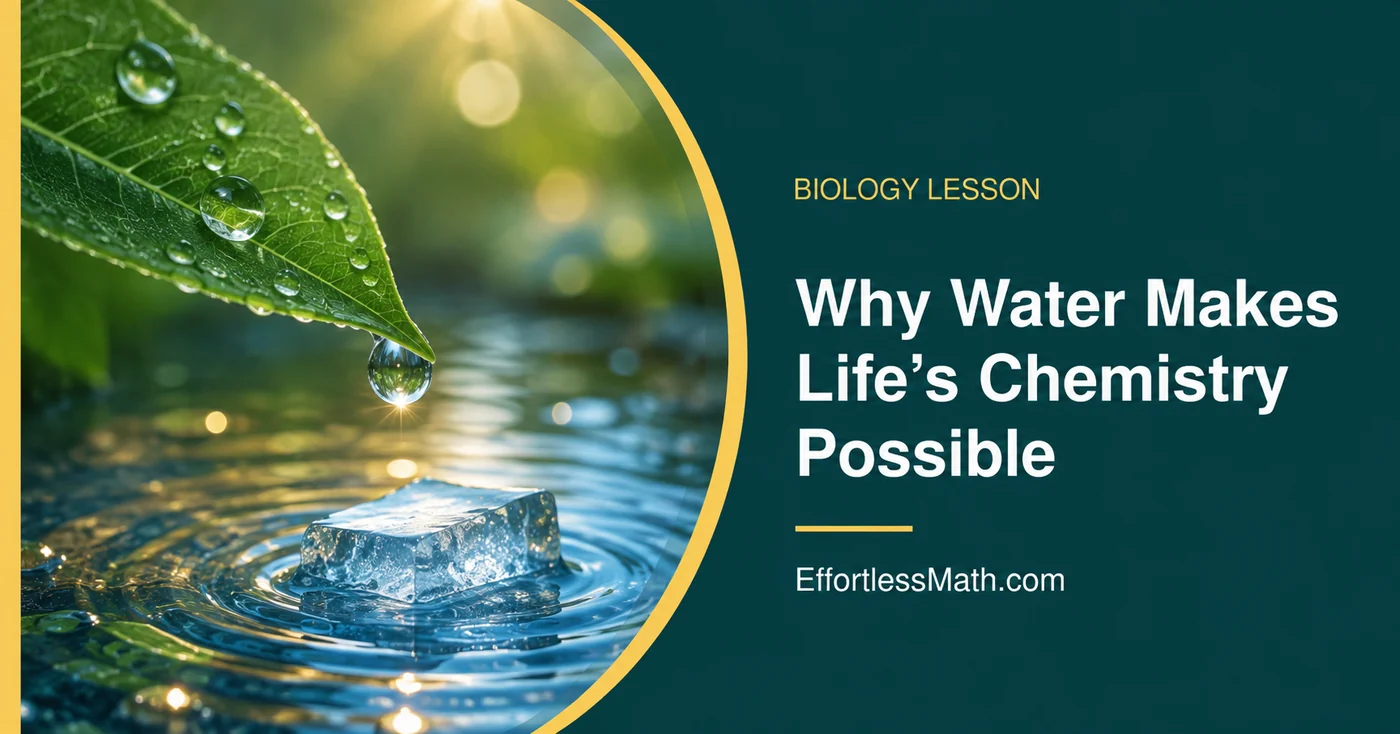
An ice layer floats above a pond while water beneath it stays liquid. Inside that water, dissolved ions move among molecules that continually form and break hydrogen bonds. Start at this molecular scale. Water’s uneven charge distribution helps explain both the pond’s behavior and the chemistry inside its organisms.
Water’s polarity supports interactions with ions and other polar molecules. Hydrogen bonding among water molecules helps explain cohesion, high specific heat, and the open structure of ice.
Why is a water molecule polar?
Oxygen pulls shared electrons more strongly than hydrogen does. The oxygen end of a water molecule therefore carries a partial negative charge, while the hydrogen ends carry partial positive charges. The molecule is still electrically neutral overall. Its charge is distributed unevenly.
That uneven distribution lets neighboring water molecules attract one another through hydrogen bonds. One hydrogen bond is weak compared with a covalent bond. A large network of them, however, gives water several properties that living systems depend on.
How does water dissolve substances?
Water’s charged regions can surround ions and many polar molecules. Oxygen faces positive ions. Hydrogen faces negative ions. Once surrounded, those particles can spread through the solution. This is why blood plasma and the fluid inside cells can carry many dissolved materials.
Solvent does not mean universal: oils and other nonpolar substances do not mix well with water. Their behavior helps cell membranes form a stable boundary.
Why does water resist rapid temperature change?
Energy must disrupt part of the hydrogen-bond network before the molecules can move much faster. Water can absorb a considerable amount of energy while its temperature changes only gradually. That high specific heat helps organisms, lakes, and coastal environments avoid sudden temperature swings.
How do cohesion and adhesion help plants?
Cohesion is attraction among water molecules. Adhesion is attraction between water and another polar surface. Together, they help maintain a continuous water column in narrow plant tissue. Evaporation from leaves can pull that column upward through xylem.
Why does ice float?
As water freezes, hydrogen bonds hold the molecules in a more open arrangement. Solid water is therefore less dense than liquid water. Ice floats and forms an insulating layer at the surface of a lake. Water below can remain liquid, giving aquatic life a place to survive through cold weather.
| Property | Cause | Biological importance |
|---|---|---|
| Polarity | Unequal electron sharing | Helps dissolve ions and polar molecules |
| High specific heat | Hydrogen-bond network | Moderates temperature change |
| Cohesion and adhesion | Attraction between charged regions | Supports water movement in plants |
| Ice is less dense | Open crystal structure | Allows ice to float and insulate water below |
How does pH connect to living chemistry?
The pH scale tracks hydrogen-ion concentration. A one-unit pH change represents a tenfold concentration change. A buffer can accept or release hydrogen ions and resist a sudden pH shift. For an enzyme, altered group charges can disrupt substrate binding or the interactions that maintain its functional shape.
Watch the idea take shape
Watch Khan Academy connect water’s molecular structure with its properties. For the floating-ice example, explain how hydrogen bonds affect the spacing between molecules.
Check your understanding
- What makes water polar?
- Why can water dissolve many salts?
- Which property helps a lake resist a rapid temperature swing?
- How are cohesion and adhesion different?
- Why does ice float?
- Why can a pH change affect an enzyme?
Answers
- Oxygen attracts the shared electrons more strongly, producing an uneven distribution of partial charge.
- Its charged regions surround and separate the ions.
- Water’s high specific heat.
- Cohesion attracts water molecules to one another. Adhesion attracts water to another polar surface.
- Frozen water has a more open, less dense structure than liquid water.
- pH can alter the charges and shape of a protein, including its active site.
For the AP course sequence and practice tests, use the AP Biology study hub.
Further reading: OpenStax Biology 2e: Water

Related to This Article
More math articles
- How to Multiply Three or More Mixed Numbers, Fractions & Whole Numbers?
- How to Using Decimals, Grid Models, and Fractions to Represent Percent
- Full-Length 7th Grade PARCC Math Practice Test
- Timing, Stamina, and Test Day
- Grade 7 Math Flashcards (Free Online: Formulas, Terms & Concepts)
- Geometry Puzzle – Challenge 63
- The Fundamental Theorem of Algebra
- HSPT Math Flashcards (Free Online: Formulas, Terms & Concepts)
- Double Consciousness and Intersectionality
- The Ultimate 7th Grade NYSTP Math Course (+FREE Worksheets)






















What people say about "Why Water Makes Life's Chemistry Possible"?
No one replied yet.