The Money Question, Agrarian Distress, and the Grange
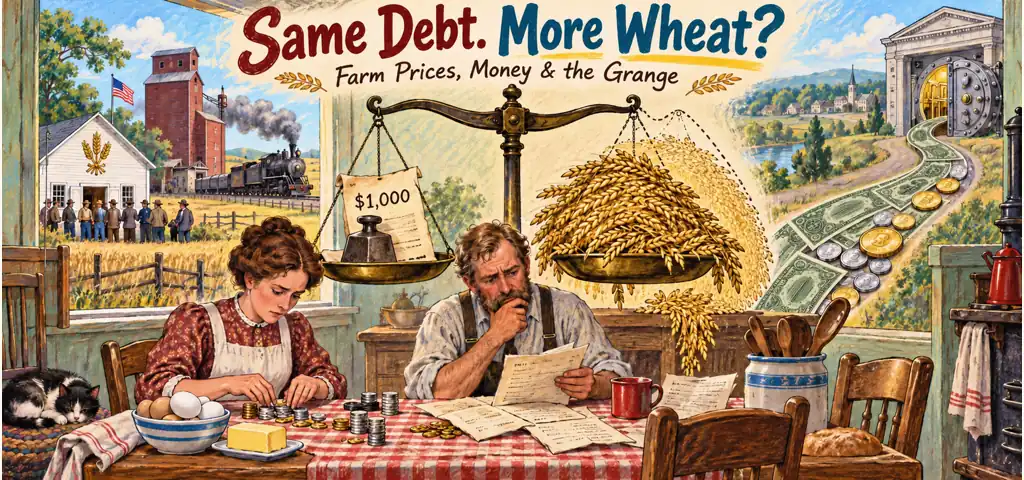
Chapter 5 of the CLEP History of the United States II study guide on Effortless Math covers The Money Question, Agrarian Distress, and the Grange: the key terms, the core ideas, and worked examples showing how this topic is tested on the exam.
CLEP History of the United States II, Chapter 5
The dollar had a distributional effect
After the Civil War, Americans argued over what counted as money and how much should circulate. Debtors often favored a larger supply of paper money or silver because modest inflation could raise prices and make fixed debts easier to repay. Creditors and many commercial interests preferred gold-backed money that protected purchasing power. These positions were not automatic: region, party, occupation, and confidence also mattered. The central reasoning chain is price level to real debt burden. When crop prices fell but the number of dollars owed stayed fixed, farmers had to sell more produce to meet the same mortgage payment.
The Public Credit Act pledged coin repayment
Civil War bonds had been purchased with paper currency, and the postwar question was whether the government could repay them in greenbacks or must use coin. The Public Credit Act of 1869 pledged payment of federal obligations in coin, rather than depreciated paper, unless a contract expressly provided otherwise. Creditors welcomed the promise; greenback advocates saw an advantage granted to bondholders at taxpayers' expense. The law linked wartime debt repayment to the emerging partisan conflict between hard-money advocates and those seeking a more elastic or inflationary currency. It did not create the Federal Reserve or authorize free silver.
Greenbacks survived but became redeemable
Congress had issued United States notes, or greenbacks, during the war without immediate coin redemption. Postwar contraction helped inspire the Greenback movement, which wanted the paper notes kept in circulation. The Resumption Act of 1875 promised that the Treasury would redeem greenbacks in gold beginning in January 1879. Confidence rose before redemption began, bringing paper to parity with gold; holders did not rush to exchange it. The Greenback Labor Party combined currency expansion with labor and agrarian reform and won about one million votes in 1878. It demanded continued paper circulation, not a higher protective tariff or merit examinations.
Silver laws stopped short of free coinage
Congress had omitted the standard silver dollar from the 1873 coinage law, an action silver supporters later denounced as the "Crime of 1873." The Bland-Allison Act of 1878 required limited Treasury purchases of silver and coinage of silver dollars. The Sherman Silver Purchase Act of 1890 required larger monthly purchases and paid with Treasury notes redeemable in coin; because holders could demand gold, the system placed pressure on the gold reserve. Neither act granted free and unlimited coinage at sixteen ounces of silver to one of gold. The Gold Standard Act of 1900 finally declared the gold dollar the standard unit and required gold redemption.
National bank notes were inelastic
Under the National Banking Acts, a national bank deposited United States government bonds with the Treasury and could issue bank notes against them. The arrangement created a more uniform currency, but note volume followed the supply and price of federal bonds rather than seasonal business demand. In farming regions, demand for cash rose at harvest, yet banks could not quickly issue currency by presenting short-term commercial loans for rediscount. This inelasticity contributed to interest-rate spikes and financial panics. The Federal Reserve system of 1913 later allowed member banks to obtain currency against eligible commercial paper, making supply more responsive.
Farm distress had several causes
Railroads connected farmers to national and world markets, but land, machinery, seed, and freight often required borrowed money. Meanwhile, expanding production in the United States, Russia, Argentina, Canada, and India pushed grain into the same world market. One Kansas farmer could not raise the global wheat price by planting less. Deflation increased the real burden of debt, while freight-rate differences and high prices for protected manufactured goods deepened resentment. Good harvests could even reduce income if expanded supply drove prices down. Agrarian protest therefore joined currency, credit, transport, tariff, and market-power complaints.
Women sustained the weekly cash economy
A staple crop might produce one large payment after harvest, much of it already claimed by a lender or merchant. Farm women's sales of butter, eggs, poultry, cream, and other dairy goods often supplied smaller but steadier cash receipts through the year. That money paid store bills and purchased household necessities. Calling such work merely "domestic" hides its market role. It also helps explain women's participation in agrarian organization: farm policy affected labor they performed and income they managed. Household economic strategy joined annual field-crop revenue to weekly small-scale production.
The Grange mixed education, cooperation, and politics
Oliver Hudson Kelley founded the Patrons of Husbandry, or Grange, in 1867. Local granges offered education, sociability, cooperative purchasing and marketing, and a political network. Women entered from the beginning and four offices were reserved for them, giving many rural women unusual experience in public speaking and organizational leadership. Cooperative stores and elevators sought to reduce dependence on middlemen, although weak capital and management limited many ventures. In the Midwest, Grangers also pressed states to regulate railroad and grain-elevator rates. Their movement preceded the Farmers' Alliances and People's Party.
Regulation met a constitutional boundary
In Munn v. Illinois (1877), the Supreme Court upheld state regulation of grain warehouses devoted to public use. But Wabash v. Illinois (1886) limited state power over rates affecting interstate commerce. Congress responded with the Interstate Commerce Act of 1887. These decisions did not resolve the money question; they illustrate a separate agrarian demand and the scale problem of a national rail network. A state could regulate local business under some conditions, but Congress had to address interstate rates.
The depression of 1893 joined rail failure and gold drain
Overextended railroads failed in 1893, shaking banks and investors. At the same time, holders of Treasury notes redeemed them for gold, and the federal reserve fell. Unemployment surged and thousands of businesses collapsed. President Cleveland won repeal of the Sherman Silver Purchase Act, believing silver purchases undermined confidence, but repeal did not quickly restore employment. His administration arranged a bond sale through bankers including J. P. Morgan to replenish Treasury gold. The episode made hard-money policy appear responsive to creditors while workers and farmers bore depression.
Later credit reform addressed loan duration
The Alliance's subtreasury proposal would have placed federal warehouses in farming regions, allowed farmers to store nonperishable crops, and issued Treasury notes as low-interest loans against them. It aimed to let producers delay sale and bypass scarce private credit. Congress rejected it. The Federal Farm Loan Act of 1916 took another route, creating twelve federal land banks that offered long-term mortgage loans, sometimes running forty years and repaid in installments. Those mortgages served land finance; they were not seasonal crop loans for seed or fertilizer.
follow the balance sheet
Imagine wheat prices fall by half while a mortgage remains $1,000.
Watch the history in motion
This short lesson adds voices, images, and chronology to the ideas you just studied.
Video: The Populist Movement Explained, Mr. Beat.
Try four CLEP-style questions
- A bondholder praises an 1869 pledge because repayment will retain purchasing power. Which debtor objection follows most directly?
- Coin repayment reduces the real value of every creditor's claim as prices fall.
- Taxes may use dearer dollars than those originally loaned.
- The pledge makes the nominal principal of federal bonds expand whenever gold appreciates.
- Payment in coin shifts the entire war debt from federal taxpayers to national banks.
- The act authorizes unlimited silver coinage, exposing bondholders to a cheaper repayment medium.
- Why did women have a direct material stake in agrarian politics even when legal title to a family farm belonged to a man?
- Married women's property laws transferred each farm mortgage to the borrower's wife.
- Railroad commissions reserved voting seats for women who marketed household produce.
- Grange rules confined women to social events outside the cooperative economy.
- National banks accepted butter and egg receipts as collateral for issuing currency.
- Women sold household production for cash and held offices within Grange organizations.
- What local symptom would most likely appear when harvest demand for cash met an inelastic bond-secured note supply?
- Banks would issue additional notes against warehouse receipts, pushing seasonal lending rates downward.
- Silver certificates would displace bank notes wherever seasonal rates exceeded a federal ceiling.
- Crop prices would rise because national-bank note supply expanded with harvested acreage.
- Borrowers would compete for scarce cash, producing a seasonal rise in short-term interest rates.
- Mortgage principal would be indexed downward to prevailing crop prices.
- After undercapitalized cooperative stores fail, Grange members use the same local networks to petition legislatures. What change has occurred?
- They have pursued vertical integration by purchasing the interstate rail network themselves.
- They have narrowed a broad transport complaint into a campaign for coin redemption alone.
- They have redirected cooperative organization toward political regulation of rates and warehouses.
- They have abandoned organization in favor of individual bargaining with elevators and carriers.
- They have concluded that state law can regulate every interstate shipment without constitutional limits.
Check your answers and reasoning
Independent preparation. CLEP is a registered trademark of the College Board, which does not endorse this lesson.

Related to This Article
More math articles
- Division Facts Review for 4th Grade
- Grade 2 Math Worksheets for Ohio Second Graders — Free Printables
- DNA, RNA, and Protein Synthesis
- How to Use Models to Place Decimal Numbers in Order
- Grade 3 Math: Word Problems: Addition and Subtraction
- How to Prepare for the TASC Math Test?
- The Best Grade 8 Math Book for Delaware Students
- How to Multiply and Divide Rational Numbers
- Algebra Puzzle – Challenge 39
- Louisiana LEAP Grade 5 Math Worksheets — 49 Free Printable Single-Skill PDFs














What people say about "The Money Question and the Grange"?
No one replied yet.