Farmers’ Alliances, Populism, and the Realignment of 1896
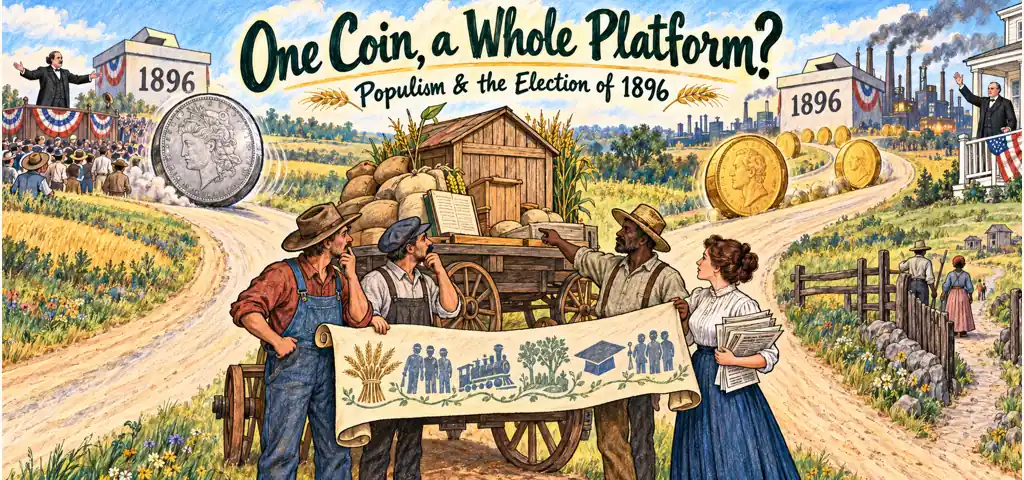
Chapter 5 of the CLEP History of the United States II study guide on Effortless Math covers Farmers’ Alliances, Populism, and the Realignment of 1896: the key terms, the core ideas, and worked examples showing how this topic is tested on the exam.
CLEP History of the United States II, Chapter 5
The Alliances built a movement infrastructure
The Farmers' Alliances spread during the 1880s through lectures, local chapters, newspapers, cooperative exchanges, and traveling organizers. The Southern Alliance, Northwestern Alliance, and Colored Farmers' Alliance were distinct bodies rather than one smooth organization. They taught members how credit, railroad rates, tariffs, and monetary policy shaped farm income. Cooperative purchasing and marketing tried to bypass merchants, but thin capital and hostile lenders exposed their limits. When economic cooperation could not alter the rules of exchange, many Alliance members moved into independent politics. The organizational path ran from local education to coordinated demands and then to the People's Party.
The subtreasury plan attacked forced sale
Charles Macune and other Alliance leaders proposed a federal subtreasury system. Government warehouses would accept nonperishable crops, and farmers could borrow Treasury notes for a large portion of their value at low interest. A producer could wait for a better price instead of selling immediately after harvest, when a crop glut depressed prices and creditors demanded payment. The proposal joined currency expansion to federal farm credit. It was not the same as railroad rate regulation, acreage payments, or the later Federal Farm Loan system. Congress rejected it, convincing supporters that the established parties served financiers and middlemen.
The Omaha Platform converted grievances into policy
The People's Party met at Omaha in 1892. Its platform demanded free and unlimited silver coinage, a graduated income tax, government ownership of railroads and telegraphs, a subtreasury system, direct election of senators, and political reforms including initiative and referendum. It also endorsed an eight-hour workday and restrictions on alien landownership. These planks mixed agrarian needs with labor and democratic reform. The platform criticized concentrated corporate power and a currency controlled through banks. It did not seek a higher protective tariff or the restoration of patronage.
Populists sought a producer coalition
Populist rhetoric imagined farmers and workers as producers confronting monopolies, railroads, and finance. In some places, white and Black farmers cooperated through elections or economic organizations. Tom Watson of Georgia initially appealed across race, and Populist-Republican Fusion won North Carolina offices. Yet racial solidarity faced violence, disfranchisement, unequal Alliance structures, and white leaders unwilling to sustain it. Southern Democrats charged that Populism meant "Negro rule" and used white-supremacy campaigns to break biracial coalitions. The movement revealed both a possible class alliance and the power of the color line to destroy it.
The cotton pickers' strike revealed an internal limit
The Colored Farmers' Alliance claimed a vast membership, but many members were tenants or wage laborers whose interests could conflict with landowners inside the white Alliance. In 1891, Black cotton pickers in Arkansas struck for higher pay. Planters and armed posses crushed the action, killing participants and destroying the organizing effort. Shared anger at merchants and railroads did not erase the employer-worker conflict within the rural "producer" coalition. The episode helps explain why impressive membership figures did not automatically become unified power.
The election of 1892 demonstrated regional strength
Populist presidential nominee James B. Weaver received more than one million popular votes and twenty-two electoral votes in 1892, carrying Colorado, Idaho, Kansas, and Nevada and winning electors elsewhere. That performance showed that the People's Party had become a regional force, especially in the West, rather than merely a protest club. It did not displace Democrats across the South or command industrial workers nationally. State outcomes depended on fusion arrangements, local racial politics, and existing party institutions. National breakthrough required a crisis capable of rearranging those alignments.
Depression radicalized protest
The depression beginning in 1893 closed banks, broke railroads, and produced mass unemployment. Jacob Coxey led a march of the unemployed to Washington in 1894, asking the federal government to issue paper money for road construction. Police arrested him for walking on Capitol grounds, and Congress rejected the plan. Coxey's proposal matters because it used public works and monetary expansion as a depression remedy. It was not the Alliance subtreasury, which lent on stored crops. Both programs challenged a federal policy focused on gold confidence and limited relief.
Bryan captured the silver issue
At the 1896 Democratic convention, William Jennings Bryan's "Cross of Gold" speech condemned a monetary system that sacrificed ordinary producers to creditors and won him the nomination. Democrats endorsed free silver at sixteen to one. Populists faced a strategic choice: run an independent ticket and divide silver votes, or fuse with Bryan and risk losing their broader identity. They nominated Bryan but selected their own vice-presidential candidate. Fusion made silver the campaign's center while pushing railroad ownership, the subtreasury, and other Omaha demands aside.
McKinley assembled the winning coalition
Republican William McKinley defended the gold standard and protective tariff. Campaign manager Mark Hanna organized large contributions, extensive print material, and disciplined outreach. Economic recovery began before voting, reducing silver's appeal. McKinley won industrial workers and urban voters in key states while Bryan dominated much of the South and West. The result established Republicans as the stronger national party for most of the next generation. Industrial and populous states became central to the governing coalition, while Democrats were more heavily confined to the South and parts of the West.
Realignment outlasted free silver
Bryan ran again in 1900. Prosperity weakened the money grievance, and overseas expansion after the Spanish-American War added a new issue. Bryan opposed the treaty annexing the Philippines in principle but urged Senate ratification so the question could be taken to voters; he later campaigned against imperialism. McKinley defeated him more decisively. The Gold Standard Act had already formalized gold in 1900. Populist organization declined as Democrats absorbed free silver and many reform proposals migrated into Progressive politics. Direct election of senators and the income tax eventually became constitutional, but not through a Populist national victory.
New South boosterism offered a rival diagnosis
Journalist Henry Grady promoted a "New South" of industrial development, northern investment, sectional reconciliation, and diversified production. He presented modernization without challenging white supremacy. Alliance and Populist critics answered that mills and rail links alone did not solve debt, monopoly, low crop prices, or political exclusion. The contrast is diagnostic: boosters emphasized capital and regional growth, whereas agrarian radicals asked who controlled credit, transport, and government. Industrial development could coexist with unequal landholding and disfranchisement.
distinguish coalition from platform
Suppose a party endorses free silver but says nothing about federal crop warehouses.
Populism changed the questions of national politics
The People's Party did not win the presidency, but it made concentrated power, currency control, railroads, taxation, and democratic procedure unavoidable issues. Its biracial experiments showed that economic grievance could cross racial lines, while their defeat exposed how violence and white supremacy shaped political outcomes. The 1896 realignment was therefore institutional as well as electoral: Republicans linked industry, gold, and national growth; Democrats became the home of agrarian silver protest; and an independent third party lost space. Later reformers adopted several Populist proposals under different coalitions.
Watch the history in motion
This short lesson adds voices, images, and chronology to the ideas you just studied.
Video: The Populist Movement Explained, Mr. Beat.
Try four CLEP-style questions
- Why did repeated failures of Alliance cooperatives encourage an independent political movement?
- Profitable exchanges convinced members that private marketing alone had already solved railroad and credit problems.
- Private exchanges could not rewrite public rules for money, transport, and credit.
- Alliance networks dissolved when cooperative stores failed, leaving no organization that could enter politics.
- National banks began offering the Alliance's proposed crop-backed Treasury loans without federal legislation.
- State railroad laws convinced Alliance leaders that no national political program was necessary.
- A 1896 campaign promises free silver but drops federal railroad ownership and crop-warehouse loans. Which Populist concern is least satisfied?
- Reversing the price pressure associated with a creditor-favored monetary standard
- Changing control of transportation and credit, not currency alone
- Reducing the real burden of fixed farm debts through a higher price level
- Defeating a candidate committed to preserving the gold standard
- Increasing the volume of money available for exchange and debt payment
- Which paired evidence best demonstrates both the possibility and fragility of biracial agrarian politics?
- Fusion victories followed by white-supremacist intimidation, together with the violent defeat of Black cotton strikers
- A western Populist electoral victory together with a Democratic endorsement of silver
- Large Colored Alliance membership together with a shared critique of merchants, but no evidence of repression or employer conflict
- Coxey's interracial public-works march together with McKinley's urban vote
- The Omaha labor plank together with Republican protection of Black voting in every southern state
- Why should Coxey's road-building proposal not be confused with the Alliance subtreasury plan?
- The subtreasury applied only to urban workers, while Coxey's plan applied only to landowners.
- Coxey proposed crop warehouses, whereas the subtreasury paid wages for federal highway construction.
- Both plans relied on private railroad bonds rather than federal currency.
- Coxey proposed public jobs; the subtreasury proposed crop-backed producer loans.
- Both proposals required borrowers to surrender permanent ownership of land to the Treasury.
Check your answers and reasoning
Independent preparation. CLEP is a registered trademark of the College Board, which does not endorse this lesson.

Related to This Article
More math articles
- What Is on the ALEKS Math Placement Test?
- How to Scale a Function Vertically?
- The Best Grade 5 Math Book for Wisconsin Students
- Math Games That Actually Teach: 12 Games Worth Your Time
- FREE 7th Grade MCAS Math Practice Test
- Rates, Fertility, Mortality, and Reader-Friendly Calculations
- EZ Baccarat, Punto Banco, Chemin de Fer: A Probability Comparison
- 7th Grade K-PREP Math Worksheets: FREE & Printable
- Party organization
- Free Spins Math: Pricing the Bonus Round Yourself
















What people say about "Farmers' Alliances, Populism, and 1896"?
No one replied yet.