Disfranchisement, the Civil Rights Cases, and Plessy
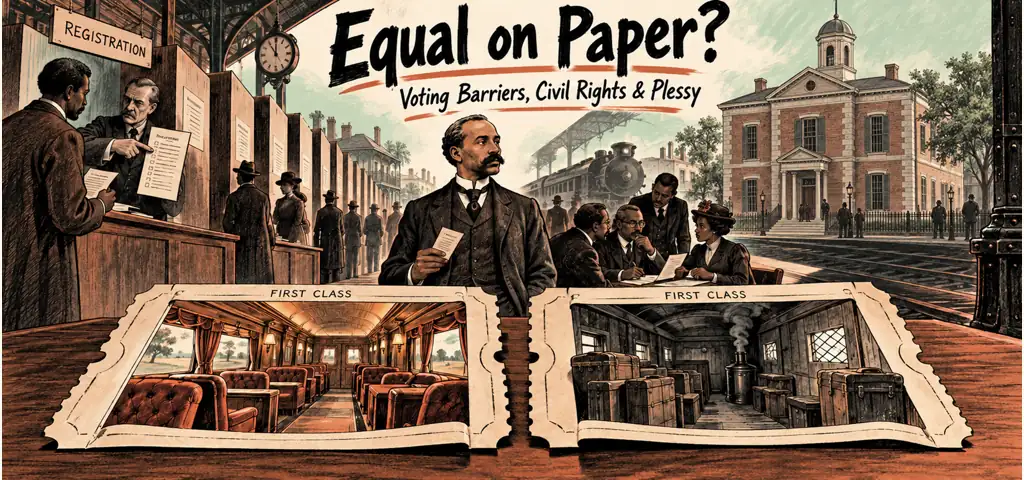
Chapter 5 of the CLEP History of the United States II study guide on Effortless Math covers Disfranchisement, the Civil Rights Cases, and Plessy: the key terms, the core ideas, and worked examples showing how this topic is tested on the exam.
CLEP History of the United States II, Chapter 5
Redemption became a governing system
After federal withdrawal from Reconstruction, white Democratic "Redeemers" consolidated control across the South. They reduced public spending, weakened Black political participation, and defended a racial order through law, employment, debt, and violence. Black men still voted in significant numbers in parts of the South during the 1880s, and biracial Populist-Republican coalitions threatened Democratic rule in the 1890s. Disfranchisement was therefore an organized political response, not an automatic consequence of 1877. State conventions rewrote election rules while mobs and employers imposed additional coercion.
Facially neutral devices were selectively administered
Poll taxes required payment before voting and often accumulated across missed years. Literacy tests let registrars decide whether an applicant could read or interpret a constitutional passage. Understanding clauses created similar discretion. Grandfather clauses exempted men whose ancestors had voted before a specified date, protecting many illiterate white citizens whose grandfathers could vote before Black suffrage. White primaries defined the Democratic nomination as a private party affair and excluded Black participants where winning that nomination effectively decided office. Residency rules, complex registration, economic retaliation, and violence reinforced the statutory barriers.
Why lawmakers avoided naming race
The Fifteenth Amendment prohibited denying the vote because of race, color, or previous condition of servitude. Southern lawmakers therefore wrote many qualifications without explicit racial words. Selective administration and grandfather exemptions achieved the intended result while making a constitutional challenge harder. Poor white voters were sometimes disfranchised too, but officials could assist or exempt them. In Williams v. Mississippi (1898), the Supreme Court sustained facially race-neutral provisions because the text did not name race and the record did not establish discriminatory administration. Formal neutrality concealed unequal operation.
Oklahoma rebuilt exclusion after Guinn
In Guinn v. United States (1915), the Supreme Court invalidated Oklahoma's grandfather clause, which excused many white voters from literacy requirements by looking back to ancestors eligible before Black enfranchisement. Oklahoma answered by preserving the old registration list and opening only a brief 1916 window for people previously kept off it. Missing that window meant permanent exclusion. Lane v. Wilson (1939) invalidated the substitute because it carried forward the discriminatory consequences of the old rule. The sequence shows that a court victory against one device could prompt officials to design a facially neutral replacement.
The Civil Rights Cases narrowed federal protection
The Civil Rights Act of 1875 prohibited racial discrimination in inns, public conveyances, theaters, and similar accommodations. In the Civil Rights Cases (1883), the Supreme Court invalidated those provisions. The majority reasoned that the Fourteenth Amendment restrains state action, not purely private discrimination, and that the Thirteenth Amendment did not authorize this accommodation rule as written. The decision did not hold segregation equal, decide a voting case, or invalidate the Fourteenth Amendment. It created a state-action boundary that left much private exclusion beyond this federal statute's reach.
Railroad segregation supplied a planned test
Louisiana's Separate Car Act of 1890 required racially separate railway accommodations. A New Orleans citizens' committee deliberately arranged a test: Homer Plessy, who was legally classified as Black but appeared white, bought a first-class ticket, entered the car designated for white passengers, announced his ancestry, and was arrested. The facts were designed to force review of the statute. This was a planned constitutional challenge, not a spontaneous refusal caused by denial of first-class payment. A ticket purchased transportation in the racially assigned car, not a right to choose any car.
Plessy constitutionalized separate but equal
In Plessy v. Ferguson (1896), the Supreme Court upheld Louisiana's law. The majority said legally required separation did not itself stamp Black citizens with inferiority and accepted "separate but equal" accommodations under the Fourteenth Amendment. The ruling gave constitutional shelter to expanding Jim Crow laws, even though facilities were rarely equal in practice. It did not approve slavery or decide school segregation specifically. The doctrine governed state-imposed separation until later litigation exposed both its inequality and its constitutional failure.
Harlan's dissent supplied a contrary principle
Justice John Marshall Harlan dissented alone. He declared that the Constitution is color-blind and knows no caste among citizens, while also using some assumptions characteristic of his period. His legal point was that the state could not sort citizens by race in the enjoyment of civil rights. On a CLEP item, Harlan's famous dissent identifies Plessy, not the Civil Rights Cases, although he dissented in both. The precise issue matters: Plessy concerned state-mandated railway separation; the 1883 cases concerned Congress's power over private discrimination.
Equal price did not mean equal treatment
A Black passenger could buy a first-class ticket yet be compelled to sit in a separate car. The nominal service class and fare could match while location, condition, access, and status differed. Segregation laws reached railroads, schools, streetcars, waiting rooms, hospitals, neighborhoods, and public facilities through varying state and local rules. The system was built by public law and private enforcement together. Violence threatened people who challenged it; employment and credit dependence discouraged political resistance. Formal claims of equality should therefore be tested against control, administration, and material conditions.
Railway accommodations could be equal in price but unequal in function
Railroads sometimes charged Black and white first-class passengers the same fare while assigning Black passengers to a car that also served smoking and baggage functions. The nominal ticket class therefore did not establish equivalent conditions. A historian must compare the space, services, and burdens attached to the fare, not infer equality from price alone. This evidence makes the formal claim of "separate but equal" testable in material terms: separation could preserve status hierarchy even when the rate printed on two tickets matched.
Disfranchisement protected the broader color line
Removing Black voters from electorates made it harder to challenge segregated schools, convict leasing, unequal taxation, and mob violence. It also reduced accountability for white officials and weakened Populist opposition. State devices interacted: a poll tax reduced the applicant pool, a discretionary literacy test filtered those remaining, a white primary denied influence over the decisive contest, and violence raised the cost of trying. No single device explains the transformation. By the early twentieth century, Black registration had collapsed in much of the South.
separate actor from conduct
A question says a hotel owner refuses a room without any state law ordering the refusal.
The legal sequence narrowed practical citizenship
The Fifteenth Amendment announced a prohibition, but election devices avoided explicit racial text. The Fourteenth Amendment promised equal protection, but the Civil Rights Cases restricted its reach to state action and Plessy tolerated state separation. Law did not act alone; intimidation, party control, and economic pressure made the rules effective. Yet the constitutional language also gave later activists a basis for challenge. Understanding the color line requires holding doctrine and administration together: what a rule said, who enforced it, and what power citizens retained to contest it.
Watch the history in motion
This short lesson adds voices, images, and chronology to the ideas you just studied.
Video: Jim Crow Laws and Racial Segregation in America | The Civil Rights Movement, GPB Education.
Try four CLEP-style questions
- A registrar gives difficult constitutional passages to Black applicants but reads answers aloud for white applicants. What evidence is essential to a challenge when the statute contains no racial words?
- The qualification's formally neutral wording in the state constitution
- The registrar's assertion that every applicant received the same printed passage
- Comparative records showing that officials burdened one group while assisting similarly situated applicants from another
- The number of applicants who had already paid the poll tax
- The date on which the state convention adopted the registration provision
- What is wrong with claiming that Plessy v. Ferguson directly decided the constitutionality of segregated public schools?
- The case concerned state railway separation, not public schools.
- The Court reviewed a federal accommodation statute rather than any state segregation measure.
- The Court invalidated Louisiana's rail law and reserved school segregation for Congress.
- The case concerned discriminatory administration of a neutral registration rule rather than explicit separation.
- The decision addressed only private theater owners acting without state law.
- Which sequence correctly shows how disfranchisement devices could operate at different stages?
- Accumulated poll taxes blocked registration; white primaries blocked influence over nominations.
- A grandfather clause excluded illiterate white registrants before a literacy test assisted their Black counterparts.
- A poll tax was collected only after ballots were counted, while a white primary governed residency.
- Every device operated at registration, so nomination rules added no separate barrier.
- A white primary first determined general-election eligibility, after which a poll tax selected the party nominee.
- Why did disfranchisement help preserve unequal schools, coercive labor systems, and racial violence beyond the polling place?
- It increased federal supervision and made national officials more responsive to local racial violence.
- It shifted competition from party primaries to general elections, increasing Black voters' bargaining power.
- It moved enforcement of racial segregation from elected officials to federal courts, reducing local political influence.
- It tied poll-tax revenue to equal school funding, separating voting restrictions from education policy.
- It reduced Black electoral use and officials' accountability to communities harmed by the wider racial order.
Check your answers and reasoning
Independent preparation. CLEP is a registered trademark of the College Board, which does not endorse this lesson.

Related to This Article
More math articles
- FREE TASC Math Practice Test
- 4th Grade OST Math Practice Test Questions
- Indiana Algebra 1 Free Worksheets: Free Skill-Targeted Algebra 1 Worksheets with Answer Keys
- Discovering the Magic of ASA and AAS Congruence in Triangles
- Biological Macromolecules
- Perimeter for 4th Grade
- Online Baccarat vs. Land Baccarat: Where the Math Actually Diverges
- Free Maine MTYA Grade 3 Math Worksheets: 49 Printable PDFs with Friendly Answer Keys
- Advanced Vocabulary Words: Magnitude to Opulent
- How to Prepare for the CHSPE Math Test?















What people say about "Disfranchisement, Civil Rights Cases, Plessy"?
No one replied yet.