Free Grade 6 English Worksheets for Hawaii Students
There is a particular kind of summer that lives in Hawaiian sixth-grade households, the long stretch where school is out, the library on Punchbowl or in Hilo is one short drive away, and a kid who would rather be in the water is being gently nudged toward a book. Most parents lose this fight at some point in July. The smart move is not to fight it at all. A page of focused practice over breakfast, before the day gets going, undoes a surprising amount of summer slide without anyone calling it “studying.”
That is the rhythm behind this page. Sixth grade English on the islands runs on the Hawaii Common Core State Standards for ELA, and the Smarter Balanced assessment that lands in the spring tests exactly those standards through computer-adaptive reading items and a performance task that asks for an extended piece of writing. The Standards have not changed much. What has changed is what sixth grade asks a reader to do with them, more evidence, more inference, more independent argument on the page.
The worksheets below are built for the slow weeks rather than the test week. Forty-six PDFs, each one a single skill from the Common Core framework, formatted to be readable on a kitchen lanai with a juice glass beside the page.
What’s on this page
Every worksheet here covers one Grade 6 ELA skill. Page one is a Quick Review in plain student language. Page two is the practice. The final page is the answer key, with each correct answer explained the way a patient teacher would explain it, short, specific, no parent-translator required.
No accounts, no email, no paywall. Print it, work it, recycle it.
Reading: Literature
- Citing Textual Evidence and Drawing Inferences, [RL.6.1] claim the inference, point at the line that earns it
- Theme and Objective Summary, [RL.6.2] what the story teaches, in a single careful sentence
- Plot, Episodes, and Character Change, [RL.6.3] the small scenes that turn a character into someone new
- Figurative Language, Connotation, and Tone, [RL.6.4] the feeling a word adds past its definition
- Structure: How a Scene or Stanza Builds the Whole, [RL.6.5] every chunk has work to do for the larger piece
- Developing the Narrator’s Point of View, [RL.6.6] how an author makes you see through a character’s eyes
- Reading vs. Watching: Comparing Versions, [RL.6.7] what the page does that the screen cannot
- Comparing Stories Across Forms and Genres, [RL.6.9] same theme, different shape
Reading: Informational Text
- Citing Evidence and Drawing Inferences in Nonfiction, [RI.6.1] quote the sentence that clinches the conclusion
- Central Idea and Objective Summary in Nonfiction, [RI.6.2] the article’s main point, no filler
- How Ideas and Events Are Developed, [RI.6.3] how a writer introduces a point and elaborates on it
- Word Meaning in Nonfiction: Figurative, Connotative, Technical, [RI.6.4] one word, three different working modes
- Text Structure: How Sections Fit Together, [RI.6.5] cause, effect, problem, solution, comparison, sequence
- Author’s Point of View and Purpose, [RI.6.6] the angle of the writer and the reason for the writing
- Integrating Information from Text, Visuals, and Data, [RI.6.7] read the words, the chart, and the picture together
- Evaluating Arguments and Claims, [RI.6.8] separate the claim from the support and rate the support
- Comparing Two Authors on the Same Topic, [RI.6.9] same subject, different facts, different angles
Working on Math Too? Try the Hawaii Smarter Balanced Grade 6 Math Bundle
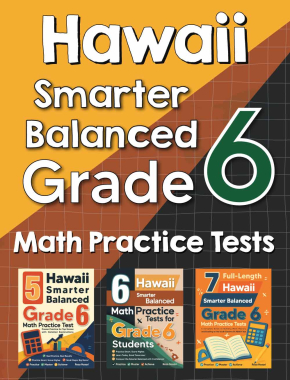
Many third graders are getting ready for the Smarter Balanced in both subjects. If your child also needs math practice that matches the same standards, this companion bundle is the shortest path, workbook, study guide, and full practice tests in one download.
Writing
- Argument Writing: Claim, Reasons, Evidence, [W.6.1] defend a position with reasons and quoted proof
- Informative and Explanatory Writing, [W.6.2] teach a reader something cleanly
- Narrative Writing, [W.6.3] hook, pacing, dialogue, sensory detail, real ending
- Clear Writing for Task, Purpose, and Audience, [W.6.4] match writing to the person on the other side
- Planning, Revising, and Editing, [W.6.5] drafts in passes, not single shots
- Short Research Projects, [W.6.7] focused question, multiple sources, tidy report
- Gathering, Evaluating, and Citing Sources, [W.6.8] which sources to trust and how to credit them
Speaking & Listening
- Collaborative Discussions, [SL.6.1] show up prepared, listen, build on what was said
- Interpreting Diverse Media, [SL.6.2] what each format does well and what it skips
- Analyzing a Speaker’s Argument, [SL.6.3] find the claim, the reasons, the soft spots
- Presenting Claims and Findings, [SL.6.4] open with the point, walk the evidence, land the close
- Adapting Speech to Context, [SL.6.6] friend, classmate, teacher, principal, different talk for each
Grammar
- Pronoun Case: Subjective, Objective, and Possessive, [L.6.1a] I, me, my, and which one belongs where
- Intensive Pronouns, [L.6.1b] myself, themselves, and the emphasis they bring
- Avoiding Shifts in Pronoun Number and Person, [L.6.1c] pick one person and one number, stay there
- Vague Pronouns and Unclear Antecedents, [L.6.1d] every pronoun needs a noun the reader can point at
- Recognizing and Improving Non-Standard English, [L.6.1e] when to keep your voice and when to switch into school English
Conventions: Punctuation, Spelling
- Punctuation: Commas, Parentheses, and Dashes, [L.6.2a] three ways to insert extra information
- Spelling Grade-Appropriate Words, [L.6.2b] the homophones and tricky spellings sixth graders miss most
Knowledge of Language and Style
- Varying Sentence Patterns for Style, [L.6.3a] combine, expand, and rearrange to keep prose alive
- Consistency in Style and Tone, [L.6.3b] pick a register and hold it from first sentence to last
Vocabulary and Word Study
- Using Context Clues, [L.6.4a] slow down at the strange word, look at the words around it
- Greek and Latin Roots and Affixes, [L.6.4b] port, dict, tele, photo, and the doors they open
- Using Dictionaries and Thesauruses Effectively, [L.6.4c] match the tool to the question
- Verifying Word Meaning, [L.6.4d] check the guess, do not trust it
- Figurative Language: Personification and More, [L.6.5a] the moves that bring writing to life
- Word Relationships: Cause-Effect, Part-Whole, Category, [L.6.5b] patterns that link words together
- Connotation: Shades of Meaning, [L.6.5c] thin, slender, scrawny, same idea, different feel
- Academic and Domain-Specific Vocabulary, [L.6.6] cross-subject words and field-specific words
How to use these worksheets at home
A page over breakfast, before the trade winds pick up and the day calls everyone outside. That is the model. Twelve to fifteen minutes of focused work in the morning, paper and pencil only, no screens. The pages are short on purpose. The point is consistency, not volume.
If your sixth grader is working off a printed book in class, match the worksheet to the genre. Working on a novel? Pull the theme and character-change pages. Working on a science article? Pull the central idea and text structure pages. The transfer between class reading and worksheet practice is fastest when they are working the same kind of muscle on the same week.
Save the answer key for the end. When your child gets something wrong, do not move on. Have them read the explanation out loud, in their own voice. That spoken-aloud step is what cements the correction. Silent reading of a right answer rarely teaches anything.
A note about Smarter Balanced ELA
Smarter Balanced ELA, the assessment Hawaii uses for sixth-grade English in the spring, is computer-adaptive. The first part of the test, the computer-adaptive items, adjusts in difficulty based on your child’s answers. The second part is the performance task, an extended activity that asks students to read a short set of related texts, answer questions about them, and then produce a longer piece of writing (often argumentative or informational) that draws evidence from those texts.
The performance task is where the year’s writing instruction really matters. A sixth grader who has practiced argument writing with quoted evidence, and who knows how to plan, draft, and revise in passes, has a real advantage there. The argument-writing, citing-evidence, planning-and-revising, and informative-writing PDFs on this page are designed for the muscle the performance task demands.
Want everything in one bundle?
If you would rather have one consolidated study resource, the Grade 6 ELA Preparation Bundle is the route. It collects full-length practice tests with answer explanations into one package, so your sixth grader can rehearse the whole pacing and shape of the assessment rather than working through one skill at a time.
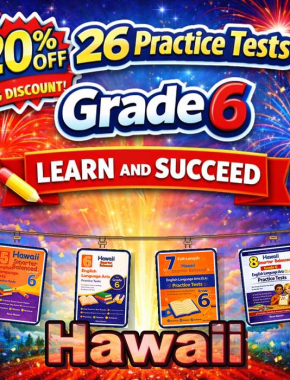
Hawaii Grade 6 ELA Preparation Bundle, four practice-test books, 26 unique full-length tests, complete answer keys with explanations.
A short closing
Summer is long here, and the school year is longer than it looks from August. A worksheet a morning, a careful read at the breakfast table, an answer key explained aloud. That is the practice that quietly turns a sixth grader into a stronger reader by spring. Bookmark this page. There is no wrong week to come back to it.
Best Bundle to Ace the Hawaii Smarter Balanced Grade 6 ELA
Looking for the best resource to help your kid ace the Hawaii Smarter Balanced? Try this bundle, four full practice-test books (5 + 6 + 7 + 8 tests) covering the same Grade 6 reading, writing, and language skills your child is already learning. Instant PDF download, answer keys included.

Related to This Article
More math articles
- Intelligent Math Puzzle – Challenge 87
- Top 10 8th Grade PARCC Math Practice Questions
- FREE TASC Math Practice Test
- Hyphens, Dashes, and Parentheses
- Reliability, Validity, and Bias
- Maryland Algebra 1 Free Worksheets: 65 Free Printable Algebra 1 Worksheets with Worked Answers
- Higher Education, Debt, and Unequal Returns
- 3rd Grade ACT Aspire Math Practice Test Questions
- A Comprehensive Collection of Free TASC Math Practice Tests
- CLEP U.S. History I 061: Cotton Expansion, Forced Migration, and Slavery





What people say about "Free Grade 6 English Worksheets for Hawaii"?
No one replied yet.