Lynching, Ida B. Wells, Washington, Du Bois, and Black Institution Building
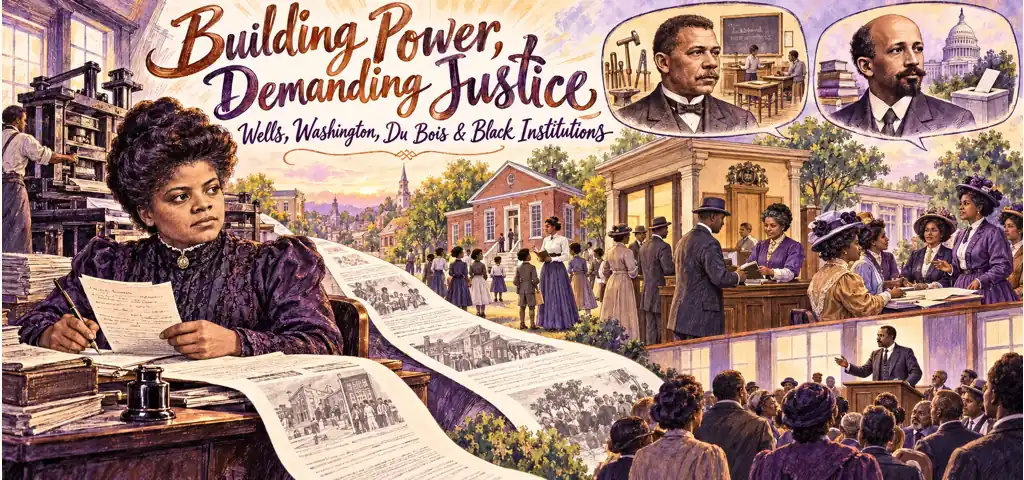
Chapter 5 of the CLEP History of the United States II study guide on Effortless Math covers Lynching, Ida B. Wells, Washington, Du Bois, and Black Institution Building: the key terms, the core ideas, and worked examples showing how this topic is tested on the exam.
CLEP History of the United States II, Chapter 5
Mob murder enforced the color line
Lynching was public violence carried out without legal trial, often with officials' tolerance or participation. Its victims were disproportionately Black men in the South, though Black women and people of other groups were also killed. White defenders claimed mobs protected white womanhood, but accusations frequently lacked evidence, and conflicts over labor, land, business, or political assertion often preceded attacks. Lynching terrorized communities beyond the immediate victim. It warned Black citizens against voting, economic competition, migration, or challenges to racial etiquette. Law enforcement's failure made mob power part of the governing order.
Ida B. Wells investigated the stated excuse
After a white mob murdered her friends Thomas Moss, Calvin McDowell, and Henry Stewart in Memphis in 1892, journalist Ida B. Wells investigated lynching cases. She compared newspaper allegations with available evidence and showed that the stock claim of punishing rape often concealed consensual relationships, business rivalry, or efforts to enforce racial subordination. Her pamphlets Southern Horrors and A Red Record, lectures, and organizing brought the evidence to national and international audiences. A mob destroyed her press, but exile did not silence her. Her method joined empirical case comparison to political advocacy.
Black women built national reform networks
Black women's clubs created schools, kindergartens, homes, health programs, and campaigns against lynching while confronting racism inside the broader women's movement. In 1896, clubs united as the National Association of Colored Women under the motto "Lifting as We Climb." Mary Church Terrell became its first president; Wells was among its prominent activists. The NACW did not exist solely to enter white federations or recruit domestic workers into a union. It joined community institution building to a defense of Black womanhood against degrading stereotypes. In the 1913 Washington suffrage procession, organizers asked Black women to march at the rear; Wells refused and entered with the Illinois delegation.
Washington built power through Tuskegee
Booker T. Washington led Tuskegee Institute from 1881. Students studied trades, agriculture, and teacher preparation and helped construct the campus. Washington argued that economic skill, property, disciplined institutions, and interracial cooperation could build security under hostile conditions. In his 1895 Atlanta Exposition address, he accepted social separation for the present while asking white employers and philanthropists to support Black economic advancement. His national network channeled donations, appointments, and press influence. The position was strategic, not a belief that segregation was just, but critics argued that public accommodation surrendered urgent rights.
Du Bois demanded immediate civil and political rights
W. E. B. Du Bois, trained at Fisk, Harvard, and the University of Berlin, challenged Washington's accommodation. In The Souls of Black Folk (1903), he argued that voting rights, civil equality, and higher education for talented leaders could not be postponed. The Niagara Movement, founded in 1905, demanded full manhood suffrage, equal civil rights, and opposition to segregation. It deliberately organized against Washington's dominance. T. Thomas Fortune's earlier Afro-American League had also opposed the color line, but it arose before Washington became the leading national figure. The Niagara Movement helped supply leadership and principles for the NAACP.
Violence accelerated national organization
White supremacists overthrew Wilmington, North Carolina's biracial elected government in 1898, killing Black residents and driving officials from office. This was a coup, not simply an isolated lynching. In Atlanta in 1906, a governor's race centered on disfranchisement and newspapers published unproven accusations of Black assaults; white mobs attacked Black Atlantans. In Springfield, Illinois, racial violence in 1908 shocked northern reformers. Black activists and white allies formed the National Association for the Advancement of Colored People in 1909, drawing directly on Niagara veterans. The NAACP used publicity, lobbying, and litigation against disfranchisement, segregation, and mob violence.
Mutual aid answered exclusion from white institutions
White banks, insurers, hospitals, and professional associations often excluded or exploited Black customers. Black communities responded with churches, schools, fraternal orders, newspapers, insurance firms, and banks. Maggie Lena Walker led the Independent Order of St. Luke and founded Richmond's St. Luke Penny Savings Bank in 1903, pooling savings and extending community credit. Charles W. Chesnutt used fiction to challenge plantation romance, turning familiar storytelling conventions against the myth of a contented slave past. Economic, cultural, and civic institutions formed a durable infrastructure for self-defense and advancement.
All-Black towns made self-government concrete
Between the 1880s and 1910, settlers created dozens of all-Black towns in Oklahoma and Indian Territory, including Langston and Boley. Their founders and residents were chiefly Black Southerners and Freedmen of the Five Tribes seeking land, safety, business opportunity, and self-government. They were not federal Freedmen's Bureau colonies or principally mission settlements. Residents established governments, newspapers, banks, schools, churches, and farms. Conditions varied and land speculation shaped promotion, but the towns embodied an effort to construct political and economic autonomy beyond direct white municipal control.
Schools required community and public money
Black families paid taxes for public schools yet received grossly unequal facilities. Washington and philanthropist Julius Rosenwald began the Tuskegee school-building experiment in 1912, and the Rosenwald Fund was established in 1917. The program eventually helped build more than five thousand rural southern schoolhouses, shops, and teachers' homes. The fund supplied a minority share and required Black communities and public school authorities to contribute money, land, materials, or labor; school boards were expected to own and maintain the buildings. Black families thus gave additional resources on top of taxes. The program expanded access without eliminating the segregated system.
Urban migration produced new service institutions
The National Urban League, formed in New York in 1910 through a merger of organizations, helped Black migrants secure employment and housing and trained social workers. It differed from the NAACP's primary emphasis on legal and political rights. Later organizations extended the network: Mary McLeod Bethune founded the National Council of Negro Women in 1935 as an umbrella through which established Black women's groups could speak collectively in Washington. The chronology crosses the First World War, but it shows institutional continuity. Black New Yorkers' silent Fifth Avenue march in 1917 protested killings in East St. Louis and nationwide racial violence.
Antilynching allies could disagree over federal law
Jessie Daniel Ames founded the Association of Southern Women for the Prevention of Lynching in 1930. It recruited white southern women, often through church and missionary networks, to reject the claim that mobs defended them. The association opposed federal antilynching legislation, arguing for changed white southern opinion and state enforcement. The NAACP, by contrast, publicized cases and pressed Congress for a federal law. Both condemned mob murder, but constituency, institutional route, and position on federal power differed.
Strategies differed in means and timetable
Washington, Wells, Du Bois, clubwomen, business builders, and NAACP lawyers shared opposition to racial domination but chose different levers. Washington prioritized schools, trades, property, and negotiated patronage; Wells exposed violence with data and direct denunciation; Du Bois demanded immediate rights and higher education; clubwomen paired service with protest; financial institutions pooled capital; towns claimed space for self-rule. These were not mutually exclusive camps in every local setting. A precise comparison identifies the immediate objective, institution, audience, risk, and timetable instead of reducing the debate to education versus protest.
infer strategy from evidence
A fundraising circular requires a county school board to maintain a building, a philanthropic fund to contribute, and local Black families to supply cash, land, or labor.
Institution building was resistance
The color line restricted voting, safety, finance, education, housing, and public representation. Black Americans answered by exposing violence, litigating, organizing clubs, teaching, saving, publishing, migrating, and governing towns. These actions did not accept segregation merely because they sometimes operated within separate institutions. Building a bank where white banks refused customers or a school where public authorities withheld equality could be both survival and collective challenge. The era's central debate concerned how to convert limited resources into durable power while pressing a nation that denied its constitutional promises.
Watch the history in motion
This short lesson adds voices, images, and chronology to the ideas you just studied.
Video: How did Washington, Du Bois, and Ida B. Wells approach civil rights in the early 20th century?, Anti-Social Studies.
Try four CLEP-style questions
- Why did Wells's pamphlets and overseas lectures remain politically useful after a mob destroyed her Memphis press?
- They carried evidence beyond local suppression and widened the antilynching audience.
- They transferred criminal jurisdiction over southern mobs to foreign courts.
- They made state officials legally bound by conclusions reached during the lectures.
- They substituted elite philanthropy for evidence and organizing inside the United States.
- They restored her ownership of the newspaper through a federal compensation law.
- Which project could Washington and Du Bois both value while still disagreeing about political timetable and curriculum?
- A school restricted to industrial training and barred from preparing teachers or civic leaders
- A well-supported Black school that expanded knowledge and community leadership
- An educational campaign conditioned on accepting permanent disfranchisement
- A classical college that excluded practical training as inherently degrading
- A philanthropic program that denied Black families any role in governance or support
- How did an all-Black town extend the autonomy offered by a community bank?
- It required a philanthropic fund to match school-board and community contributions.
- It spread loans among customers in several cities without creating territorial government.
- It joined pooled economic resources to elected municipal offices and authority over local public institutions.
- It concentrated on litigation against state laws through a national legal office.
- It publicized racial violence abroad while leaving local governance unchanged.
- Which conclusion best avoids mistaking Black-controlled institutions for acceptance of segregation?
- Their separate organization by itself demonstrated that public systems had become equal.
- They met needs and supported protest while public exclusion continued.
- Their success made national civil and political rights unnecessary.
- Their functions remained economic and educational rather than political or legal.
- They represented withdrawal from American citizenship rather than claims upon it.
Check your answers and reasoning
Independent preparation. CLEP is a registered trademark of the College Board, which does not endorse this lesson.

Related to This Article
More math articles
- Institutions can reduce transaction costs
- The Best Grade 3 Math Book for Iowa Students
- California CAASPP Grade 6 Math Free Worksheets: 72 Skill-by-Skill Worksheets You Can Print Today
- Twenty-Second Amendment
- The Ultimate ISEE Middle-Level Math Course (+FREE Worksheets & Tests)
- Taft-Hartley, the Fair Deal, and the Election of 1948
- Taylor Series Uncovered: Transforming Functions into Useful Approximations
- The Best Grade 3 ELA Practice Tests for Alabama Students
- What Kind of Math Is on the ACT Test?
- Is It Possible to Improve at Math Without Extra Tutoring




















What people say about "Ida B. Wells, Washington and Du Bois"?
No one replied yet.