How to Solve Literal Equations? (+FREE Worksheet!)
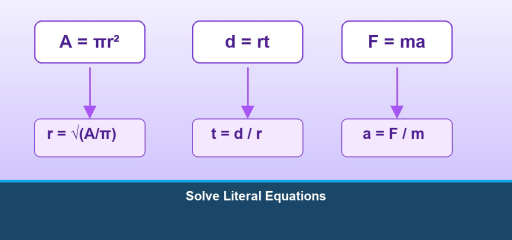
A literal equation is any equation that contains two or more variables (letters). Formulas you already know, like the area of a rectangle \(A = \ell w\), the perimeter \(P = 2\ell + 2w\), or the slope-intercept form \(y = mx + b\), are all literal equations. Learning to rearrange these formulas to solve for any variable is one of the most practical algebra skills you can build.
Solve Literal Equations: what to notice and how to work it
What to notice first
Common student mistake
Key formulas and cues
A reliable path
- Simplify each sideDistribute and combine like terms before moving variables.
- Collect variablesUse inverse operations to get variable terms on one side and constants on the other.
- Check in the originalSubstitute the solution into the original equation, the simplified line.
Worked examples
Two-step equation
- Subtract 5 from both sides.
- Divide both sides by 3.
- Check 3(5) + 5 = 20.
Variables on both sides
- Subtract 2x from both sides.
- Add 7 to both sides.
- Divide by 2.
Try one before moving on
Solve Literal Equations: pop-up practice
In this guide you will learn the step-by-step process for isolating a specified variable, see fully worked examples, and get practice problems with complete solutions.
What Are Literal Equations?
Literal equations look just like regular equations, except the answer is expressed in terms of other variables rather than a single number. The goal is always the same: isolate the target variable on one side of the equation using inverse operations.
- \(A = \ell w\) → solve for \(\ell\): divide both sides by \(w\) → \(\ell = \frac{A}{w}\).
- \(P = 2\ell + 2w\) → solve for \(w\): subtract \(2\ell\), then divide by 2 → \(w = \frac{P – 2\ell}{2}\).
Step-by-Step Guide to Solving Literal Equations
- Identify the target variable, the letter you need to isolate.
- Treat every other letter as if it were a number. This is the key mindset shift.
- Use inverse operations in reverse order of operations (undo addition/subtraction first, then multiplication/division, then exponents/roots).
- Simplify the result if possible.
The operations are exactly the same as solving a one-variable equation, addition undoes subtraction, multiplication undoes division, and so on.
Common Formulas Reference Table
| Formula | Name |
|---|---|
| \(A = \ell w\) | Area of a rectangle |
| \(P = 2\ell + 2w\) | Perimeter of a rectangle |
| \(d = rt\) | Distance formula |
| \(I = Prt\) | Simple interest |
| \(V = \frac{1}{3}Bh\) | Volume of a cone/pyramid |
| \(y = mx + b\) | Slope-intercept form |
| \(ax + b = c\) | Linear equation |
| \(C = \frac{5}{9}(F – 32)\) | Celsius from Fahrenheit |
Worked Examples
Example 1, Solve \(d = rt\) for \(t\)
Goal: Isolate \(t\).
Solution:
\(d = rt\)
Divide both sides by \(r\):
\(\dfrac{d}{r} = t\)
Answer: \(t = \dfrac{d}{r}\)
Example 2, Solve \(ax + b = c\) for \(x\)
Goal: Isolate \(x\).
Solution:
Subtract \(b\) from both sides: \(ax = c – b\)
Divide both sides by \(a\): \(x = \dfrac{c – b}{a}\)
Example 3, Solve \(V = \frac{1}{3}Bh\) for \(h\)
Goal: Isolate \(h\).
Solution:
Multiply both sides by 3: \(3V = Bh\)
Divide both sides by \(B\): \(h = \dfrac{3V}{B}\)
Example 4, Solve \(P = 2\ell + 2w\) for \(w\)
Goal: Isolate \(w\).
Solution:
Subtract \(2\ell\): \(P – 2\ell = 2w\)
Divide by 2: \(w = \dfrac{P – 2\ell}{2}\)
Video Lesson
Watch this video for additional examples and a step-by-step walkthrough:
Tips for Success
- Think of every other variable as a constant. If you are solving \(y = mx + b\) for \(m\), treat \(y\), \(x\), and \(b\) as numbers. Then it is just \(y – b = mx\), so \(m = \frac{y – b}{x}\).
- Undo operations in reverse PEMDAS order. Start with addition/subtraction, then multiplication/division, then exponents/roots.
- Check by substituting. Plug your rearranged expression back into the original equation to see if both sides are equal.
- Watch for fractions and negative signs. When a coefficient is a fraction (like \(\frac{1}{3}\)), multiply by the reciprocal (3) instead of dividing.
Practice Problems
- Solve \(A = \ell w\) for \(w\).
- Solve \(y = mx + b\) for \(x\).
- Solve \(I = Prt\) for \(r\).
- Solve \(C = 2\pi r\) for \(r\).
- Solve \(A = \frac{1}{2}bh\) for \(h\).
- Solve \(3x + 2y = 12\) for \(y\).
- Solve \(F = \frac{9}{5}C + 32\) for \(C\).
- Solve \(S = 2\pi r h + 2\pi r^{2}\) for \(h\).
- Solve \(V = \pi r^{2} h\) for \(h\).
- Solve \(ax – by = c\) for \(y\).
Solutions
- \(w = \dfrac{A}{\ell}\)
- \(x = \dfrac{y – b}{m}\)
- \(r = \dfrac{I}{Pt}\)
- \(r = \dfrac{C}{2\pi}\)
- \(h = \dfrac{2A}{b}\)
- \(y = \dfrac{12 – 3x}{2}\) or equivalently \(y = 6 – \frac{3}{2}x\)
- \(C = \dfrac{5}{9}(F – 32)\)
- \(h = \dfrac{S – 2\pi r^{2}}{2\pi r}\)
- \(h = \dfrac{V}{\pi r^{2}}\)
- \(y = \dfrac{ax – c}{b}\)
Why Literal Equations Matter
Rearranging formulas is not just a classroom exercise. Scientists, engineers, economists, and medical professionals do it every day:
- Physics: Rearranging \(F = ma\) to \(a = \frac{F}{m}\) lets you calculate acceleration from measured force and mass.
- Finance: Solving \(I = Prt\) for \(t\) tells you how long an investment takes to earn a target amount of interest.
- Cooking/Chemistry: Rearranging conversion formulas (\(C = \frac{5}{9}(F-32)\)) is essential for switching between measurement systems.
Common Mistakes to Avoid
- Dividing only part of one side. When you divide by a variable, you must divide every term on both sides.
- Forgetting to distribute before isolating. In \(A = P(1 + rt)\), if solving for \(r\), first divide by \(P\), then subtract 1, then divide by \(t\): \(r = \frac{\frac{A}{P} – 1}{t}\).
- Dropping negative signs. Moving a negative term across the equals sign changes its sign.
Frequently Asked Questions
What is the difference between a literal equation and a formula?
Every formula (like \(A = \pi r^{2}\)) is a literal equation. “Literal equation” is the broader term for any equation with more than one variable.
Can you solve a literal equation for any variable?
Usually yes, as long as the variable you want appears in the equation and is not trapped inside an operation that cannot be inverted in your current number system (for instance, you need square roots to undo squaring).

Related to This Article
More math articles
- Free Grade 3 English Worksheets for Georgia Students
- Free Grade 2 English Worksheets for North Dakota Students
- Repeating Patterns
- Your Winning Game Plan: How to Use Angle Relationships to Write and Solve Equations
- Alaska AK STAR Grade 3 Math Worksheets — 49 Free Printable Single-Skill PDFs
- 5th Grade SOL Math Worksheets: FREE & Printable
- Comparing & Ordering Numbers Practice (Free)
- The Best Algebra 1 Book for Virginia Students
- Math As The Language Of Chance: An Introduction To Probability
- Digital SAT Math Error Log: Separate Algebra, Reading and Calculator Errors (2027 Prep)
What people say about "How to Solve Literal Equations"?
No one replied yet.