Mexican American and Asian American Citizenship and Resistance
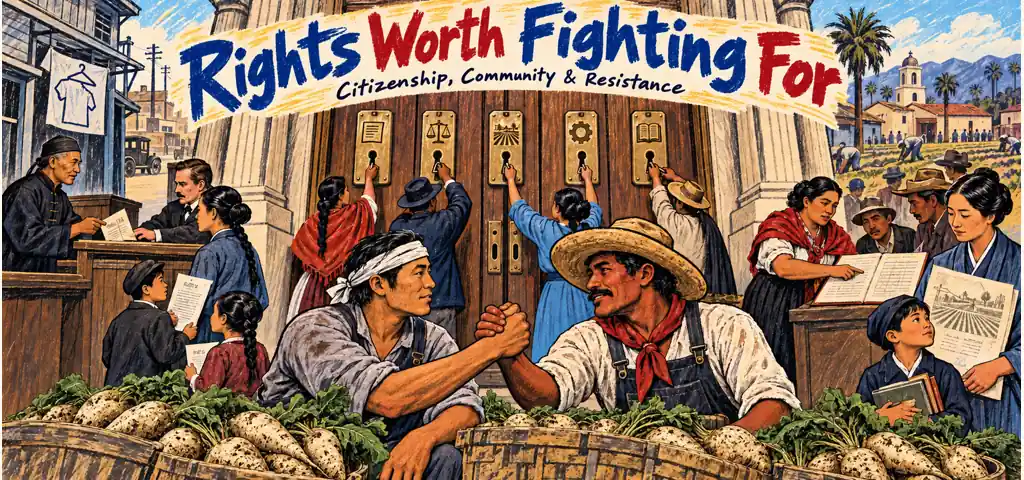
Chapter 5 of the CLEP History of the United States II study guide on Effortless Math covers Mexican American and Asian American Citizenship and Resistance: the key terms, the core ideas, and worked examples showing how this topic is tested on the exam.
CLEP History of the United States II, Chapter 5
Citizenship had several legal routes
The Fourteenth Amendment made people born in the United States citizens, but eligibility to naturalize was controlled by statute. In 1870, Congress extended naturalization eligibility to "aliens of African nativity and to persons of African descent" while leaving Chinese and most other Asian immigrants ineligible. The distinction meant a U.S.-born child could be a citizen even when the child's immigrant parents could not naturalize. It also underlay state alien land laws keyed to "aliens ineligible to citizenship." Birthright citizenship, naturalization, property rights, and voting rights must therefore be analyzed separately.
Wong Kim Ark confirmed birthright citizenship
Wong Kim Ark was born in San Francisco to Chinese parents who were domiciled there but not eligible for naturalization. After a trip abroad, officials denied him reentry. In United States v. Wong Kim Ark (1898), the Supreme Court held that the Fourteenth Amendment made him a citizen at birth under the common-law rule of birth within U.S. jurisdiction, with narrow exceptions such as diplomats' children. The ruling did not naturalize his parents or repeal Chinese exclusion. It protected the citizenship of the American-born generation within an exclusion regime.
Yick Wo focused on discriminatory administration
San Francisco required laundries in wooden buildings to obtain permits. The rule appeared neutral, but officials approved nearly every white applicant and denied nearly every Chinese applicant. In Yick Wo v. Hopkins (1886), the Supreme Court held that this unequal administration violated the Fourteenth Amendment's Equal Protection Clause. The protection covered persons, not citizens alone, so Yick Wo's alienage did not remove him from constitutional protection. The decision did not rest on a treaty or say cities lacked fire-safety authority; it condemned arbitrary, discriminatory enforcement of a facially neutral ordinance.
Chinese associations organized practical defense
The Chinese Consolidated Benevolent Association and district associations commonly called the Six Companies helped newcomers find work and lodging, settled disputes, lent money, repatriated remains, and hired lawyers to challenge exclusion. Their role was broader than either criminal organizations or mission homes. The Page Act of 1875 and Chinese Exclusion Act of 1882 restricted migration, producing heavily male communities as wives struggled to enter. After the 1906 San Francisco earthquake and fire destroyed municipal records, some Chinese residents claimed U.S. birth and reported China-born sons; documents or identities tied to those claims became routes for later "paper sons."
Courts could scrutinize racial public health measures
During a 1900 plague scare, San Francisco authorities sealed Chinatown while allowing white people to move through the boundary. In Jew Ho v. Williamson, a federal court struck down the quarantine because it burdened residents by ancestry rather than actual exposure and was administered unreasonably. The episode resembles Yick Wo in structure: a claimed police-power purpose did not excuse racially selective operation. It did not eliminate legitimate quarantine authority. The decision required public health measures to relate to risk rather than use ethnicity as a substitute for evidence.
Japanese families confronted alien land laws
California's Alien Land Law of 1913 barred "aliens ineligible to citizenship" from owning agricultural land and limited leases. Because Japanese immigrants were excluded from naturalization, the category targeted them without naming nationality. Many families placed land in the names of American-born children, who were citizens, before a 1920 initiative tightened restrictions and targeted such arrangements. The strategy depended on the difference between immigrant ineligibility and children's birthright citizenship. It did not convert the parents into citizens or guarantee freedom from state interference.
Oxnard workers crossed ethnic lines
In 1903, Japanese and Mexican sugar-beet laborers at Oxnard, California, formed the Japanese-Mexican Labor Association against a labor contractor who controlled hiring and extracted fees. They struck and won the ability to negotiate directly with growers. The American Federation of Labor offered a charter only if the organization excluded Japanese members. The workers refused that condition. Their choice reveals both cross-ethnic labor solidarity and the racial boundary of much organized labor. The episode preceded the IWW and was not won by a federal Pullman-style injunction.
Mexican Americans defended property and civic claims
The Treaty of Guadalupe Hidalgo promised protection for property of Mexican residents in the ceded territories, but expensive litigation, ambiguous titles, taxes, fraud, and unfamiliar legal procedures transferred much land. Mexican American communities used courts, mutual-aid societies called mutualistas, Spanish-language newspapers, labor organization, and electoral politics to defend claims. Legal U.S. citizenship did not ensure equal treatment. In the Southwest, school segregation, occupational exclusion, and mob violence marked a racial order that did not fit neatly into the Black-white legal binary.
Brownsville exposed precarious military citizenship
After gunfire killed a white man in Brownsville, Texas, in 1906, townspeople accused Black soldiers of the Twenty-fifth Infantry. The soldiers denied involvement, and no individual was tried or convicted. President Theodore Roosevelt nevertheless discharged 167 men without honor for an alleged conspiracy of silence. Later investigations discredited the accusation, and the Army eventually corrected records. The episode concerned Black soldiers rather than Mexican or Asian immigrants, but it belongs in a comparison of minority citizenship: uniformed service did not guarantee due process or protection from racial presumption.
Hawaii's language schools met Americanization pressure
By 1920, many Japanese American children in Hawaii attended Japanese-language schools after the public-school day. Territorial authorities sought licensing, curriculum control, and heavy fees as part of an Americanization campaign. In Farrington v. Tokushige (1927), the Supreme Court invalidated excessive controls as a violation of liberty under the Fourteenth Amendment. The schools were supplemental, not boarding institutions or replacements for public schools. The controversy showed families maintaining language and community while raising U.S.-born citizens within an annexed, multiethnic territory.
Native professionals formed a national reform body
Founded in Columbus, Ohio, in 1911, the Society of American Indians was the first Native-run national reform organization. Native professionals including physicians Charles Eastman and Carlos Montezuma, educator Zitkala-Sa, and others debated citizenship, health, education, law, and the Bureau of Indian Affairs. It was not a federal advisory board, an alliance of tribal governments, a missionary society, or a legal fund created by non-Native patrons. Members often favored U.S. citizenship and reform while disagreeing about assimilation and tribal identity. Their leadership distinguished self-representation from federal administration of Native life.
identify the protected status
A city enforces a safety ordinance against immigrant-owned businesses but not identical white-owned businesses.
Resistance used law, association, labor, and family
Minority communities faced different legal classifications, but their strategies often converged. Chinese associations funded litigation; Japanese families used their citizen children's legal capacity; Japanese and Mexican workers built a joint union; Mexican Americans relied on mutualistas and courts; Native professionals spoke through a national organization; and Black soldiers claimed the procedural rights their service should have secured. A strong comparison does not collapse these histories. It identifies whether the barrier concerned entry, naturalization, property, public health, employment, education, or official presumption, then asks what institution could contest it.
Watch the history in motion
This short lesson adds voices, images, and chronology to the ideas you just studied.
Video: The Supreme Court Case that Affirmed Birthright Citizenship, American Experience | PBS.
Try four CLEP-style questions
- What common reasoning links Yick Wo's laundry permits with the federal court's rejection of San Francisco's Chinatown quarantine?
- Both measures failed because municipalities possessed no authority over fire or public health risks.
- Both decisions accepted ancestry as a substitute for individualized evidence when officials invoked safety.
- The laundry ruling protected citizens, whereas the quarantine ruling protected only noncitizens.
- A legitimate police-power purpose did not excuse administration that selected people by ancestry rather than relevant conduct or risk.
- Both courts required an ordinance to name a racial group before unequal administration could be challenged.
- Why could a mutualista be valuable even to Mexican American members who were already United States citizens?
- Citizenship transferred disputed land titles to the association without litigation.
- Mutualistas replaced courts by issuing binding federal judgments on property claims.
- Members pooled benefits and civic defense where citizenship did not ensure equality.
- Membership converted treaty property guarantees into tax exemptions administered by the group.
- The associations supplied naturalization papers to citizens excluded from voting by federal law.
- Two children are born in San Francisco: one to Chinese merchants domiciled there and one to an accredited foreign diplomat. Which distinction follows from the reasoning of Wong Kim Ark?
- Neither child can be a citizen because the parents cannot vote in state elections.
- Both children are citizens because birthplace eliminates every jurisdictional exception.
- The diplomat's child is a citizen, while the merchants' child must naturalize as an adult.
- Citizenship depends on whether either parent owns property rather than on jurisdiction at birth.
- The merchants' child is born within United States jurisdiction, while a diplomat's child falls within a narrow jurisdictional exception.
- What does disagreement within the Society of American Indians over assimilation and tribal identity demonstrate?
- A shared national forum could coordinate reform debate without requiring Native participants to hold one uniform position.
- Professional training made differences over citizenship and tribal identity politically irrelevant.
- The Society functioned as a federation whose positions were dictated by tribal governments.
- Members rejected participation in national debates whenever they disagreed about assimilation.
- A national reform organization could exist only when all members accepted the Indian Office's program.
Check your answers and reasoning
Independent preparation. CLEP is a registered trademark of the College Board, which does not endorse this lesson.

Related to This Article
More math articles
- Probability Calculator (Free)
- 3rd Grade North Carolina End-of-Grade Math Worksheets: FREE & Printable
- How Mathematical Thinking Transforms Your View of Life
- The Best Grade 3 ELA Practice Tests for New Mexico Students
- Top 10 Pre-Algebra Prep Books (Our 2024 Favorite Picks)
- 10 Most Common 7th Grade NYSE Math Questions
- The Best Grade 4 ELA Practice Tests for New Hampshire Students
- Free Grade 7 English Worksheets for Washington, D.C. Students
- Supreme Court
- Rounding to the Nearest 10, 100, and 1,000 for 4th Grade


















What people say about "Mexican American and Asian American Citizenship"?
No one replied yet.