The Roots of Expansionism and the Annexation of Hawaii
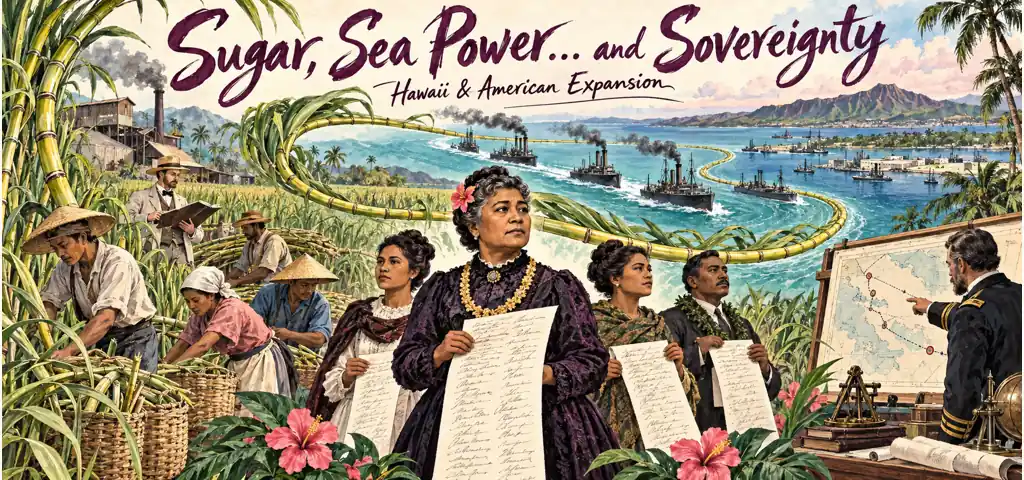
Chapter 6 of the CLEP History of the United States II study guide on Effortless Math covers The Roots of Expansionism and the Annexation of Hawaii: the key terms, the core ideas, and worked examples showing how this topic is tested on the exam.
CLEP History of the United States II, Chapter 6
Expansion joined economics, strategy, and belief
By the 1890s, American overseas expansion drew support from several arguments. Manufacturers and farm exporters wanted markets; naval planners wanted bases; missionaries sought converts; politicians invoked national greatness; and racial ideologies ranked peoples and described rule as uplift. These motives could reinforce one another without being identical. A merchant might favor access without annexation, while a naval officer valued a harbor even if trade stayed small. A missionary could oppose commercial exploitation yet accept cultural hierarchy. On an exam, identify the proposed instrument-market access, fleet, mission, protectorate, or annexation-before choosing the motive.
Mahan made commerce a naval system
Captain Alfred Thayer Mahan argued in The Influence of Sea Power upon History (1890) that national power rested on ocean commerce protected by a concentrated battle fleet. Such a fleet required coaling and repair stations along major routes and a canal across Central America to shift ships between oceans. Mahan did not argue that coastal forts alone or a merchant marine without warships would suffice. His logic connected productive capacity, overseas markets, bases, fleet concentration, and strategic passages. Hawaii's Pearl Harbor and Caribbean approaches to an isthmian canal consequently acquired importance beyond their immediate local trade.
Mission networks made foreign places familiar
Protestant foreign missions expanded through denominational boards, colleges, publications, and voluntary societies. The Student Volunteer Movement, organized in 1886, rallied college students around the goal of evangelizing the world "in this generation" and recruited thousands for overseas service. Missionaries established schools, clinics, translations, and churches, while reports to American donors described societies through Protestant assumptions. Mission activity did not mechanically cause annexation, but it supplied information, emotional ties, and a language of moral duty that could support intervention. Missionaries sometimes criticized violence or imperial abuses, demonstrating that religious connection and state conquest were not the same policy.
Hawaii became a plantation kingdom
American missionaries reached the Hawaiian Islands in the 1820s, and some descendants became landowners and sugar planters. Reciprocity in 1875 admitted Hawaiian sugar to the United States duty-free, giving island producers an advantage. Planters recruited contract laborers first from China, then heavily from Japan and Portugal, and later from Korea and the Philippines. Native Hawaiians suffered catastrophic population loss, land dispossession, and reduced political power. An 1887 constitution forced on King Kalakaua by an armed planter group restricted royal authority and voting, earning the name "Bayonet Constitution." Plantation labor diversity did not translate into equal control of the kingdom.
A tariff changed the annexation calculation
The McKinley Tariff of 1890 admitted foreign raw sugar duty-free and paid a bounty to domestic producers. Hawaiian sugar lost the special advantage it had enjoyed under reciprocity. Annexation promised treatment inside the American tariff system and therefore appealed more strongly to planters. Queen Liliuokalani, who succeeded Kalakaua in 1891, sought a new constitution restoring royal and Native political authority. In January 1893, the planter-led Committee of Safety overthrew her while United States Marines landed nearby. Minister John Stevens recognized the provisional government. The economic incentive, constitutional struggle, armed local action, and American diplomatic role must all remain visible.
Cleveland refused to ratify the overthrow
Outgoing President Benjamin Harrison sent an annexation treaty to the Senate. Grover Cleveland withdrew it after taking office and appointed James Blount to investigate. Blount concluded that the American minister and troops had aided the overthrow. Cleveland called for restoration of the queen if she granted amnesty, but the provisional government refused and Cleveland would not use force. The Senate's Morgan Report later defended American conduct. The Republic of Hawaii was proclaimed in 1894 under Sanford Dole. Cleveland's response delayed annexation; it neither restored the monarchy nor recognized a right of planters to dictate American policy.
War supplied the final route to annexation
The Spanish-American War made Hawaii a valuable communications and supply point for operations in the Philippines. A treaty of annexation still lacked the two-thirds Senate vote required for ratification. Congress instead adopted the Newlands Resolution in July 1898 by simple majorities in both houses, and President McKinley signed it. Hawaii became a U.S. territory in 1900. The route matters constitutionally: acquisition came through a joint resolution, unlike the Treaty of Paris transferring Spain's islands. Native Hawaiian opposition was substantial; the Hui Aloha Aina petitions collected thousands of signatures against annexation. Strategic urgency did not create Hawaiian consent.
Imperial culture described rule as obligation
Rudyard Kipling's 1899 poem "The White Man's Burden," addressed to the United States as it took the Philippines, urged Americans to treat colonial rule as a difficult civilizing duty. The phrase expressed paternalism: colonized peoples appeared incapable of self-government, while empire became sacrifice by the ruler. Critics answered that republican government required consent and that racial hierarchy contradicted American liberty. Cultural language mattered because it converted material control into a moral story. A claim of benevolent purpose does not establish either consent or beneficial consequences.
Hemispheric assertion preceded overseas war
In 1895, Secretary of State Richard Olney demanded arbitration of a boundary dispute between British Guiana and Venezuela and invoked the Monroe Doctrine. Britain eventually accepted arbitration, signaling greater recognition of the United States as the dominant hemispheric voice. In 1903, an international tribunal settled the Alaska boundary dispute; the British member joined the three Americans in largely accepting the American line against Canada's claim to access from the Klondike. These disputes did not annex Hawaii, but they show rising confidence that American power should shape boundaries and diplomacy in the Western Hemisphere and North Pacific.
Pacific commitments formed a sequence
Four markers organize the expansion: Congress annexed Hawaii in 1898; fighting between American forces and Emilio Aguinaldo's Philippine republic began in 1899; American troops joined the international force against the Boxer uprising in China in 1900; and Roosevelt mediated the Treaty of Portsmouth in 1905. The sequence moves from island acquisition to colonial war, participation in a multinational intervention, and great-power mediation. It helps distinguish the origin of a commitment from the diplomacy used to manage consequences later.
separate base from market
A memorandum says a mid-Pacific harbor would let battleships refuel and protect shipping routes to Asia.
Annexation changed whose sovereignty counted
Hawaii's annexation was neither an inevitable extension of commerce nor a simple diplomatic purchase. Plantation interests changed the kingdom's political economy, contract migration built a diverse labor force, American officials assisted an overthrow, Cleveland questioned its legitimacy, and wartime strategy helped Congress bypass a failed treaty. The United States gained a base and territory; Native Hawaiians lost an internationally recognized sovereign government without a ratified popular choice. Expansion must therefore be analyzed from Washington, from the planter economy, and from the people whose political order was displaced.
Watch the history in motion
This short lesson adds voices, images, and chronology to the ideas you just studied.
Video: DEBATES about American IMPERIALISM [APUSH Review], Heimler's History.
Try four CLEP-style questions
- Why might commercial access to an island fail to satisfy a coalition of naval strategists and tariff-conscious sugar planters?
- Access guarantees neither a controlled base nor domestic tariff treatment.
- It secures permanent naval use while leaving sugar classified as a foreign import.
- It places sugar inside the tariff boundary while leaving base privileges subject to diplomacy.
- It answers the naval concern but makes reciprocity unavailable to planters.
- It supplies both strategic control and domestic tariff status but leaves missionary access unsettled.
- Congress adopts the Newlands Resolution by the required majorities, while petitions carry thousands of Native Hawaiian signatures opposing annexation. What distinction does the combined evidence require?
- The petitions nullified the resolution under the Senate's treaty-ratification rules.
- American legal authority did not establish popular Hawaiian consent.
- Legislative passage demonstrated that the Hawaiian electorate had approved the transfer through a referendum.
- Petition signatures converted the Republic of Hawaii into an incorporated United States territory before Congress acted.
- Opposition to annexation showed that Native Hawaiians rejected every commercial or religious connection with the United States.
- Cleveland stopped an annexation treaty in 1893, but Congress acquired Hawaii by joint resolution in 1898. What does the interval best demonstrate?
- Treaty withdrawal barred another branch from revisiting acquisition while the same provisional government survived.
- Executive recognition in 1893 had already transferred sovereignty, making the 1898 measure ceremonial.
- Congress in 1898 merely completed ratification of Cleveland's withdrawn treaty.
- Executive resistance could delay acquisition without eliminating a later legislative route under changed political conditions.
- The later measure resolved the earlier dispute over American involvement by supplying retroactive Hawaiian consent.
- Which interpretation best joins the labor and sovereignty histories of Hawaii?
- A diverse contract workforce broadly distributed plantation ownership and political authority.
- Plantation expansion increased Native control of land while reducing planter influence.
- Contract recruitment weakened the plantation economy enough to preserve royal control.
- Annexation chiefly reflected a political campaign led by contract workers seeking American citizenship.
- Diverse labor coexisted with planter power and reduced Native authority.
Check your answers and reasoning
Independent preparation. CLEP is a registered trademark of the College Board, which does not endorse this lesson.

Related to This Article
More math articles
- 4th Grade MAP Math FREE Sample Practice Questions
- Entry eliminates long-run economic profit
- Top 10 ASVAB Math Prep Books (Our 2023 Favorite Picks)
- Understanding and Mastering Perpendicular Lines and How to Draw Them
- How to Choose the Best Backup Software Solution for School Districts?
- 10 Tips for Advanced Studying Mathematics
- How to Graph Inequality: Using Number Lines to Graph Inequalities
- Number Properties Puzzle – Challenge 17
- CLEP U.S. History I 016: Atlantic Trade, Mercantilism, and the Navigation Acts
- Full-Length ISEE Upper-Level Math Practice Test-Answers and Explanations





















What people say about "Expansionism and the Annexation of Hawaii"?
No one replied yet.