Ratios and Proportions: A Complete Guide with Examples
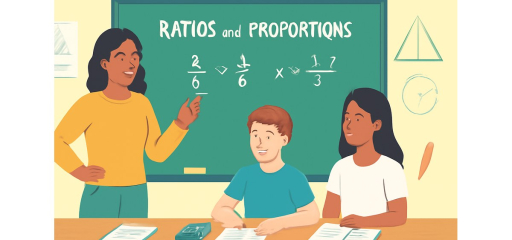
Ratios and proportions are everywhere, recipes, maps, gear ratios, currency conversion, even your phone’s screen aspect ratio. Master them once and you’ve got a tool you’ll use for life.
What’s a ratio?
A ratio compares two quantities. You can write it three ways:
- $3: 2$
- \(\tfrac{3}{2}\)
- “3 to 2”
All mean the same thing.
Equivalent ratios
Like fractions, ratios can be simplified or scaled. \(6: 4 = 3: 2\) (divide by 2). And \(3: 2 = 12: 8\) (multiply by 4).
What’s a proportion?
A proportion is two equal ratios:
\[\dfrac{a}{b} = \dfrac{c}{d}\]
Cross-multiply to solve: \(a \cdot d = b \cdot c\).
Example: solve \(\dfrac{3}{x} = \dfrac{12}{20}\).
Cross-multiply: \(3 \cdot 20 = 12 \cdot x \to 60 = 12x \to x = 5\).
Word problems with proportions
If 4 apples cost $2.40, how much do 7 apples cost?
Set up: \(\dfrac{4}{2.40} = \dfrac{7}{x}\). Cross-multiply: $4x = 16.80 \to x = \$4.20$.
A 12-inch map shows 360 miles. How many miles is 5 inches?
\(\dfrac{12}{360} = \dfrac{5}{x} \to 12x = 1800 \to x = 150\) miles.
Scale factors
When two figures are similar, all their corresponding sides share a constant ratio, the scale factor.
If triangle ABC has side lengths 3, 4, 5 and the bigger similar triangle has sides 9, 12, 15, the scale factor is 3.
Common mistakes
- Cross-multiplying in the wrong direction.
- Forgetting that ratios compare parts, $3:2$ describes 3 parts to 2 parts, not 3/5 vs 2/5 (though the fraction version of “3 out of 5 things” is related).
- Mixing up part-to-part and part-to-whole ratios.
FAQ
What’s the difference between a ratio and a fraction?
A fraction compares a part to a whole. A ratio compares two quantities, which may or may not include the whole.
What’s a proportion?
Two equal ratios. Used to scale up or scale down quantities.
How do I solve a proportion?
Cross-multiply, then solve the resulting equation.
Are ratios on the SAT?
Yes, especially in word problems, data analysis, and scale problems.
Extra study tips that move the needle
Most students don’t fail because the math is too hard. They fail because their practice habits are inefficient. Here are the habits that separate the students who improve fast from those who stall.
Practice with a timer. Untimed practice teaches you to eventually get the right answer; timed practice teaches you to get it in test conditions. Set a stopwatch every time you sit down. Aim for 90 seconds per question on most standardized tests.
Keep an error log. A simple spreadsheet with three columns, Problem, My answer, Correct answer, Why I missed it, is the single most powerful study tool ever invented. Review your error log weekly. The same mistakes show up again and again until you name them.
Mix topics every session. Doing 20 problems on the same topic feels productive, but spaced and interleaved practice, mixing topics, builds retrieval skills, which is what the test actually measures. Spend 70% of your time on mixed sets and only 30% on isolated drills.
Sleep on it. Memory consolidation happens during sleep. A 30-minute session the night before a quiz, followed by 7+ hours of sleep, beats a 3-hour cram session that ends at midnight. This is settled cognitive science.
Teach the topic out loud. If you can’t explain it, you don’t fully know it. Either record yourself, write a one-paragraph “how I’d teach this” explanation, or grab a friend to listen. Teaching exposes the gaps your problem sets hid.
When to ask for help
Spinning your wheels for more than 15 minutes on a single problem is a signal, not of failure, but of a missing piece of background. Stop, mark the problem, and either ask a teacher, post in our community, or watch a video on the relevant subtopic. Resuming after gaining the missing piece is much more efficient than guessing your way forward.
A quick self-assessment
Before you close this tab, answer these three questions honestly:
- What’s the one topic in this article you understood best?
- What’s the one topic that still feels fuzzy?
- What concrete next step (a worksheet, a practice test, a video) will you take in the next 48 hours?
Writing those answers down, even just in a notes app, has been shown to roughly double the chance you actually follow through. Treat the next 48 hours as a small, doable experiment, not a marathon. Your future test-day self will thank you.
A deeper dive into common questions
The questions students ask after reading an article like this one tend to cluster. Here are the most useful ones, and short, direct answers.
What is ratio and proportion in maths with examples? A ratio compares two quantities, such as 3 boys to 2 girls, written 3:2, 3/2 or 3 to 2. A proportion says two ratios are equal, like 3/2 = 12/8. For example, if a recipe uses 2 cups of flour for every 3 eggs, then 6 eggs need 4 cups of flour, because 2:3 = 4:6.
How do you solve ratios and proportions step by step? Write the two ratios as fractions with matching units in the same positions, cross-multiply, then divide to find the unknown. To solve 3/x = 12/20, multiply 3 × 20 = 60 and 12 × x = 12x, so 12x = 60 and x = 5. Check your answer by simplifying both sides: 3/5 and 12/20 both equal 0.6.
Are ratios and proportions the same? No. A ratio is a single comparison, such as 4 apples for $2.40. A proportion is an equation stating that two ratios are equal, such as 4/2.40 = 7/x. You use a proportion when you know one ratio and want to scale it. In this case, cross-multiplying gives 4x = 16.80, so 7 apples cost $4.20.
How are ratios and proportions used in everyday life? You use them when you double a recipe, read a map scale, mix paint or cleaning solutions, convert currency or compare prices. On a map where 12 inches stands for 360 miles, a 5-inch distance works out to 150 miles using the proportion 12/360 = 5/x. Unit prices at the grocery store are ratios too, such as dollars per ounce.
How are proportions, ratios and percentages related? A percent is a ratio out of 100, so percent problems are proportion problems. To find what percent 18 is of 24, set up 18/24 = x/100. Cross-multiplying gives 24x = 1,800, so x = 75, meaning 75%. Any ratio can become a percent this way, and any percent can be written as a ratio, such as 40% = 40:100 = 2:5.
Is ratio and rate the same? A rate is a special kind of ratio that compares quantities with different units, such as 60 miles per hour or $3 per pound. A plain ratio often compares the same kind of thing, like 3 red marbles to 5 blue marbles. A unit rate has 1 in the denominator, so 180 miles in 3 hours becomes 60 miles per 1 hour.
A short worked example you can copy
Here’s a typical worked example pattern that applies to many problems in this article’s topic:
- Identify the question. What exactly is being asked? Underline it.
- Identify the given information. What numbers and relationships are you handed?
- Pick the relevant formula or rule. From your toolkit, which one connects the given info to the question?
- Plug in carefully. Write each substitution explicitly. Don’t do steps in your head.
- Simplify. Reduce fractions, combine like terms, simplify radicals.
- Verify. Plug your answer back into the original setup. Does it make sense?
This 6-step pattern handles roughly 80% of problems you’ll see in middle-school, high-school, and standardized-test math.
Mini-glossary
A few terms that come up repeatedly in this topic and its neighbors:
- Variable. A letter (often \(x\) or \(y\)) that stands in for an unknown number.
- Coefficient. The number multiplying a variable. In $3x$, the coefficient is 3.
- Expression. A combination of numbers, variables, and operations, without an equals sign. Example: $3x + 5$.
- Equation. Two expressions joined by an equals sign. Example: \(3x + 5 = 14\).
- Inequality. Two expressions joined by $<$, $>$, \(\le\), or \(\ge\).
- Solution. A value (or set of values) of the variable that makes an equation or inequality true.
- Evaluate. Substitute a number for the variable and simplify to a single value.
- Simplify. Rewrite the expression in its cleanest equivalent form.
Internalize this vocabulary. Test questions assume you know it.
Your next 7 days
If this article inspired you to act, here’s a small, doable 7-day plan:
- Day 1. Re-read the worked examples. Try them with the page covered.
- Day 2. Do a 15-minute warm-up of related practice problems.
- Day 3. Take a short timed quiz. Score yourself.
- Day 4. Review your misses. Write one sentence about each.
- Day 5. Do a mixed practice set blending this topic with two others.
- Day 6. Rest, or do a light review.
- Day 7. Take a longer timed practice set and track your progress.
Seven days is enough to feel a real shift. Two or three of those cycles, and the topic moves from “hard” to “easy.”
Why students lose easy points (and how to stop)
After years of analyzing test data, the same patterns appear over and over. Strong students lose points to the same handful of mistakes, not to the questions they “couldn’t do.”
Misreading the question. Roughly 1 in 8 missed questions is misread. The student knew the math; they answered a different question than the one asked. The fix: physically circle or underline the question’s last sentence before you start computing. Sometimes the question asks for “the smaller value,” “the product,” or “the next integer”, easy to miss when you’re rushing.
Stopping one step short. A problem asks “what is the perimeter,” and the student computes the side length and stops. The fix: ask yourself “have I actually answered the question?” after every problem. Did you reduce the fraction? Convert to the requested units? Pick the matching answer choice?
Decimal-place slip. A correct calculation with a misplaced decimal looks completely wrong. Always sanity-check the size of your answer. If a 6-foot ladder leaning against a wall produces a 60-foot answer, your decimal is in the wrong spot.
Sign mistakes. \(-3 \cdot (-4) = 12\), not $-12$. \(-3 – (-4) = 1\), not $-7$. Negative numbers cause a huge fraction of all errors. The fix: practice signed arithmetic until it’s automatic. Most adult learners benefit from 10 minutes of signed-arithmetic drill every day for two weeks.
Misusing a formula. Plugging values into the wrong slot of a formula. The fix: write out the formula with the variable names first, then substitute one piece at a time on the line below. Don’t try to do it in one step.
Three more high-yield drills
Drill A, Estimate first. Before you compute the exact answer, write down a quick estimate. If your final answer doesn’t match your estimate, slow down and find the mistake. This single habit catches more errors than any other.
Drill B, Sanity-check units. If the question asks for square feet, your answer needs to be in square feet. If it asks for hours but you computed minutes, divide by 60. Tracking units catches setup mistakes early.
Drill C, Re-read your work for 30 seconds. Not for math errors (you’ll miss your own), but for transcription errors. Did you write $7$ when you meant $9$? Did you copy $+$ when the problem had $-$? Half of missed problems have this kind of error, and 30 seconds of re-reading catches most of them.
The 80/20 of test prep
If you only have 10 hours to prepare and need maximum gain, here’s the most efficient breakdown:
- 4 hours on your two weakest topics (from a diagnostic).
- 3 hours on full-length timed practice tests.
- 2 hours reviewing the questions you missed.
- 1 hour of mixed drill across all topics.
That’s it. Resist the urge to grind problems on topics you already know well. The biggest gains come from the topics where you’re currently between 50% and 70% correct. Below 50% means you need foundation work; above 70% means diminishing returns.
A note about anxiety
Math anxiety is real, and it’s not a character flaw. Brain scans show that math-anxious students activate the same pain-and-threat circuits that they’d use for a physical danger. The fix isn’t “just calm down”. It’s reframing. Tell yourself “I haven’t learned this yet” instead of “I’m bad at this.” Two words, huge difference. Studies show this single reframe meaningfully improves test scores.
What grade are ratios introduced?
Most curricula introduce ratios in 6th grade and dive deep in 7th.

Related to This Article
More math articles
- Why Third Parties Struggle in U.S. Elections
- Chronology, Cause and Effect, and Comparison
- Full-Length DAT Quantitative Reasoning Practice Test-Answers and Explanations
- 3rd Grade SBAC Math Practice Test Questions
- The Best Grade 6 ELA Practice Tests for Connecticut Students
- The Ultimate SIFT Math Course (+FREE Worksheets & Tests)
- Arkansas ATLAS Algebra 1 Free Worksheets: 72 Free PDF Worksheets with Friendly Answer Keys
- 4th Grade English Worksheets for Utah (RISE): 57 Free Printable PDFs
- 7th Grade Common Core Math FREE Sample Practice Questions
- 3rd Grade PARCC Math FREE Sample Practice Questions





What people say about "Ratios and Proportions: A Complete Guide"?
No one replied yet.