PMP Business Environment: Connect Project Work to Outcomes (2027 Prep)
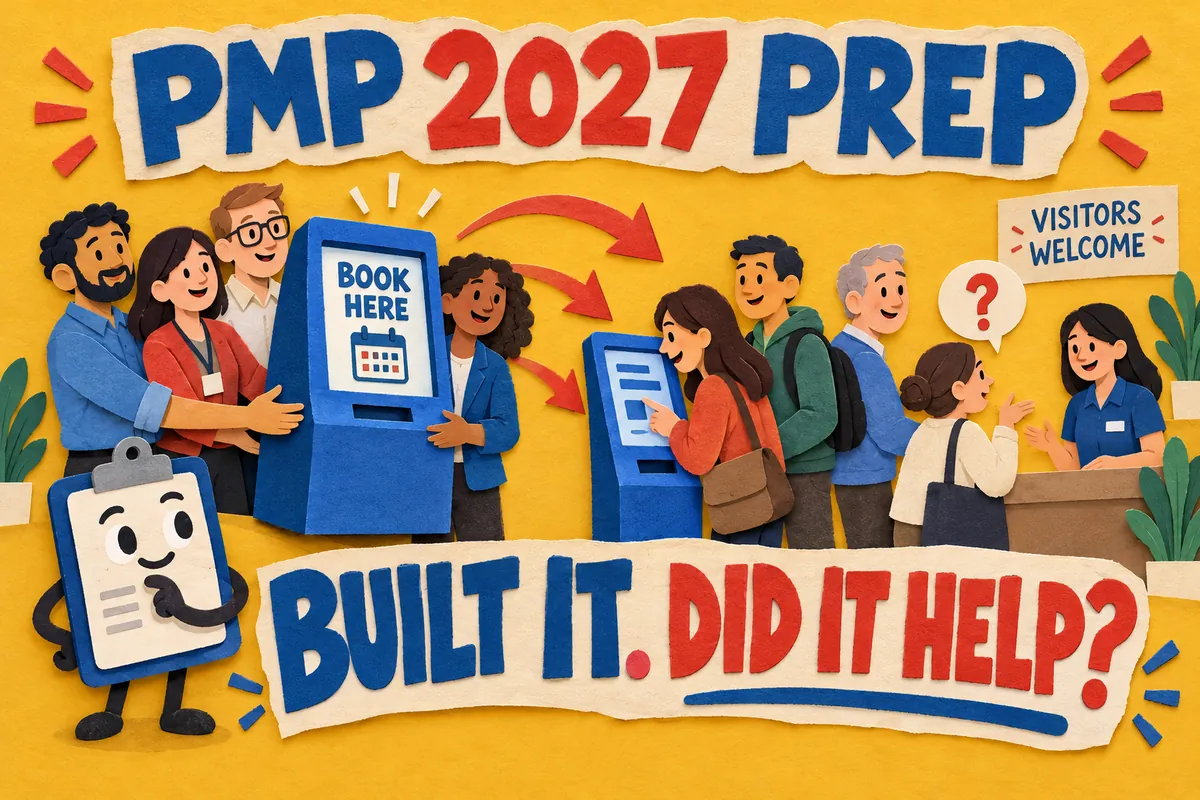
The new booking kiosk is installed, the team has accepted it, and visitors still queue at the reception desk. The project delivered a working machine. The organization wanted visitors to finish booking without needing someone to do it for them.
Look at the visitors. A completed deliverable gives you one kind of evidence, while the way people use it tells you whether the intended change is taking place.
For PMP study, follow that connection through a small fictional project charter and its measurement plan. You will separate delivery evidence from outcome evidence, calculate a percentage-point change, and examine a result that improves for one group while making another group's experience worse. These are teaching examples, not official or recalled exam questions.
Connect this topic to the current exam outline
PMI's exam-update page describes a focus on outcomes, value and business impact in the exam launched in July 2026. PMI current exam-update page This article's 2027 title identifies the preparation edition.
The current PMP Examination Content Outline gives Business Environment a weight of 26%. Its tasks include governance, compliance, changes and risk, alongside organizational change and external business changes. Value-based delivery also appears under Process. Avoid treating everything about benefits as belonging exclusively to one domain.
For this lesson, connect measures to the value-delivery task and consider what changes in the business environment would do to the intended result. You still need to study the other tasks in the outline. A worked kiosk example cannot replace the full domain.
Read the purpose in the fictional charter
Imagine a community learning center introducing a self-service booking kiosk for evening workshops, with a fictional charter authorizing the working machine and the staff training needed to support it. The intended improvement is fewer visitors needing a receptionist to complete an otherwise eligible booking.
The charter keeps assisted booking available. Some visitors need help or prefer that route, and the center wants them to retain access to workshops. For this case, the operations manager will own the post-launch booking measures, with the sponsor reviewing the proposed benefit.
Those assignments belong to our example. Real projects must agree responsibilities through their own governance and benefits arrangements, including who will gather evidence after the delivery team leaves.
Write the purpose clearly. "Install a kiosk" describes the deliverable, but it does not explain which visitor experience the center hopes to improve or how the team will notice an unintended consequence.
Separate the machine from the change in use
The installed, tested kiosk is an output in this case. Visitors successfully completing eligible bookings through it represents a change in how the service is used. Fewer avoidable requests for receptionist assistance could be a benefit if access and service quality remain acceptable.
Follow the evidence. A signed installation record can support a claim that the kiosk was delivered and accepted against its technical criteria, provided the record identifies the version being accepted. It cannot establish that visitors find the screen understandable or that assistance requests have fallen since launch.
The table separates these observations. Our labels provide a plain-language way to study the case rather than a claim that every project uses identical terminology or that a single metric proves total value.
PMI's 2016 benefits-during-execution report discusses maintaining a benefits focus during execution and the varying responsibilities of project managers and business owners. It is historical background for the measurement lesson. Use the current exam outline for current assessment scope.
| Observation | What it supports | What remains to check |
|---|---|---|
| Kiosk installed and accepted | Delivered output | Whether visitors can use it |
| Visitors finish eligible bookings | Observed use of the service | Assistance and access effects |
| Comparable assistance rate falls | Possible intended benefit | Persistence and unintended burdens |
Calculate the observed change with a clear denominator
Before launch, the center records sixty assisted bookings among one hundred eligible booking attempts during a defined evening observation period. The assistance rate is 60 divided by 100, or 60%. After launch, a comparable period records forty assisted bookings among one hundred eligible attempts, giving 40%.
Subtract the rates. The observed reduction is 60% minus 40%, or 20 percentage points. Relative to the original 60% rate, the reduction is 20 divided by 60, approximately 33.3%.
They describe different comparisons. Writing "assistance fell 20%" leaves the reader unsure whether you mean twenty percentage points or a twenty-percent relative reduction, so name the comparison beside the number.
All figures are invented. Equal sample sizes make this arithmetic easy, but they do not establish that the kiosk caused the change. Attendance patterns, staff availability and the mix of eligible attempts could differ between the two periods.
Define the observation before calling the result a benefit
Agree the definitions first. In our fictional plan, assistance means a receptionist completing an eligible booking on the visitor's behalf after the person has asked for help with the booking process. A quick answer about workshop content does not count toward that measure.
Keep the definition stable. If the first period counts every question and the second counts only completed bookings, the rates would describe different activities. Correcting that mismatch matters before interpreting the direction of the change.
The center also checks completed bookings and access to assisted service, including attempts that began at the kiosk but ended without a booking being made. A falling assistance rate could reflect an easier process, but it could also appear because frustrated visitors gave up without booking. Read those observations together before announcing success.
Add the collection period. A first-week observation can inform a rollout adjustment while visitors are still learning the screen, but the agreed benefit review might require evidence from a later period of normal operation. Label an early result as early evidence and record when the operations manager will check whether it persists.
Investigate an improvement that hides a new burden
Now alter the case. The overall assistance rate falls, but visitors using the large-text setting report that the confirmation button is difficult to find. Some return to reception after an unsuccessful attempt.
Investigate that experience. Ask the affected users and review the relevant task flow with the people responsible for the service. The aggregate assistance rate does not tell you whether this group can book successfully.
In our example, the team records the access problem and evaluates a correction through its agreed issue and change process. The operations manager keeps assisted booking available while the responsible owners assess the impact. These actions belong to the fictional project described here, and a real center would also need the responsible specialists to determine the accessibility requirements that apply in its jurisdiction.
Report the burden beside the improvement. The sponsor needs the evidence about unsuccessful attempts when judging whether the delivered result is worth its cost and disruption. A single positive measure leaves part of that decision unexplained.
Prepare the handover for benefits that appear later
The project team can finish installation before the center has enough evidence to judge the sustained benefit. Decide who will continue observing the service, where the measures will be recorded and which conditions require a response after handover.
Name the owner. For this fictional project, the operations manager accepts the measurement responsibility and receives the definitions and baseline records. The sponsor remains involved in reviewing the expected benefit under the case's governance arrangements.
PMI's 2016 benefits-sustainment overview addresses monitoring and responding to problems after project work transfers to the business unit. That provides background for this handover discussion, rather than a new 2027 requirement or a universal assignment of every benefit to one job title.
Include a follow-up date. The center could agree a review after four weeks of operation, with earlier action for an observed access problem. Four weeks is an invented case choice, so choose the timing stated in the scenario you are studying.
Use the evidence map on a fresh project
The blank benefits evidence map (CSV) has spaces for the intended change and measure definition, with additional fields to record the baseline, observation period, responsible owner and any unintended effects found during review. Start with the kiosk case, then use a different fictional project so you can check the reasoning without repeating the same labels from memory.
Try a staff scheduling tool. A delivered application might meet its technical acceptance criteria while employees still struggle to request a shift change. Describe the evidence needed to understand that experience and identify who will assess the proposed improvement.
Our PMP study hub collects PMP study resources. Return to the current outline to choose another Business Environment task, then add one changed business condition to your evidence map. Explain how that condition affects the benefit you intended to measure.
2027 preparation edition. Official public sources checked October 11, 2026. Learning-center charter, measures, role assignments, kiosk records and numerical examples are original fictional teaching material. Older PMI reports supply dated background, not current exam specifications. No official or recalled questions, exam answer guarantees, causal study claims or legal advice.

Related to This Article
More math articles
- The Best ACT Math Prep Book for a Stress-Free Score Boost
- Free Grade 5 English Worksheets for Michigan Students
- The Best Algebra 1 Book for Rhode Island Students
- Unconventional participation
- Chi-Square Tests in Genetics: Calculation and Examples
- Top 10 7th Grade NYSE Math Practice Questions
- Oklahoma OSTP Algebra 1 Free Worksheets: 64 Free PDF Worksheets Aligned to OSTP Algebra 1
- Use a schedule when curves are replaced by numbers
- Free Grade 2 English Worksheets for Michigan Second Graders
- The Anatomy of a Paragraph




















What people say about "PMP Business Environment: Connect Project Work to Outcomes (2027 Prep)"?
No one replied yet.