Party Stalemate, Civil Service, and the Tariff
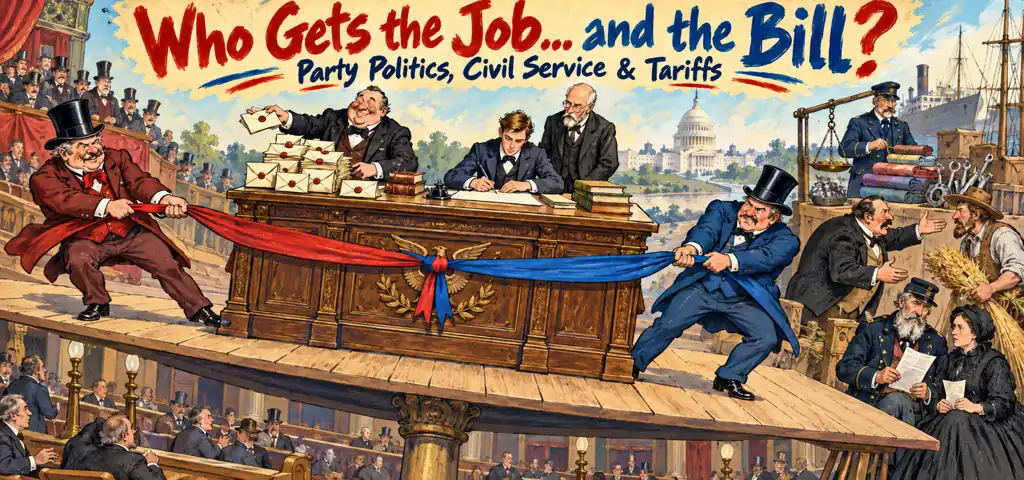
Chapter 5 of the CLEP History of the United States II study guide on Effortless Math covers Party Stalemate, Civil Service, and the Tariff: the key terms, the core ideas, and worked examples showing how this topic is tested on the exam.
CLEP History of the United States II, Chapter 5
Close elections rewarded organization
From 1876 through 1892, Republicans and Democrats were nearly balanced nationally. Republicans usually drew strength from Union veterans, many northern Protestants, Black voters where they could still vote, and much of the industrial North. Democrats depended on the white South and many Catholic and immigrant communities in northern cities. High turnout and durable loyalties made a few swing states decisive. Samuel Tilden won the popular vote but lost the disputed election of 1876; Grover Cleveland won the popular vote in 1888 but lost the electoral vote to Benjamin Harrison. Neither party possessed a secure national majority.
Memories and identities structured voting
Republicans "waved the bloody shirt" by reminding northern voters that Democratic secession had caused the Civil War. The Grand Army of the Republic, a Union veterans' organization, pressed for pensions and connected veterans' welfare to Republican loyalty. By the mid-1890s, roughly one million veterans and widows received pensions, which consumed about a third of federal spending. Democrats attracted many immigrant Catholics and opponents of Protestant moral regulation. State fights over prohibition and English instruction in parochial schools could therefore move voters even when national speeches emphasized tariffs. Party allegiance joined memory, religion, ethnicity, and material benefits.
Patronage divided Republicans
The spoils system treated federal jobs as rewards for party service. Republican Stalwarts defended patronage and party machinery; reform-minded Half-Breeds accepted some change. The quarrel became deadly when Charles Guiteau, a disappointed office seeker, shot President James A. Garfield in 1881. Garfield died after months of illness. Public anger helped Congress pass the Pendleton Civil Service Act in 1883. It created competitive examinations for a limited share of federal positions and protected covered employees from removal for political reasons. Presidents later expanded coverage, gradually shrinking the patronage supply rather than ending it overnight.
Mugwumps turned reform into defection
In 1884, independent Republicans called Mugwumps rejected their party's nominee, James G. Blaine, whom they associated with machine politics and questionable railroad dealings. They supported Democrat Grover Cleveland as a symbol of honest administration. Mugwumps favored merit appointment, limited government, and administrative integrity; they did not organize around free silver or renewed military Reconstruction. Their bolt mattered because New York was close. The episode shows how reform could cut across party identity without dissolving the two-party system. Stalwarts valued loyal organization, while Mugwumps feared that patronage corrupted public institutions.
Credit Mobilier revealed subsidy's corrupt route
The Union Pacific's insiders created a construction company called Credit Mobilier of America and awarded it inflated contracts to build the railroad. Because the same interests stood on both sides of the transaction, federal subsidies could be converted into private gains. Representative Oakes Ames distributed shares at favorable, cut-rate terms to influential members of Congress. The New York Sun's 1872 revelations did not prove that every recipient had sold a vote, but they exposed conflicts of interest and damaged confidence in Republican leadership during Ulysses S. Grant's administration. The scandal concerned railroad construction-company self-dealing, not the later Whiskey Ring's tax fraud.
Tariffs divided producers and consumers
A protective tariff made imported goods more expensive, sheltering American manufacturers from foreign competition. Republicans generally defended high duties as support for industry, wages, and national development. Democrats usually sought lower, revenue-oriented rates. Export farmers objected that they sold wheat or cotton at world prices yet bought tools, clothing, and household goods in a tariff-protected market. The McKinley Tariff of 1890 raised many rates and helped produce a voter backlash. The Democratic Wilson-Gorman Tariff of 1894 lowered rates less than reformers wanted and paired the reduction with an income tax to offset lost customs revenue; the Supreme Court invalidated that tax in 1895.
The Fifty-first Congress used narrow control aggressively
Republicans controlled the presidency and Congress in 1889-1891. Speaker Thomas B. Reed defeated the "disappearing quorum," in which members present stayed silent so the House appeared to lack enough participants. Reed counted present but silent members toward a quorum, allowing a majority to act. Congress enacted the McKinley Tariff, expanded veterans' pensions, purchased more silver, and admitted six western states-North Dakota, South Dakota, Montana, Washington, Idaho, and Wyoming. Those admissions added twelve senators and electoral votes from states Republicans expected to carry. Voters punished the party in 1890 amid tariff-price anger and state cultural conflicts.
Federal election protection lost a Senate fight
Henry Cabot Lodge's Federal Elections Bill passed the House in 1890. It would have permitted federal supervision of congressional elections when voters petitioned for it, creating a possible check on fraud and suppression in the South. It did not abolish poll taxes directly or distribute education funds. Southern Democrats filibustered, and western Republicans prioritized silver legislation; the measure died in the Senate. Its failure marked the waning congressional will to protect Black voting rights. The episode also reveals legislative bargaining: a party could control institutions yet fail when factions ranked tariff, currency, and election enforcement differently.
Cleveland defined a restrained federal role
President Cleveland vetoed many private pension bills and an 1887 appropriation for seed for drought-stricken Texas farmers. He acknowledged suffering but argued that the Constitution did not authorize federal relief to individuals and warned that public aid might weaken self-reliance. His position expressed late-nineteenth-century limited-government liberalism, although the same federal government collected tariffs, distributed pensions, subsidized transport, and administered public lands. The contrast is important. Government was not simply absent; political actors disagreed about which constituencies and purposes justified national spending.
classify the party issue
A source condemns "assessment" of officeholders for party funds and proposes examinations before appointment.
Stalemate was active, not empty
Gilded Age politics did not lack policy. Closely matched parties fought over who deserved office, which goods should be taxed, whether federal officials should supervise elections, how much veterans should receive, and when public relief was constitutional. Strong loyalties encouraged turnout and organization, but they also made governing coalitions fragile. Patronage reform changed administration incrementally; tariffs shifted sharply with party control; pensions built an early national benefit system; and the Lodge bill's defeat narrowed federal protection of the ballot. The era's stalemate meant repeated, high-stakes contests without durable supremacy.
Watch the history in motion
This short lesson adds voices, images, and chronology to the ideas you just studied.
Video: Gilded Age Politics: Crash Course US History #26, CrashCourse.
Try four CLEP-style questions
- As presidents place more federal positions under competitive examinations, which resource of a party organization shrinks most directly?
- The authority of state machines over municipal appointments
- The Senate's power to confirm principal executive officers
- The tenure of officials who remain outside the classified service
- The dues a party collects voluntarily from private members
- Distributable offices exchanged for party work
- Why would a tariff advocate's claim that protection necessarily produced high factory wages require additional evidence?
- Customs duties applied only when factories paid less than a federal minimum wage.
- Protection lowered domestic prices and therefore reduced the revenue available for wages.
- Tariff schedules set product prices and factory wages through the same federal commission.
- Protection could enlarge a firm's market without determining how its gains were divided.
- Manufacturers received tariff rebates only after documenting corresponding increases in payroll.
- Which evidence would best support the claim that Gilded Age stalemate still produced consequential government?
- Divided control kept tariff schedules unchanged from 1876 through 1892.
- Civil service coverage remained fixed at its original 1883 level under every later president.
- A narrow majority changed House procedure and enacted major legislation.
- The Lodge elections bill died in the Senate after passing the House.
- Twice a popular-vote plurality failed to produce an electoral-vote victory.
- Which safeguard would most directly have interrupted the self-dealing at the center of Credit Mobilier?
- Requiring disclosure of legislators' shares only after construction contracts had been completed
- Barring members of Congress from railroad stock while permitting railroad directors to own the contractor
- Fixing a uniform subsidy per mile without independent review of affiliated construction charges
- Requiring independent bidding and barring railroad insiders from controlling or profiting from the construction contractor
- Allowing directors to approve an affiliate's contract whenever its price stayed below a statutory ceiling
Check your answers and reasoning
Independent preparation. CLEP is a registered trademark of the College Board, which does not endorse this lesson.

Related to This Article
More math articles
- The Best Grade 8 ELA Practice Tests for Colorado Students
- Clearing the Fog: How to Identify Independent and Dependent Variables
- How to Understand Density of Real Numbers? (+FREE Worksheet!)
- Slavery, Caste, Estate, and Class Systems
- Intermediate scrutiny
- Agenda setting
- 3rd Grade NYSE Math Practice Test Questions
- Sexuality, Identity, and Institutions
- The Best Grade 3 Math Book for California Students
- Free Grade 3 English Worksheets for Alabama Students









What people say about "Party Stalemate, Civil Service, and the Tariff"?
No one replied yet.