Settlement Houses, the Social Gospel, and Commercial Mass Culture
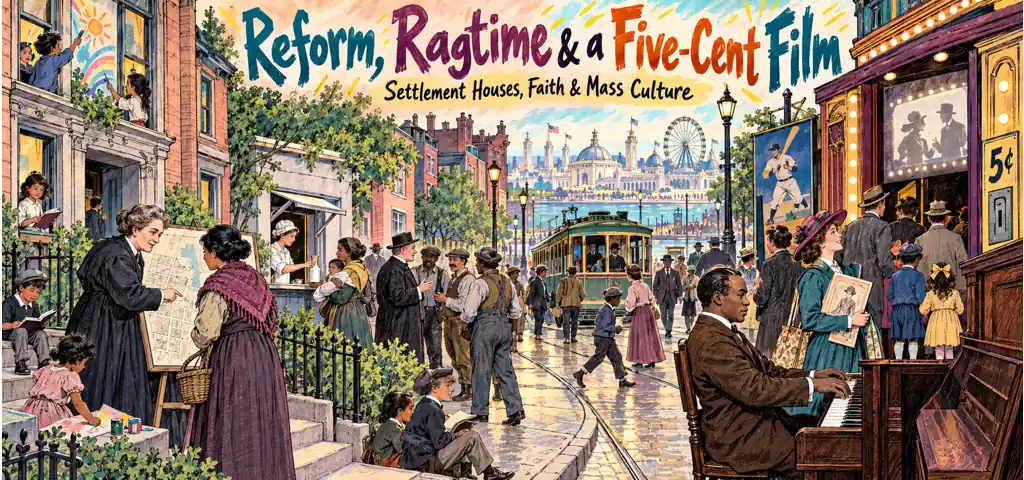
Chapter 4 of the CLEP History of the United States II study guide on Effortless Math covers Settlement Houses, the Social Gospel, and Commercial Mass Culture: the key terms, the core ideas, and worked examples showing how this topic is tested on the exam.
CLEP History of the United States II, Chapter 4
A neighborhood becomes a place to learn
Jane Addams and Ellen Gates Starr opened Hull House in a Chicago immigrant neighborhood in 1889. Unlike charity organization societies that investigated applicants and sorted the "deserving" from the "undeserving" poor, settlement residents lived in the neighborhood, formed relationships, studied local conditions, and pressed for legislation. Hull House offered kindergartens, clubs, classes, a gymnasium, arts programs, and meeting space. Its residents mapped wages, rents, nationalities, sanitation, and industrial disease. Service and research worked together: direct contact generated evidence, and evidence supported factory inspection, juvenile courts, child-labor limits, and public health.
Settlement work opens women's public careers
College-educated women faced restricted access to professions and politics. Settlements offered purposeful residence, colleagues, field research, and routes into administration. Florence Kelley moved from Hull House into factory inspection; Julia Lathrop into child welfare; Alice Hamilton into industrial medicine; and the Abbott sisters into social research and federal service. This was not simply benevolent volunteering. Residents created expertise and institutions while sometimes bringing paternalistic assumptions about immigrant life. The historical significance lies in both: women expanded public authority, and reform relationships contained inequalities of class and culture.
Women organize reform and labor
Under Frances Willard's "Do Everything" policy after 1879, the Woman's Christian Temperance Union added prison reform, labor questions, kindergartens, public health, and woman suffrage to temperance. It argued that mothers needed ballots to protect homes. The National Women's Trade Union League, founded in 1903, joined wage-earning organizers with wealthy allies. It helped women build unions and supplied strike funds, bail, food, publicity, and political connections, especially in garment strikes. The WTUL did not certify consumer labels-that was associated with the National Consumers' League. Distinguishing the organizations preserves women's varied routes into public life.
Private experiments could become public-health models
Reformers argued that city children needed supervised play space rather than streets crowded with wagons, horses, and commercial amusements. The Playground Association of America, founded in 1906, promoted directed play for health and citizenship and encouraged municipal recreation departments. Milk stations addressed infant deaths from contaminated supplies. Nathan Straus's pioneering New York depots in the 1890s were privately financed, not city agencies. They sold or gave poor families clean, pasteurized milk. Their results persuaded municipal health departments to adopt preventive infant-health work. The sequence runs from private demonstration to public infrastructure, not from a Straus system that was already municipal.
Checkpoint: from neighborhood evidence to public action
Retrieve without looking. Name one service, one investigation, and one policy associated with settlement work. Then distinguish the WCTU, WTUL, and National Consumers' League by method. Finally, explain in one sentence how Straus's private milk depots could influence later municipal public health without themselves being city agencies.
The Social Gospel changes the unit of sin
Revivalist Dwight L. Moody used businesslike urban campaigns, advance committees, halls, and Ira Sankey's hymns to seek individual conversion. Social Gospel thinkers such as Walter Rauschenbusch asked how wages, hours, tenements, and concentrated power created social sin. Older charity might aid a poor household; Social Gospel reform sought to alter institutions producing poverty. The approaches could coexist within Protestant denominations, but their unit of action differed: redeemed persons versus reconstructed social relationships. Settlement workers and labor reformers became natural allies of ministers who treated industrial conditions as a moral question.
Churches turn doctrine into labor standards
Pope Leo XIII's encyclical Rerum Novarum (1891) rejected socialism and defended private property while affirming a just wage and workers' natural right to form associations. In 1908, the Protestant Federal Council of Churches adopted a Social Creed calling for abolition of child labor, a living wage, rest, protection from dangerous machinery, and provision for injured and aged workers. These documents did not propose identical theology or ownership systems. They show major religious institutions accepting that industrial relations had moral standards beyond freedom of contract.
Religion could welcome contact or police difference
Josiah Strong's Our Country (1885), written to raise support for home missions, portrayed immigration, Catholicism, cities, socialism, and concentrated wealth as dangers to Anglo-Saxon Protestant civilization. His reform impulse carried nativist and racial assumptions. The World's Parliament of Religions at Chicago in 1893 produced a different encounter: Hindu teacher Swami Vivekananda, Buddhist representative Anagarika Dharmapala, and other non-Christian speakers gained a large American platform. The meeting did not erase Protestant dominance, but it widened public awareness of Asian religious thought. Urban religion could pursue conversion, social reform, cultural defense, or exchange.
Checkpoint: diagnose the religious remedy
Retrieve without looking. Match Moody, Rauschenbusch, Rerum Novarum, the Federal Council's Social Creed, Josiah Strong, and the World's Parliament to individual conversion, institutional reform, labor standards, cultural defense, or interfaith encounter. For two entries, state both the problem diagnosed and the actor expected to respond.
Commercial leisure becomes possible
Shorter hours for some workers, higher disposable income, electric transit, dense urban audiences, and mass advertising created a commercial leisure market. Vaudeville theaters sold mixed bills of comedy, song, dance, acrobatics, and novelty. Circuit Chautauqua also sold tickets but advertised lectures, sermons, and concerts as self-improvement, drawing many small-town audiences. Nickelodeons spread after 1905 by charging five cents for continuous programs of short silent films in converted storefronts. Silence reduced language barriers, and continuous entry distinguished them from scheduled stage performances.
Baseball becomes a national business
Promoters turned baseball into commercial spectator sport by enclosing grounds, charging admission, paying salaried players, and using railroads and sporting pages to coordinate league schedules. The Cincinnati Red Stockings openly paid players in 1869; the National League formed under owner control in 1876. Contracts bound labor while ticket sales made audience size a revenue source. Owners drew a color line by the late 1880s, and Black professionals created teams and later separate leagues. Commercial mass culture could build national identity while reproducing racial exclusion.
Retailing creates consumers and new jobs
Department stores such as Marshall Field's and Wanamaker's gathered many lines of goods under one downtown roof, used fixed prices, offered delivery and returns, and employed large sales forces of women at wages below men's. Mail-order houses such as Montgomery Ward and Sears bought in volume, printed catalogs, and shipped by rail directly to rural customers, reducing dependence on country-store selection and credit. A department store had a sales floor; a mail-order house reached buyers without one. Both transformed shopping into a large corporate system and made consumption part of national culture.
Newspapers speak across markets and languages
German, Yiddish, Italian, Polish, and other immigrant newspapers connected readers to old-country news, neighborhood affairs, labor politics, advice, and American civic life in familiar languages. They aided adaptation without requiring immediate cultural erasure. At the same time, mass-circulation English-language papers competed through bold headlines, illustrations, crime, scandal, and emotionally charged reporting. In the 1890s, Joseph Pulitzer's New York World and William Randolph Hearst's New York Journal became associated with yellow journalism. The label describes sensational circulation competition, not simply every newspaper that supported war.
Ragtime travels through print
Ragtime's signature placed a syncopated melody-accents off the expected beat-against a steady march-like bass. Scott Joplin, a Black composer trained in European musical forms, achieved a national success with "Maple Leaf Rag" in 1899. Published sheet music carried the piece into parlors and performance venues far beyond Sedalia, Missouri. Ragtime was more score-centered than the collective improvisation associated with later jazz. Its circulation illustrates how Black creativity, copyright, publishers, pianos, and commercial distribution combined to make a national craze.
Naturalism describes constraint
Literary naturalists including Stephen Crane, Frank Norris, and Theodore Dreiser portrayed ordinary people shaped by heredity, environment, appetite, chance, and impersonal economic forces. Norris's The Octopus gave railroad power an almost natural force; Dreiser's Sister Carrie let the city and market shape a young woman's fate. Naturalism pushed realism toward a stronger sense of constraint. Mark Twain and Charles Dudley Warner's The Gilded Age (1873) used satire instead, mocking land speculation, get-rich-quick schemes, and Washington corruption; its title suggested glitter covering cheaper material and later named the era.
Henry James used cultural contrast as psychological inquiry
Henry James's international theme placed Americans in European settings whose social codes they only partly understood. In The American and The Portrait of a Lady, differences in experience, manners, freedom, and constraint reveal how characters perceive and choose. James was not simply cataloging regional custom or explaining behavior through heredity. The transatlantic encounter gave psychological realism a test: comparatively inexperienced Americans could value freedom yet misread sophisticated people and institutions, while European convention could offer culture and conceal manipulation.
The Eight challenged an exhibition system, not with one style
Robert Henri and seven allies bypassed conservative academy juries by organizing an independent exhibition at New York's Macbeth Galleries in 1908. Five participants became closely associated with Ashcan urban realism, but the Eight did not share a single subject or technique. Their common act was institutional: artists claimed the authority to show work outside the official selection system. The exhibition preceded the much larger 1913 Armory Show, which introduced broad American audiences to European cubism and fauvism.
Gender and architecture expose social expectations
Kate Chopin's The Awakening (1899) and Edith Wharton's The House of Mirth (1905) each follow a woman damaged by the social and economic expectations of respectable marriage, though neither is a reform tract. The built environment offered another cultural argument. The 1893 Columbian Exposition's White City used monumental neoclassical symmetry and inspired the City Beautiful movement. Frank Lloyd Wright's Prairie houses answered with long horizontal lines, low sheltering roofs, open interiors, and connection to the site. Style expressed competing visions of order and modern life.
A chronology of cultural landmarks
Four markers organize change: Twain and Warner published The Gilded Age in 1873; Jacob Riis published How the Other Half Lives in 1890; the Columbian Exposition opened in 1893; and the Armory Show introduced a broad American public to radical modern art in 1913. The sequence is satire, social investigation, classical civic spectacle, then modernist challenge. The World's Parliament of Religions met alongside the 1893 fair, while ragtime and department-store culture expanded before 1900 and nickelodeons after 1905. Chronology prevents the era's many innovations from becoming one undifferentiated "modern culture".
Checkpoint: classify culture by medium and purpose
Retrieve without looking. Sort vaudeville, Chautauqua, nickelodeons, baseball, department stores, mail-order catalogs, immigrant newspapers, yellow journalism, ragtime, naturalism, the White City, and Prairie houses by medium. Then choose three and label the main function as entertainment, distribution, community information, critique, or design argument.
identify reform versus consumption
Suppose one source maps wages and sanitation block by block, while another advertises five-cent continuous films.
The double edge of mass culture
Commercial culture created common products, celebrities, songs, sports, and reading while giving women, immigrants, and Black artists new employment and audiences. It also commodified leisure, enforced racial lines, sensationalized news, and concentrated control in owners and advertisers. Reform institutions similarly combined service with surveillance or cultural pressure. The most accurate conclusion avoids a simple opposition between uplifting reform and corrupt entertainment. Chautauqua sold self-improvement; settlements staged arts; immigrant newspapers mixed community service and commerce; department stores offered public space while underpaying saleswomen. Modern urban culture was built through overlapping moral and market institutions.
Watch the history in motion
This short lesson adds voices, images, and chronology to the ideas you just studied.
Video: REFORM in the Gilded Age [APUSH Review Unit 6 Topic 11] Period 6:1865-1898, Heimler's History.
Try four CLEP-style questions
- Settlement residents offered services and advocated reform but sometimes judged immigrant customs through middle-class standards. Which interpretation best fits both sides of that record?
- Paternalism prevented settlements from producing useful research or legislation.
- Neighborhood residence removed class differences between reformers and residents.
- Cultural pressure was the settlement's only significant effect.
- Reform could expand resources while retaining unequal assumptions about recipients.
- Service made settlements equivalent to ward machines exchanging aid for votes.
- A reform organization investigates factory conditions and asks shoppers to favor goods carrying its label, while another supplies strike funds and organizers to women workers. Which pairing is correct?
- The National Consumers' League used consumer pressure; the WTUL built labor-support coalitions.
- The WTUL certified goods; the WCTU supplied strike organizers.
- The WCTU inspected factories; the Consumers' League organized industrial unions.
- The Federal Council issued labels; the WTUL administered municipal relief.
- Hull House controlled national product certification; the Consumers' League ran garment strikes.
- Rerum Novarum defended private property, and the Federal Council's Social Creed arose in a Protestant setting. What position did both nevertheless support?
- Property rights made wage and safety standards a private matter in both documents.
- Only the Protestant statement recognized workers' right to associate.
- The Catholic statement addressed wages, while the Protestant creed confined itself to individual charity.
- Both endorsed public ownership as the necessary remedy for industrial conflict.
- Industrial society owed workers standards such as just compensation, safety, and protection from exploitation.
- Josiah Strong presents immigration and non-Protestant religion as threats to Anglo-Saxon civilization; speakers at the 1893 World's Parliament present Hindu and Buddhist traditions to large American audiences. What contrast is most useful?
- Both institutions seek cultural defense through Protestant conversion.
- Both reject missionary activity and claims of cultural hierarchy.
- The Parliament restricts immigration, while Strong advocates diplomatic exchange.
- Strong represents Social Gospel labor reform, while the Parliament promotes temperance.
- One frames religious difference as danger; the other enables public interfaith encounter.
Check your answers and reasoning
Independent preparation. CLEP is a registered trademark of the College Board, which does not endorse this lesson.

Related to This Article
More math articles
- Party organization
- Word Problems Involving Comparing Ratio
- 8th Grade PARCC Math FREE Sample Practice Questions
- FREE 6th Grade MEAP Math Practice Test
- Handling First, Best, and Next Questions
- How to Multiply and Dividing Functions? (+FREE Worksheet!)
- Types of Angles (Acute, Right, Obtuse) for 4th Grade
- The 8 Best Webcams for Online Teachers
- Utah RISE Grade 7 Math Worksheets: 95 Free Printable Single-Skill PDFs with Keys
- The Ultimate OAR Math Course (+FREE Worksheets)
















What people say about "Settlement Houses and the Social Gospel"?
No one replied yet.