Tenements, Streetcar Suburbs, and Political Machines
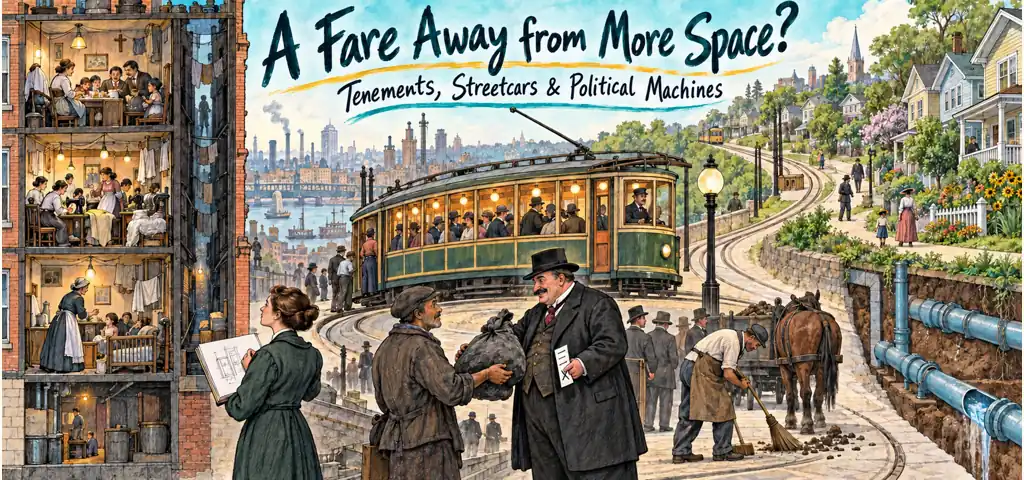
Chapter 4 of the CLEP History of the United States II study guide on Effortless Math covers Tenements, Streetcar Suburbs, and Political Machines: the key terms, the core ideas, and worked examples showing how this topic is tested on the exam.
CLEP History of the United States II, Chapter 4
The walking city becomes dense
Industrial jobs, immigration, and internal migration drove rapid urban growth after 1870. Before electric transit, most workers had to live near factories, docks, or commercial streets. Landowners built deeply on narrow lots, dividing buildings into small flats. Tenements brought families close to work, kin, shops, and ethnic institutions, but crowding, dark interior rooms, shared toilets, fire hazards, and poor ventilation made disease and injury more likely. Housing form expressed income and transportation: the poorest households could not trade a daily fare and commute time for more space.
Housing law improves standards slowly
New York's 1879 law required a window in each room, prompting the dumbbell tenement with narrow air shafts that often collected garbage and spread noise and fire. The Tenement House Act of 1901 required new buildings to provide windows opening onto a street or meaningful courtyard, indoor water and toilets, and stronger fire protection, supervised by a new department. The act did not instantly renovate every old building. Reform worked through standards for new construction, inspection, and gradual replacement, leaving families in old-law tenements for years.
The sweating system moves the factory upstairs
In garment production, a manufacturer could cut cloth and send bundles to a contractor. The contractor rented a tenement workroom, supplied machines, hired operators, and promised finished garments for a set price. This contract shop shifted the risk of slack demand downward; the contractor then pressed workers through piece rates and long hours. An inside factory kept the workroom and employees under the manufacturer's direct organization. Both might pay by the piece, so payment method is not the distinction. Ownership and responsibility for the workplace are.
Electric streetcars sort the city by income
Frank Sprague's successful electric streetcar system in Richmond in 1888 demonstrated reliable urban traction. A worker who could pay a daily fare could live miles from employment, and lines opened land for streetcar suburbs. Clerks, managers, and skilled workers moved outward more readily; poorer and recent immigrant families remained near factories and central districts. Downtown did not disappear, because lines converged there and fed department stores and offices. Transit expanded city area while increasing residential separation by class.
Suburbs resist annexation when they can self-finance
Cities had long annexed adjacent communities that wanted water, sewers, schools, fire protection, and other services. Brookline rejected annexation to Boston in 1873, becoming a symbol of suburban independence. As affluent towns built their own utilities and schools, joining a central city could mean higher taxes and lost local political control without an obvious service gain. Some working communities still sought annexation; Lake View joined Chicago in 1889 partly for sewer service. The pattern depended on local capacity, not a universal suburban ideology.
Machines exchange welfare for votes
Political machines such as Tammany Hall organized wards through patronage and personal service. A precinct captain might find a job, deliver coal, speak to a judge, help with naturalization, or pay funeral costs in exchange for turnout and loyalty. Before a professional welfare state, this assistance could be immediate and culturally accessible. The same system padded contracts, sold favors, and resisted civil-service reform. Calling machines only corrupt misses why voters relied on them; calling them welfare organizations misses coercion and public theft. Both functions sustained machine power.
Tweed falls but Tammany survives
William M. Tweed's ring inflated contractor bills and divided the excess, with the New York County Courthouse becoming a notorious example. The New-York Times published financial records in 1871. Thomas Nast's cartoons in Harper's Weekly made Tweed and Tammany's tiger visually recognizable even to readers who did not follow ledgers. Tammany lost an election, Tweed was convicted in 1873, and he died in jail. The organization survived for decades because exposing one corrupt leader did not eliminate the ward relationships and patronage structure beneath him.
Water systems change survival
Urban death rates fell when cities filtered water, treated supplies, and separated sewage from drinking sources. Sand filtration spread in the 1890s; continuous chlorination began in places such as Jersey City in 1908. Typhoid and other waterborne diseases declined sharply, contributing to lower infant and child mortality. Tuberculosis, transmitted through air in crowded rooms, did not respond to water treatment in the same way. This comparison illustrates a public-health principle: infrastructure works when it interrupts the particular transmission mechanism of a disease.
Horses created an urban sanitation crisis
Before motor vehicles, horses pulled freight wagons, carriages, fire engines, delivery carts, and many streetcars. Each animal produced large quantities of manure, while stables concentrated waste and cities removed thousands of carcasses annually. Dried manure contributed dust, odors, flies, and fears of summer disease; runaways and iron-shod noise added danger. Street cleaning became a major municipal function. Electric transit and motor trucks appeared sanitary as well as technologically modern because they reduced one enormous waste stream, though they created other environmental costs.
Schools absorb the growing city
Urban school enrollments rose through compulsory-attendance laws, limits on the youngest children's labor, immigrant parents' demand for education, and sheer population growth. Cities built graded schools, hired superintendents, trained teachers, and introduced kindergartens. Federal land-grant colleges did not finance ordinary city teachers, and the Committee of Ten addressed secondary curriculum rather than causing elementary enrollment. Schools taught literacy and civic routines but could also pressure children to abandon home languages. They were instruments of mobility, discipline, and Americanization at once.
Disaster creates a reform chronology
Four disasters provide an urban timeline: the Chicago Fire of October 1871; the 1878 yellow-fever epidemic centered devastatingly on Memphis; the South Fork dam failure that killed about 2,200 at Johnstown in 1889; and the Galveston hurricane that killed roughly 8,000 in 1900. Each exposed failures of building, sanitation, private infrastructure, emergency planning, or government. Responses included stricter construction rules, sewers, flood control, seawalls, and new municipal arrangements. Disaster did not automatically create reform, but it made hidden risk visible and concentrated political demand.
read an urban cross-section
Imagine a map with factories and tenements near the center, middle-income homes stretching along streetcar lines, and an affluent suburb maintaining its own schools and waterworks.
A built-environment boundary
Steel framing, safe elevators, and high land values encouraged downtown skyscrapers; the Woolworth Building opened in 1913 as a Gothic commercial tower and period endpoint. Do not pull later landmarks backward into the Gilded Age. The Empire State Building (1931), Levittown's first mass-produced houses (1947), and the Seagram Building (1958) belong to Depression-era construction, postwar suburbia, and postwar modernism.
Watch the history in motion
This short lesson adds voices, images, and chronology to the ideas you just studied.
Video: Growth, Cities, and Immigration: Crash Course US History #25, CrashCourse.
Try four CLEP-style questions
- New York's 1879 window rule produced narrow dumbbell-tenement air shafts that filled with noise and refuse. What does the result show about housing regulation?
- The 1879 rule already required the large courtyards later mandated in 1901.
- Formal compliance could still fail to provide meaningful light, ventilation, or safety.
- Air shafts solved fire spread but not the cost of indoor plumbing.
- The dumbbell plan applied only to detached suburban houses.
- Inspection rather than building design created the narrow-lot problem.
- An immigrant child gains literacy and access to further schooling but is punished for using a home language in class. Which interpretation best fits both outcomes?
- Urban schools provided mobility without attempting cultural change.
- The experience shows schools functioned chiefly as political-machine charities.
- Language discipline mattered, but literacy had little connection to mobility.
- Schools could expand opportunity while pressuring prescribed Americanization.
- Compulsory attendance protected home-language instruction from administrative control.
- Major fires, epidemics, floods, and hurricanes were often followed by demands for codes, sewers, flood controls, or new municipal arrangements. What role did disaster play?
- It guaranteed adoption of the same reform in every city.
- It proved private infrastructure was safer than public regulation.
- It shifted all emergency planning from cities to the federal government.
- It made dispersed risks visible and concentrated pressure for institutional action.
- It reduced the need for technical investigation by supplying an obvious solution.
- Financial records exposed Tweed's inflated contracts, while Nast's cartoons made the scandal legible to a much wider audience. Why did Tammany nevertheless survive Tweed's fall?
- Electoral defeat removed the ring but left ward captains without services or patronage to distribute.
- Reformers took control of the same ward network and ended its partisan function.
- Ward-level patronage and service relationships outlasted the removal of one leader.
- Tweed's conviction addressed courthouse fraud and therefore dissolved neighborhood loyalty as well.
- Public exposure changed Tammany's leadership but made personal aid less valuable to voters.
Check your answers and reasoning
Independent preparation. CLEP is a registered trademark of the College Board, which does not endorse this lesson.

Related to This Article
More math articles
- How to Divide Polynomials Using Synthetic Division?
- Cell Structure and Function
- Compare and Contrast Structure
- Free Grade 4 English Worksheets for Missouri Students
- Drawing Conclusions and Generalizations
- Matter and Its Changes: Particles, Properties, and Mixtures
- The Solar System
- Free Grade 6 English Worksheets for New Jersey Students
- How to Get ALEKS Done Fast?
- The Best Grade 3 Math Book for Florida Students










What people say about "Tenements, Streetcar Suburbs, and Machines"?
No one replied yet.